Commuters looking to reduce drink sugars
If a fizzy drink is part of your portable breakfast, compare the sugars per serving and the pack size. A can may be easier to take with you than a multi-serve bottle.


If you want a fizzy lemon drink with breakfast while reducing sugars from drinks, compare the sugars per serving on diet, zero-sugar and no-added-sugar lemonades rather than treating those labels as interchangeable. Take the drink alongside breakfast food, not instead of it. Sugar-free lemonade can still be acidic and may contain sweeteners, so the ingredients and your pattern of sipping matter too.
If a fizzy drink is part of your portable breakfast, compare the sugars per serving and the pack size. A can may be easier to take with you than a multi-serve bottle.
Lemonade can accompany food, but it does not replace it. Sheffield Children’s NHS Foundation Trust describes a breakfast that includes a fibre-rich carbohydrate, a protein source and fruit or vegetables.
Read the ingredients if a particular sweetener matters to you. Torbay and South Devon NHS Foundation Trust also identifies sugar-free lemonade as an acidic drink relevant to dental erosion, especially when it is sipped repeatedly.
Start with the drink’s sugars and ingredients, then decide whether its pack and serving pattern fit a breakfast you can take with you.
Choose when: You want lemonade with breakfast while reducing sugars from the drink; check the individual nutrition panel because the labels do not establish identical sugar contents.
Bear in mind: It is not breakfast food, and removing sugar does not remove the acidity concern associated with lemonade.
Choose when: You prefer that particular drink and its stated sugars per serving fit what you are looking for.
Bear in mind: It contributes sugars as well as being an acidic drink; the NHS advises cutting down on drinks containing free sugars.
Choose when: You do not particularly want lemonade, especially if you tend to sip a drink throughout the morning.
Bear in mind: Neither gives you fizzy lemonade; your breakfast food still needs to stand on its own.
| Priority | What to check | Your needs |
|---|---|---|
| Sugars | Compare sugars per 100ml and per stated serving. Read the ingredients for sugar, fruit juice and sweeteners; “no added sugar” does not mean a measured value of zero. | I want to reduce sugars from my breakfast drink without assuming every diet or no-added-sugar lemonade has the same nutrition figures. |
| Breakfast food | Plan food alongside the drink. Sheffield Children’s NHS Foundation Trust describes fibre-rich carbohydrate, a protein source and fruit or vegetables as components of breakfast. | A drink is quick to grab, but I also need food I can take or eat before leaving. |
| Acidity | Look for acids in the ingredients and consider whether you will finish a serving with breakfast or keep sipping it. Torbay and South Devon NHS Foundation Trust identifies an erosion concern with sugar-free lemonade too. | If I tend to sip drinks all morning, the zero-sugar label alone does not answer my dental concern. |
| Sweeteners | Check the named sweeteners on the current pack. For products containing aspartame, GOV.UK specifies wording identifying a source of phenylalanine. | I need to know which sweetener is in this particular drink, rather than assuming all diet lemonades use the same one. |
| Pack format | Choose an individual serving for immediate use or check a larger bottle’s instructions for storage after opening. | A can is straightforward to carry; a multi-serve bottle makes more sense when I can store and use the remainder as directed. |
The measured sugars can differ. Sainsbury’s lists 0.6g sugars per 250ml for its Pink Lemonade, Zero Added Sugar, while ASDA lists 0g per 250ml for its Diet Lemonade.
Compare the nutrition panels using the same volume, then check whether the ingredients include juice, sugar or sweeteners.
A diet drink does not provide the food components described in Sheffield Children’s NHS Foundation Trust’s breakfast guidance.
Take food alongside it, such as oats with yoghurt and fruit or wholemeal toast with egg, if those options work for your morning.
Torbay and South Devon NHS Foundation Trust identifies lemonade, including sugar-free versions, as relevant to dental erosion because of acidity.
Avoid turning one breakfast drink into something you sip continuously through the morning; consider water or milk between meals.
A 1L or 2L bottle is a different proposition from a single can when you need to take a drink straight out of the door.
Check the serving format and the pack’s after-opening instructions before choosing a multi-serve bottle.
An opened bottle may need fridge space and prompt use; ASDA and Sainsbury’s product instructions specify refrigeration after opening and use within three days.
These examples show why the exact variant and pack matter; a brand name alone does not tell you the sugars or serving format.
R. Whites Diet Lemonade is listed by Tesco in 330ml cans, a format to consider for a breakfast taken out of the house.
Sprite Zero Sugar is a lemon-lime drink rather than a lemon-only lemonade.
Tesco lists own-label diet lemonade in both 330ml cans and a 2L bottle.
Sainsbury’s lists pink and cloudy no-added-sugar lemonades in 2L bottles.
ASDA lists both Diet Lemonade and a sugar-containing lemonade, so choose by the exact product label.
M&S lists Diet Lemonade as a sweetened-without-sugar drink.
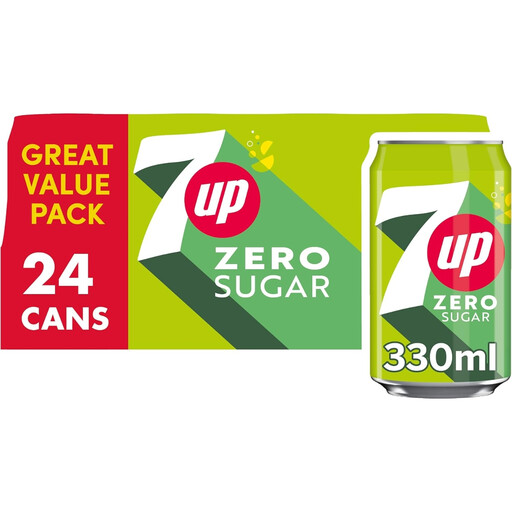
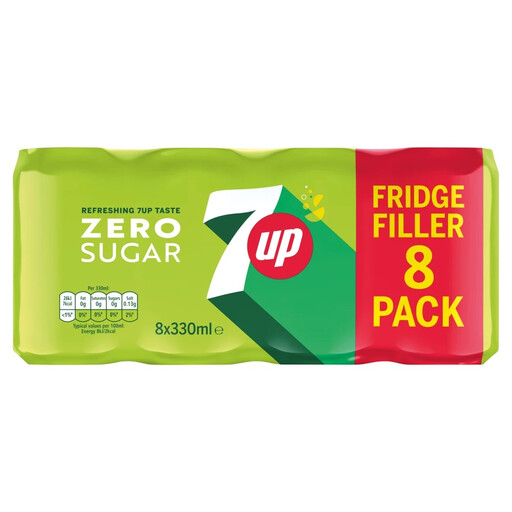
These 7UP Zero lemon-and-lime can packs suit a fizzy drink taken alongside breakfast. Choose between an eight-can pack and a 24-can pack according to how many individual servings you want.
 No image available
Individual lemon-and-lime cans can be taken with a portable breakfast. The product information lists 0g sugars per 330ml can and names aspartame, acesulfame K, citric acid and malic acid. Check the current pack if the sweeteners matter to you; zero sugar does not remove the acidity consideration.
 No image available
This smaller multipack also provides individual lemon-and-lime cans for taking with breakfast. The product information lists 0g sugars per 330ml can, alongside aspartame, acesulfame K, citric acid and malic acid. Check the current ingredients and have food alongside the drink rather than using it as breakfast.
No: treat it as a drink alongside food. Sheffield Children’s NHS Foundation Trust describes breakfast food that includes a fibre-rich carbohydrate, a protein source and fruit or vegetables.
Not necessarily. Sainsbury’s lists 0.6g sugars per 250ml for its Pink Lemonade, Zero Added Sugar, whereas ASDA lists 0g per 250ml for its Diet Lemonade. Compare the sugars row for the exact drink and serving size.
Yes. Torbay and South Devon NHS Foundation Trust identifies lemonade, even when advertised as sugar free, as an acidic drink relevant to dental erosion. The sugars figure does not tell you whether acidity is a concern.
Check the current ingredients on the specific pack rather than relying on the word “diet”. GOV.UK specifies a “Contains a source of phenylalanine” warning for foods containing aspartame; sweeteners differ between products.
Follow its label. The checked ASDA Diet Lemonade and Sainsbury’s Cloudy Lemonade listings instruct shoppers to refrigerate after opening and use the drink within three days.