Time-pressed shared-kitchen cooks
You want to brown ingredients and cook lentil ragout in one appliance without occupying the hob throughout.


If shorter cooking is your priority, look for a pressure multicooker with a sauté or browning mode; for a longer simmer, consider a slow-cooker-style model. Guided controls and automatic pressure release may make a shared pressure cooker easier to operate, but every user still needs to follow its manual. Check the cleaning requirements, worktop space and socket arrangement before choosing either format.
You want to brown ingredients and cook lentil ragout in one appliance without occupying the hob throughout.
You want clear controls when several housemates may use the cooker. Guided steps and automatic pressure release are features to compare, not substitutes for learning the manual.
You make several portions at once and need a pot that is practical to wash and an appliance you can store between uses.
Choose between pressure cooking and a longer simmer first. Then compare the controls, cleaning and space requirements of models that suit your preferred method.
| Concern | What to check | Who this matters to |
|---|---|---|
| One-pot weeknight cooking | Look for both sauté or browning and pressure-cooking modes if those are the steps you want in one pot; consult the manual for lentil filling instructions. | If I want to brown ingredients and then cook a weeknight ragout without returning to the hob, one-pot cooking comes first; around 33% of consumers would share that primary need. |
| Cleaning and shared space | Check which removable parts are dishwasher safe and where the cooker can stand and be stored. | When I share washing-up duties, I want a pot that is manageable to clean and put away; roughly 25% of consumers would prioritise that shared-kitchen practicality. |
| Pressure-cooking controls | Compare guided controls and pressure-release methods, then read the exact model's liquid, fill and lid instructions. | If housemates have different levels of pressure-cooking experience, I want clearer steps and less manual steam handling; around 25% of consumers would put ease of use first. |
| Batch size and footprint | Compare stated portions and external dimensions; a bowl's total capacity is not its pressure-cooking fill limit. | For a shared meal or several portions to keep, I need enough room for the batch without crowding our worktop; roughly 17% of consumers would prioritise capacity. |
Expanding ingredients need room in a pressure cooker. The Instant Pot Duo manual limits foods such as dehydrated vegetables to no more than half the cooker's capacity.
For dried-lentil ragout, follow your exact model's fill and liquid instructions rather than filling to its advertised capacity. Never force a pressurised lid open.
A larger bowl may suit shared portions while the appliance itself takes up worktop and cupboard space. Instant Pot UK lists the Duo 5.7L at 33.5 × 31 × 31.7 cm and 5.4 kg.
Compare the dimensions of the model you plan to buy with a stable, dry position where its cord will stay clear of sinks and cooking areas.
Electrical Safety First warns that overloaded extension equipment can overheat and says not to plug one extension lead into another. GOV.UK guidance for shared or rented accommodation also advises against overloading sockets.
Use a suitable nearby wall socket where possible. If an extension lead is needed, check its rating and the combined load, and use only one extension device per socket.
On-screen steps and automatic release do not replace the model's requirements for liquid, filling, lid and valve checks.
Before housemates share a pressure cooker, agree where it will stand and make sure each user knows the manual's cooking, release and cleaning instructions.
Instant Pot UK presents the Duo 5.7L as a six-portion pressure multicooker with sauté, slow-cook and keep-warm functions.
Tefal UK lists 6L Cook4me+ and Cook4me Touch pressure multicookers for buyers interested in guided cooking and batch portions.
Ninja UK presents the Foodi PossibleCooker MC1001UK as an 8-in-1 slow cooker and multicooker for a longer-cook approach.
These products suit shoppers considering a slower stew or simmer for lentil ragout. If pressure cooking is essential, check the exact model's functions and instructions before choosing from this list.
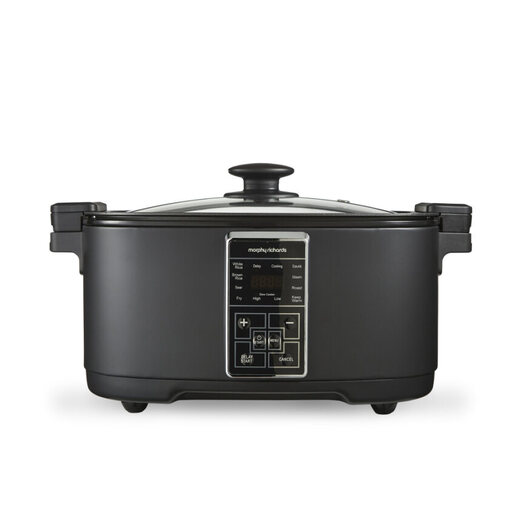 Image unavailable
Consider this for a longer-cooked shared batch when a pressure-cooking workflow is not essential.
The product name specifies 1350W, 10 preset functions and a dishwasher-safe pot and accessories. Check that the cooker fits your worktop and storage space.
 Image unavailable
Consider this if you prefer to stew or simmer ragout rather than follow a pressure-cooking method.
The product name specifies dual power control, a steamer and a non-stick cooking pot. Check its dimensions, cleaning instructions and cooking modes against your shared-kitchen needs.
 Image unavailable
Consider this for a larger shared batch when slow cooking or simmering suits your schedule.
The product name specifies a non-stick cooking pot, stir-frying and a UK plug. Compare its dimensions and cleaning instructions with the space and washing-up arrangements in your kitchen.
No. A slow-cooker-style multicooker can suit a longer simmer; consider pressure cooking if a shorter cooking schedule matters more. For a one-pot method, check that the exact model has the browning or sauté function your recipe calls for.
Follow the manual for your exact cooker, not the bowl's total capacity. The Instant Pot Duo manual limits expanding foods such as dehydrated vegetables to half capacity, requires water for pressure cooking and says not to force the lid open until internal pressure has completely dropped.
Use a suitable nearby wall socket where possible. If an extension lead is necessary, Electrical Safety First advises checking its marked rating and the combined appliance load, using only one extension device per socket and never chaining extension leads; keep the cable clear of water and hot surfaces.