For an office prioritising a lower declared sugar figure, Farmhouse Biscuits lists 0.2g sugars per 100g for its Sugar Free Ginger biscuits, compared with 25.5g per 100g for the conventional Tesco Ginger Nut Biscuits and Sainsbury’s Ginger Snaps. Sugar-free does not necessarily mean lower in calories or saturated fat, so compare the full nutrition labels and check allergens, sweeteners and any excessive-consumption warning before ordering a shared snack.
Who is choosing the biscuits?
Office buyers comparing sugars
If the shared biscuit order is intended to have less declared sugar than conventional ginger nuts, compare labels per 100g. Check calories and saturated fat separately rather than treating a sugar-free label as a judgement about the whole biscuit.
Teams wanting a familiar vegan biscuit
Tesco labels its Ginger Nut Biscuits suitable for vegans, and the research identifies Sainsbury’s Ginger Snaps as a vegan option. Both list 25.5g sugars per 100g, so neither is a sugar-free substitute.
Colleagues checking ingredients and sweeteners
A shared pack needs an allergen check as well as a sugar comparison. Sugar-free recipes may use polyols: Farmhouse Biscuits identifies isomalt and maltitol in its ginger biscuits and warns that excessive consumption may produce laxative effects.
What should you compare?
Sugar-free ginger biscuits
Consider when: The main aim is a much lower declared sugar figure, and the people sharing the biscuits can check the recipe’s allergens and sweeteners.
Trade-off: A sugar-free label does not establish lower calories or saturated fat; Farmhouse Biscuits also carries an excessive-consumption laxative warning.
Conventional ginger biscuits
Consider when: The office wants a familiar recipe rather than one sweetened with polyols; Tesco Ginger Nut Biscuits and Sainsbury’s Ginger Snaps are identified as vegan options.
Trade-off: Tesco and Sainsbury’s each list 25.5g sugars per 100g. That figure does not make either product sugar-free.
| Priority | What to check | Your needs |
|---|
| Declared sugars |
Compare sugars per 100g on the same basis. Farmhouse Biscuits lists 0.2g for Sugar Free Ginger; Tesco and Sainsbury’s each list 25.5g, and McVitie’s lists 28.9g. |
I’m choosing a ginger biscuit with a substantially lower declared sugar figure, not assuming that a conventional recipe with a slightly smaller figure is labelled sugar-free. |
| Calories and saturated fat |
Read energy and saturated fat per 100g alongside sugars. Where a per-biscuit figure is supplied, use it to compare the amount offered at a tea break. |
Less sugar is my starting point, but I also want to see what a serving contains rather than judge the biscuit by one nutrient. |
| Ingredients and warnings |
Check the current allergen declaration, named sweeteners and any excessive-consumption warning. Farmhouse Biscuits identifies isomalt and maltitol and carries a laxative warning. |
Before leaving biscuits in a shared area, I need colleagues to be able to check whether the ingredients suit them. |
| Traffic-light labels |
Use traffic-light labelling, where present, to inspect the nutrients shown; compare the underlying per-100g figures between packs as well. |
I want a quick starting point for reading packs. In the Food Standards Agency and Ipsos Northern Ireland’s 2024 tracker, 49% of 611 Northern Ireland interviewees actively used traffic-light labelling when shopping for food. |
Common buying mistakes
-
Assuming sugar-free also means fewer calories
Farmhouse Biscuits lists 485kcal and 8.5g saturated fat per 100g for Sugar Free Ginger. Tesco Ginger Nut Biscuits list 444kcal per 100g, while Sainsbury’s Ginger Snaps list 444kcal and 6.2g saturated fat per 100g.
Compare sugars, energy and saturated fat per 100g separately, then check any per-biscuit figures for the serving you plan to offer.
-
Leaving polyol-sweetened biscuits out without their packaging
Farmhouse Biscuits uses isomalt and maltitol and warns that excessive consumption may produce laxative effects. The warning matters when people can take biscuits repeatedly from a communal supply.
Keep the ingredient information and warning accessible, and consider whether another snack option is needed for colleagues who do not want a polyol-sweetened biscuit.
-
Calling a conventional ginger nut “reduced sugar”
Tesco Ginger Nut Biscuits and Sainsbury’s Ginger Snaps each list 25.5g sugars per 100g, against McVitie’s 28.9g. A comparison between these figures does not establish a reduced-sugar claim for either conventional product.
Use the actual per-100g values when describing the choices, and check the current pack before repeating a nutrition claim.
Relevant brand references
These product examples show why an office order needs a label comparison rather than a decision based on the brand name alone.
Farmhouse Biscuits
Its Sugar Free Ginger biscuits are an example for buyers prioritising a much lower declared sugar figure.
- Farmhouse Biscuits lists 0.2g sugars per 100g.
- The recipe uses isomalt and maltitol and carries an excessive-consumption laxative warning; compare its calories and saturated fat separately.
Gullón
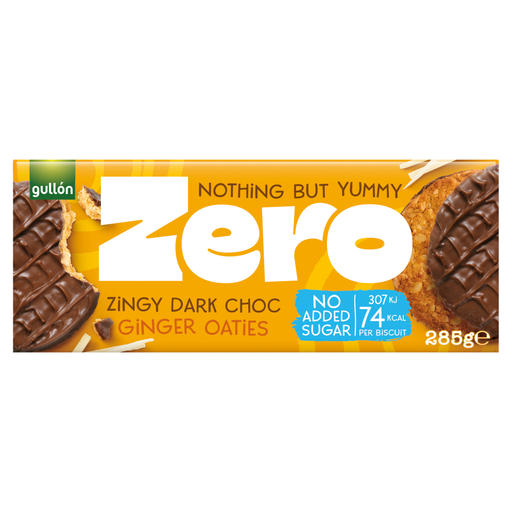
Ginger Oaties Zero Sugar Free offers a ginger-and-oat style rather than a conventional ginger nut.
- Gullón describes the product as a wheat biscuit with oats and a dark-chocolate component.
- Check the current pack’s full nutrition and allergen information before comparing it with other biscuits for a shared order.
Tesco
Tesco Ginger Nut Biscuits are a conventional own-label option labelled suitable for vegans.
- Tesco lists 25.5g sugars and 444kcal per 100g.
- The biscuits contain sugar and glucose-fructose syrup; they are not sugar-free.
Sainsbury’s
Sainsbury’s Ginger Snaps are another conventional vegan ginger-biscuit option.
- Sainsbury’s lists 25.5g sugars and 444kcal per 100g for Ginger Snaps.
- The product lists 6.2g saturated fat per 100g and does not meet a sugar-free requirement.
McVitie’s
McVitie’s Ginger Nuts are a conventional branded choice when the familiar ginger-nut style matters more than finding the lowest declared sugar figure among these examples.
- McVitie’s lists 2.9g sugars and 47kcal per biscuit.
- Its label lists 28.9g sugars per 100g, above the Tesco and Sainsbury’s products compared here.
Ginger biscuits on Joybuy
This ginger-and-oat biscuit is an option to examine if the office is considering a sugar-free style instead of a conventional ginger nut; check its current pack details before ordering for a group.
 No image available
Gullon Zero Dark Chocolate Ginger Oaties 285g
For an office considering a ginger-and-oat biscuit instead of a conventional ginger nut, this is a 285g dark-chocolate option. Gullón identifies maltitol in its Ginger Oaties Zero Sugar Free recipe; check the current pack for its nutrition, allergen declaration and any sweetener warning before sharing it.
View on Joybuy
Questions about office ginger biscuits
Does sugar-free mean a ginger biscuit has fewer calories?
No. Farmhouse Biscuits lists 0.2g sugars but 485kcal per 100g for Sugar Free Ginger; Tesco Ginger Nut Biscuits and Sainsbury’s Ginger Snaps each list 444kcal per 100g. Compare energy and saturated fat alongside sugars when choosing between the recipes.
What should I check before ordering sugar-free ginger biscuits for the office?
Check the current pack’s nutrition per 100g, ingredients, allergen declaration, named sweeteners and any excessive-consumption warning. Keep that information available when the biscuits are shared, so colleagues can assess the recipe for themselves.


