Hosts looking for less sugar in the biscuit
You want to distinguish a sugar-free biscuit from a smaller serving of conventional shortbread. Compare the sugars figure per 100 g as well as the product description.


If sugar in the biscuit is your main concern, consider a labelled sugar-free shortbread-style or shortcake biscuit rather than assuming a small conventional shortbread contains less sugar. If the familiar butter-shortbread recipe matters more, compare sugars per 100 g on the current packs and plan portions separately; also check sweeteners and allergens before serving either option.
You want to distinguish a sugar-free biscuit from a smaller serving of conventional shortbread. Compare the sugars figure per 100 g as well as the product description.
You want a recognisable shortbread serving for afternoon tea while checking its ingredients, sugars figure and the number of pieces you plan to offer.
You need the current pack information to check sweeteners, declared allergens and precautionary allergen statements before putting biscuits out to share.
Decide whether less sugar in the biscuit or a traditional shortbread recipe matters more, then compare like-for-like nutrition figures and check the pack for your guests.
| Priority | What to check | Your needs |
|---|---|---|
| Sugars | Compare sugars per 100 g on the current packs. Farmhouse Biscuits lists 0.2 g per 100 g for its Sugar Free Viennese Shorties; Marks & Spencer lists 14.8 g per 100 g for its Mini Shortbread Fingers. Check serving weight separately. | I want less sugar in the biscuit itself, rather than relying on a smaller piece of conventional shortbread. |
| Biscuit style | Check whether the product is traditional shortbread, a shortbread-labelled alternative or shortcake. Farmhouse Biscuits describes its Viennese Shorties as shortcake biscuits, while M&S presents its Mini Shortbread Fingers for afternoon tea. | Will guests expect butter shortbread, or would a differently made tea biscuit suit the occasion? |
| Other ingredients | Read the sweetener, fat and energy information alongside sugars. Farmhouse Biscuits lists maltitol and 491 kcal per 100 g for its Viennese Shorties, with an excessive-consumption warning. | I want to know what replaces the sugar before choosing a biscuit for the whole table. |
| Allergen information | Check declared allergens and any precautionary statements on each current pack. Do not assume a sugar-free biscuit is free from wheat, milk or other ingredients relevant to guests. | Guests need clear ingredient information when biscuits are set out to share. |
A lower sugars figure than another biscuit does not, by itself, establish a comparative product claim.
Use the exact sugars-per-100 g figures when comparing packs, without assigning a reduced-sugars description to a product that does not make a substantiated claim.
Farmhouse Biscuits lists maltitol, 491 kcal per 100 g and an excessive-consumption warning for its Sugar Free Viennese Shorties.
Read the current ingredients, nutrition and allergen panels, especially when several guests will share the biscuits.
Waitrose & Partners gives 3.00 g sugars per Duchy Organic Highland All Butter Shortbread biscuit, whereas the cited M&S and Dean's figures are per 100 g. Those figures have different denominators.
Use matching per-100 g figures to compare products, then consider the weight or number of biscuits in each serving.
These named products illustrate different tea-table choices; a conventional shortbread listed here should not be treated as a reduced-sugars product.
The maker describes its Sugar Free Viennese Shorties as shortcake biscuits, making them a shortbread-style alternative rather than traditional butter shortbread.
A UK retailer lists a 330 g Gullón Sugar Free Shortbread Biscuits product. It is a different product from the Gullón Cookies and Cream biscuit shown in the Joybuy section.
M&S presents its Mini Shortbread Fingers as an afternoon tea option.
Dean's Shortbread Assortment contains fingers, petticoat tails and rounds for a shared tea table.
Walker's Shortbread Fingers 250 g offer a conventional butter-shortbread reference point.
Highland All Butter Shortbread is another conventional biscuit to consider for afternoon tea.
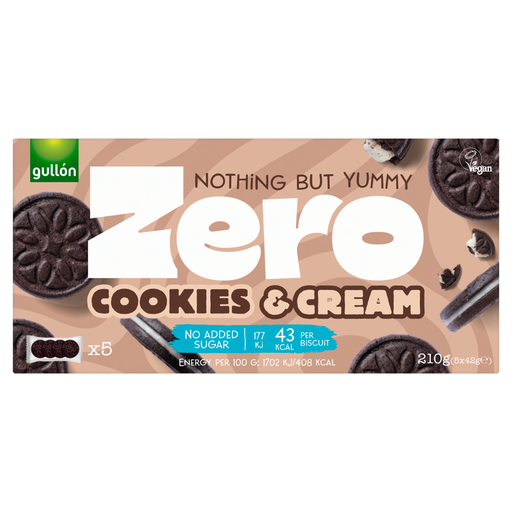
This Joybuy option is a no-added-sugar Cookies and Cream biscuit for an afternoon tea table, not traditional shortbread or the Gullón shortbread product discussed above.
 No image available
For a tea table where avoiding added sugar matters, this Cookies and Cream biscuit offers a different choice from shortbread. ‘No added sugar’ is not the same description as ‘sugar-free’; check the current pack for sugars per 100 g, sweeteners, warnings and allergens before serving.
No. Farmhouse Biscuits lists 491 kcal per 100 g for its Sugar Free Viennese Shorties. Check the full nutrition panel rather than using the sugar wording to judge other properties of the biscuit.
Keep each current pack and its ingredient information available so guests can check the exact biscuit. Farmhouse Biscuits lists wheat and precautionary information for its Viennese Shorties, while M&S lists wheat and milk for its Mini Shortbread Fingers; sugar wording does not replace an allergen check.
Follow that product's pack instructions. Marks & Spencer says to put its Mini Shortbread Fingers in an airtight container after opening.
Check the requirements for that setting separately. Department for Education guidance dated 14 September 2026 addresses food provided in state-funded schools in England; a private afternoon tea does not, simply by being an afternoon tea, establish whether any particular biscuit is suitable for school provision.