Cooks making a small accompaniment
If cheese, pickle, bread and salad are the main flavours, start with a little canned coconut milk in the sauce or dressing and adjust the amount as you prepare it.


For a small sauce or dressing alongside a ploughman's lunch, a light or reduced-fat canned coconut milk is a sensible starting point when you want less richness. Compare the fat value and coconut-extract percentage on the pack, but do not assume either figure guarantees a mild taste. A standard canned milk can give a creamier result; a carton coconut drink is a different format and may require changes to the recipe.
If cheese, pickle, bread and salad are the main flavours, start with a little canned coconut milk in the sauce or dressing and adjust the amount as you prepare it.
A canned cooking product is worth considering when a dip or sauce needs body. Decide how much richness the accompaniment needs rather than choosing by a 'mild' description alone.
A formulation without added stabilisers may separate in the can. Check the ingredients and preparation directions if a uniform pour matters to your recipe.
Choose the product format first, then compare richness and preparation details for the accompaniment you plan to make.
| Priority | What to check | Your needs |
|---|---|---|
| Cooking format | Check whether the product is canned culinary coconut milk or a carton drink. Alpro describes Coconut No Sugars as a drink, while Blue Dragon describes its canned milk as rich and creamy. | I'm making a sauce or dip that needs body, rather than a recipe written for a thin plant-based drink. |
| Richness | Compare fat on the same per-100ml or per-100g basis and check coconut-extract percentages. Tesco says its light coconut milk has 40% less fat than its standard ingredient coconut milk; that comparison does not establish how mild either tastes. | I want the coconut element to sit alongside the cheese and pickle, not dominate the accompaniment. |
| Texture and ingredients | Read the ingredient list and shaking directions. Sainsbury's notes that Tropical Sun 100% Natural Coconut Milk can separate into thicker cream and thinner liquid. | A short ingredient list matters to me, and I can work with separation—or I would rather check for a product that pours more uniformly. |
| Serving and leftovers | Read the current pack for ingredients, precautionary allergen statements and instructions for storing unused contents after opening. | I'm serving other people or making only a small portion, so the exact pack directions matter before serving and storing what remains. |
A drink and a canned cooking ingredient are not interchangeable measures of creaminess. Alpro Coconut No Sugars is labelled as a drink and lists 1.2g fat per 100ml; Blue Dragon describes its canned coconut milk as rich and creamy.
Check the format named in the recipe. If you use a carton drink instead, assess the sauce's texture as you prepare it rather than expecting the same result.
Sainsbury's describes Blue Dragon's standard canned coconut milk as both creamy and mild in coconut flavour. Those descriptions refer to different qualities.
For a restrained accompaniment, compare light and standard cans on their labels, then add the chosen milk gradually.
Sainsbury's says Tropical Sun 100% Natural Coconut Milk can separate into a thicker cream and thinner liquid in the can.
Follow the pack's shaking directions before use. Still check the product and its storage instructions rather than treating separation as a substitute for those checks.
The pack you serve from is the relevant place to check its ingredients, precautionary allergen wording and opened-product directions, especially when preparing food for someone else.
Read that pack before serving and follow its instructions for any unused coconut milk.
These product examples illustrate differences in format and formulation; the brand names alone do not indicate how mild a particular can will taste.
Tesco lists standard and light 400ml culinary coconut milks, allowing a comparison within its own range.
Sainsbury's describes Island Sun Coconut Milk as adding a mild coconut flavour in cooking.
Tropical Sun 100% Natural Coconut Milk is a canned cooking option for recipes where natural separation is manageable.
Alpro Coconut No Sugars is a carton drink, not a direct canned culinary coconut-milk equivalent.
These cans cover two different choices for a ploughman's-lunch accompaniment: a reduced-fat starting point and a 100% natural option where separation is acceptable.
 No image available
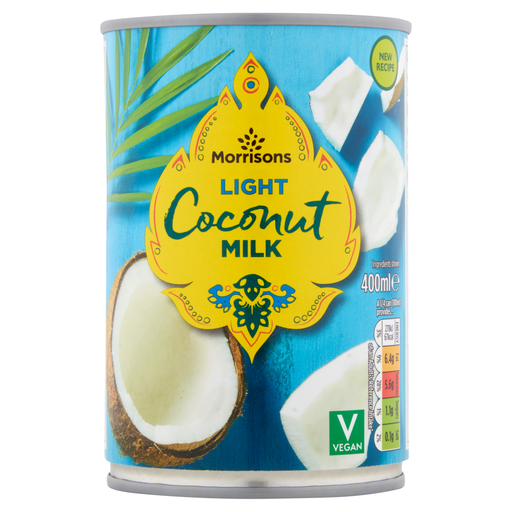
Consider this canned cooking milk when you want a less-rich starting point for a small sauce or dressing. The Joybuy product description lists 23% coconut extract and describes it as having 50% less fat than Morrisons standard coconut milk; neither detail guarantees a mild taste. Add it gradually and check the pack's directions for leftovers.
 No image available
Consider this canned option when the accompaniment needs a creamier result and natural separation is acceptable. Sainsbury's notes that this Tropical Sun product can separate into thicker cream and thinner liquid. It is not labelled as a light option; check the current pack's fat value and measurement basis before comparing it with another can.
Use canned culinary coconut milk if the accompaniment recipe calls for it or needs a creamy result. Alpro labels Coconut No Sugars as a drink, while Blue Dragon describes its canned coconut milk as rich and creamy. If you substitute a carton drink, check the texture as you make the sauce.
No. A reduced-fat label tells you about fat relative to a stated comparison product, not how strong the coconut flavour will taste. Tesco says its light coconut milk has 40% less fat than its standard ingredient coconut milk; use the label to assess richness and add the milk gradually for a restrained accompaniment.
No. That label does not establish flavour intensity. Sainsbury's notes that Tropical Sun 100% Natural Coconut Milk can separate into thick cream and thinner liquid, so consider its preparation directions as well as how much body you want in the sauce.
Follow the storage method and use-by period stated on that can. Check its instructions for transferring and refrigerating unused contents rather than applying a period from another product.
Read the current pack's ingredients and any precautionary allergen statement for the exact product before serving. Do not assume that different coconut milks carry the same allergen information.