Buffet cooks making curries or soups
A canned cooking product suits a recipe that calls for coconut milk. Compare the fat declaration on the exact tin rather than choosing a carton drink solely because its figure is lower.


For a buffet curry, soup or sauce, choose a light or reduced-fat canned cooking coconut milk and compare the fat figures on the packs. Sainsbury's Coconut Milk Light lists 5.6 g fat per 100 ml, while Blue Dragon Light and Waitrose Essential Reduced Fat each list 6.2 g per 100 ml; coconut drinks are a separate choice for serving in glasses or with cereal.
A canned cooking product suits a recipe that calls for coconut milk. Compare the fat declaration on the exact tin rather than choosing a carton drink solely because its figure is lower.
Look for an explicit vegan statement on the product you plan to use, then check its current ingredients and allergen warning. Waitrose & Partners states that Essential Reduced Fat Coconut Milk is suitable for vegans.
Alpro Coconut Original and Koko Unsweetened are coconut-based drinks. They belong on the drinks table or with cereal, rather than being treated as equivalent to a cooking tin in a curry or sauce.
Start with the recipe or serving use, then compare nutrition on a consistent basis and check the pack before catering for guests.
| Priority | What to check | Your needs |
|---|---|---|
| Fat declaration | Read total fat and saturates on the exact product. Sainsbury's lists 5.6 g fat and 4.9 g saturates per 100 ml for Coconut Milk Light; Sainsbury's lists 6.2 g and 5.1 g per 100 ml for Blue Dragon Light. | I want to compare lighter cooking tins without relying on the words “light” or “reduced fat” alone. |
| Comparable units | Waitrose & Partners lists 6.2 g fat per 100 ml for Essential Reduced Fat. Marks & Spencer lists 9.3 g per 100 g for its Reduced Fat tin; do not treat per 100 g and per 100 ml as identical measures. | If two labels use different units, I need a comparable basis before drawing a firm numerical conclusion. |
| Cooking or drinking | Check whether the product is a cooking tin or a drink. Alpro states 5.3% coconut milk in Coconut Original; Tesco lists 9% coconut milk in Koko Unsweetened. Those ingredient percentages do not establish how either drink will behave in a recipe. | For a buffet curry or sauce, I want the cooking format the recipe calls for. For drinks, I can consider a coconut-based carton. |
| Guest requirements | Read the current ingredients, vegan statement and allergen warning separately. Sainsbury's listing for Blue Dragon Light says it may contain peanuts and nuts. | I need to check allergies as well as vegan suitability before serving a shared dish. |
| Opened tins | Match the amount you open to the recipe, and follow the pack's instructions for storing and using any remainder. | For a buffet with several dishes, I would rather plan quantities than open an extra tin without a use for it. |
The compared cooking products have different declarations, and the M&S tin uses a different unit from the other listed tins.
Check total fat, saturates and the per 100 ml or per 100 g basis on the product you buy.
Alpro Coconut Original and Koko Unsweetened are drinks with different listed coconut ingredients from the compared cooking tins. Their lower fat figures do not establish that they will give a curry or sauce the same result.
Use a cooking coconut milk when the recipe specifies one; choose a drink for beverages or a recipe that expressly calls for it.
A vegan statement does not resolve a guest's separate allergy requirements. Sainsbury's Blue Dragon Light listing, for example, carries a “may contain peanuts and nuts” warning.
Ask guests about allergens and read the current physical pack before preparing a shared buffet dish.
Any remainder must be handled according to that product's post-opening storage instructions.
Work out the quantities for each dish before opening tins, and check the label if you intend to use leftovers later.
These examples cover both cooking tins and coconut-based drinks; a brand name alone does not tell you which format or nutrition figure applies.
Its Coconut Milk Light is a canned cooking option.
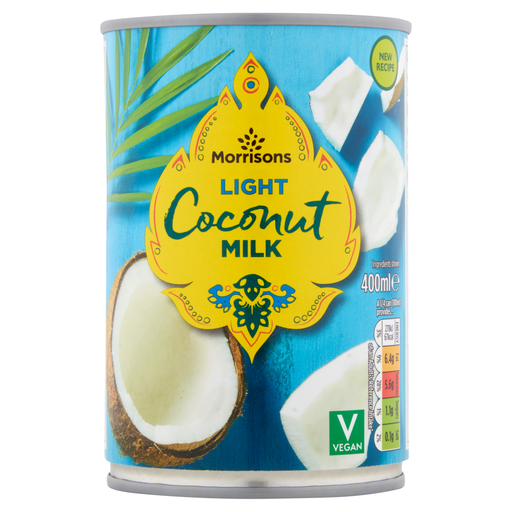
Light Coconut Milk is a canned option for cooking.
Essential Reduced Fat Coconut Milk is a canned cooking product.
Reduced Fat Coconut Milk is another cooking-tin option.
Coconut Original is a coconut-based drink, not a canned cooking product.
Unsweetened is a coconut-based drink.
This Joybuy option is a reduced-fat cooking tin for a buffet recipe that calls for canned coconut milk.
 No image available
For a buffet curry or soup that calls for canned coconut milk, this is a reduced-fat cooking-format option. Check the current pack's ingredients and allergen information before serving guests with dietary requirements.
Sainsbury's Coconut Milk Light lists 5.6 g fat per 100 ml, against 6.2 g per 100 ml for both Blue Dragon Light on Sainsbury's listing and Waitrose Essential Reduced Fat on the Waitrose & Partners listing. Marks & Spencer declares its Reduced Fat product per 100 g, so its figure is not on the same volume basis.
Do not assume it will give the same result. Alpro Coconut Original contains 5.3% coconut milk and Koko Unsweetened contains 9%, while the compared cooking tins list coconut extract at 23% to 40%; follow the recipe's specified format unless it allows a drink.
Check the exact product: Waitrose & Partners states that Essential Reduced Fat Coconut Milk is suitable for vegans. Vegan suitability does not replace an allergen check, so read the current pack before serving.
Follow the opened pack's storage and use instructions, which can differ by product. Plan the recipe quantities before opening another tin, particularly if the remainder will not be used in the buffet.