Home cooks making curries or soups
If the recipe relies on canned coconut milk for its texture, compare light cans by saturated fat per 100ml and consider how much goes into each serving. Diabetes UK also suggests using less coconut milk in a curry.


For a curry, compare light canned coconut milks by saturated fat and carbohydrate per 100ml, then account for the amount used; “light” alone does not tell you whether a serving fits your meal plan. For cereal or drinks, an unsweetened coconut drink serves a different purpose and will not give a sauce the same body as canned milk. Diabetes UK suggests using less coconut milk or choosing a lower-fat variety when making a curry.
If the recipe relies on canned coconut milk for its texture, compare light cans by saturated fat per 100ml and consider how much goes into each serving. Diabetes UK also suggests using less coconut milk in a curry.
For cereal, tea or coffee, an unsweetened coconut drink is a different choice from a cooking can. If it replaces dairy milk in your usual diet, check whether it is fortified with calcium, as Diabetes UK advises for dairy alternatives.
When planning meals around diabetes, compare carbohydrate and sugars alongside saturated fat, then consider the whole recipe and the portion you intend to eat. Diabetes UK advises cutting down on saturated fat.
Choose the format for its intended use first, then compare nutrition on the same per-100ml basis and work out how much the recipe or drink contains.
Choose it for: Curries, soups or sauces that call for canned coconut milk.
Bear in mind: A lower-fat description does not establish that the can is low in saturated fat.
Choose it for: Cereal, tea, coffee or cold drinks rather than a thick coconut sauce.
Bear in mind: It does not provide the same body as canned coconut milk in a curry.
Consider it when: Reducing the amount of coconut milk in the whole curry matters more than retaining a coconut-based sauce.
Bear in mind: Changing the amount or sauce base also changes the finished dish. Diabetes UK suggests using less coconut milk or a lower-fat variety.
| Priority | What to check | Your needs |
|---|---|---|
| Saturated fat | Compare saturates per 100ml across cooking cans, then account for the quantity used. Tesco Groceries lists 5.2g per 100ml for its Light Coconut Milk; Sainsbury's lists 4.9g per 100ml for its Coconut Milk Light. | I want to reduce saturated fat in a curry without assuming that a can labelled “light” contains little of it. |
| Carbohydrate and sugars | Read both figures per 100ml; do not use the sugars figure in place of total carbohydrate. Tesco Groceries lists 1.3g carbohydrate and 0.8g sugars per 100ml for its light can, while Sainsbury's lists 3.5g and 0.7g for its light can. | If I count carbohydrate, I need the figure for the amount going into my meal, not just a description on the front of the pack. |
| Cooking can or drink | Check whether the product is canned cooking milk or a coconut drink. For a drink replacing dairy milk, check whether it is unsweetened and fortified with calcium, as Diabetes UK advises. | A curry needs the texture called for in its recipe; for cereal or tea, I am choosing a drink instead. |
| Recipe quantity | Check how much coconut milk the recipe uses and how many portions it makes. Consider other ingredients and sides when planning the finished meal. | I would rather assess my portion of the whole curry than judge the can in isolation. |
A reduction in total fat relative to a standard product does not tell you the saturated-fat amount in your serving. Light cans can still make a noticeable contribution to a coconut-based recipe.
Compare saturates per 100ml and calculate how much coconut milk each portion contains. If you want to use less, Diabetes UK suggests reducing the quantity in a curry or choosing a lower-fat variety.
An unsweetened coconut drink and canned cooking milk serve different purposes; swapping one for the other changes a sauce’s texture.
Match the format to the dish: check the recipe before choosing a light can for cooking or an unsweetened drink for cereal and beverages.
A coconut product’s sugars figure does not describe its saturated fat or the carbohydrate in the finished meal.
Read the carbohydrate, sugars and saturates figures, then consider the amount used alongside the curry’s other ingredients and sides.
These examples illustrate differences between cooking cans and coconut drinks; the figures refer to the named products, not every product from each brand.
Tesco Light Coconut Milk is a canned cooking product for recipes such as curries, soups and sauces.
Sainsbury's Coconut Milk Light is a canned option for cooking.
Essential Reduced Fat Coconut Milk is Waitrose’s canned cooking option in this comparison.
M&S has standard and reduced-fat canned coconut milk for cooking.
Alpro Coconut No Sugars is a coconut drink for uses such as cereal and beverages, rather than a canned cooking milk.
Koko Unsweetened No Sugar Milk is a coconut-based drink for hot or cold drinks and cereal.
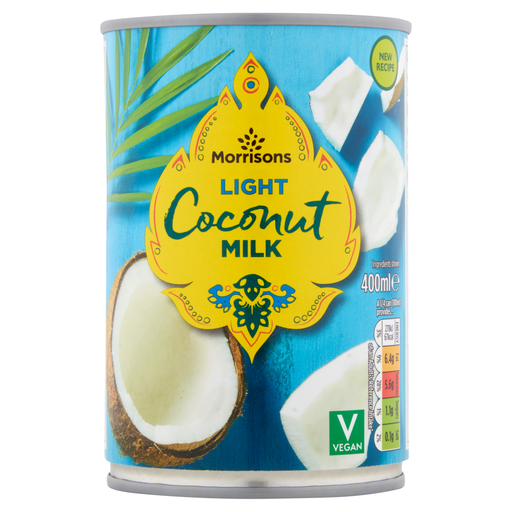
This reduced-fat canned coconut milk is an option to consider for a curry or soup that calls for cooking coconut milk.
 No image available
For a curry or soup that calls for canned coconut milk, this is a reduced-fat 400ml option. Compare the saturated fat and carbohydrate on the pack against the quantity used in your recipe; “reduced fat” does not establish that it is low in saturates.
No. “Light” describes a product’s fat content relative to another version, not its suitability for an individual meal plan. Check saturated fat, carbohydrate and sugars per 100ml, then consider the amount used and the rest of the meal.
Choose a light can when a curry, soup or sauce calls for canned coconut milk. Choose an unsweetened coconut drink for cereal or beverages, and check calcium fortification if it is replacing dairy milk in your usual diet; it will not give a sauce the same body as canned milk.
Compare fat, saturates, carbohydrate and sugars on the same per-100ml basis, then calculate the quantity you will use. The NHS includes these nutrients in its food-label guidance; the sugars figure alone cannot tell you the product’s total carbohydrate or saturated fat.