What should you check?
Decide whether the coconut product is an ingredient in dinner or a drink, then compare the label details that matter for that use.
| Priority | What to check | Your needs |
|---|
| Cooking milk and fat |
Compare cooking tins per 100ml, including saturates. Tesco lists 6.0g fat and 5.2g saturates for its light tin; Sainsbury’s lists 5.6g fat and 4.9g saturates for its light tin. |
I want coconut flavour in a curry or sauce without assuming that “light” means low in saturated fat. |
| Protein in the meal |
Check the tin’s protein per 100ml and what else is in the recipe. Tesco lists 0.4g and Sainsbury’s lists under 0.5g protein per 100ml for their light coconut milks. |
The coconut milk is one ingredient in dinner; I need to choose a separate suitable protein food for the meal. |
| Age and drink nutrients |
Distinguish a drink carton from a cooking tin. For a child aged 1 or over, check whether a dairy-free drink is unsweetened and fortified, and read its protein and nutrient values. The NHS says first infant formula is the only suitable alternative to breast milk before 12 months. |
If the product is meant to be a regular drink rather than sauce, I need to consider what it contributes to the child’s wider diet. |
| Milk allergens |
Read the exact product’s ingredients and allergen declaration. Alpro labels Coconut Original dairy-free; a different coconut beverage listed by Joybuy contains sodium caseinate and declares MILK. |
When avoiding milk, I cannot decide from the word “coconut” or the packaging image alone. |
Relevant brand examples
These examples illustrate different cooking tins and carton drinks; the brand name alone does not establish a product’s nutrition or allergen status.
Tesco
Tesco Light Coconut Milk is a tinned cooking option for comparing with its standard coconut milk.
- Tesco labels it 50% less fat than Tesco standard coconut milk and lists 6.0g fat per 100ml.
- It still lists 5.2g saturates and 0.4g protein per 100ml; it is not a replacement for the meal’s protein food or a toddler’s main milk drink.
Sainsbury’s
Sainsbury’s Coconut Milk Light is another tinned ingredient for a cooked sauce.
- Sainsbury’s lists 5.6g fat per 100ml for this light tin, compared with Tesco’s 6.0g per 100ml for its light tin.
- It also lists 4.9g saturates and under 0.5g protein per 100ml. The fat comparison alone does not establish which tin suits an entire meal.
Alpro
Alpro Coconut Original is a carton drink, not the same type of product as tinned cooking coconut milk.
- Alpro labels this drink dairy-free and lists 120mg calcium per 100ml.
- Its label lists 0.1g protein and 0µg iodine per 100ml, so calcium fortification alone does not make it nutritionally equivalent to dairy milk.
Koko
Koko’s drink and cooking milk need separate label checks because they serve different uses.
- Koko Super Milk lists 1.2g protein, 170mg calcium and 13µg iodine per 100ml.
- Koko Cuisine Coconut Milk is a cooking product listing 17.4g fat and 15.7g saturates per 100ml; it does not meet a reduced-fat cooking aim.
Joybuy cooking-milk option
This reduced-fat cooking tin is an option for a coconut-based dinner sauce, rather than a choice of dairy-free drinks.
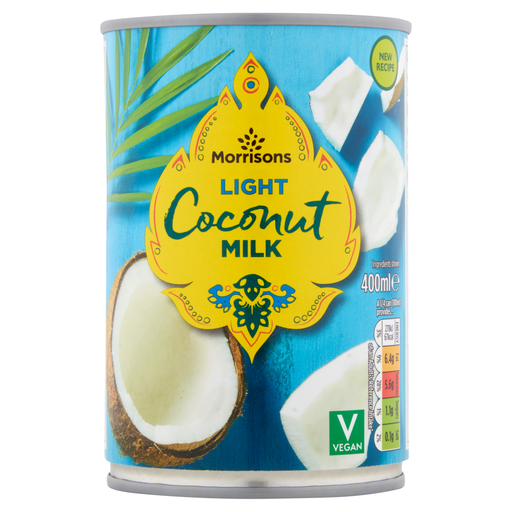 Image unavailable
Morrisons Reduced Fat Coconut Milk 400ml
A canned cooking ingredient for a coconut-based sauce. Use the pack’s per-100ml nutrition panel when deciding how much to add, and check its allergen declaration if the meal must be milk-free.
View on Joybuy
Questions about coconut milk for toddlers
Can coconut milk replace breast milk or formula before age 1?
No. The NHS says first infant formula is the only suitable alternative to breast milk in the first 12 months; a coconut drink or cooking milk must not become an infant’s main milk replacement. Ask a healthcare professional for individual advice if allergy or feeding difficulties are involved.
Does a light coconut-milk tin make a lower-fat toddler dinner?
It can reduce fat compared with the brand’s standard tin, but check the actual recipe and portion rather than relying on “light”. Tesco lists 6.0g fat and 5.2g saturates per 100ml for its light tin; Sainsbury’s lists 5.6g fat and 4.9g saturates per 100ml for its light tin. Coconut milk should remain one ingredient alongside other foods in the meal.
Can I swap a carton coconut drink for tinned coconut milk in a curry?
They are different products, so the recipe’s texture may change. The British Heart Foundation distinguishes tinned cooking coconut milk from carton coconut drink; Alpro Coconut Original, for example, lists 0.9g fat and 0.1g protein per 100ml. Choose according to the sauce you are making, and check the drink’s nutrients separately if it will also be served as a drink.
Does coconut milk contain dairy?
That depends on the exact product. Alpro labels Coconut Original dairy-free, while a coconut beverage listed by Joybuy contains sodium caseinate and declares MILK. For a milk-free meal, read the ingredients and allergen declaration on the pack being used.
What matters if a toddler regularly has a dairy-free drink?
For a child aged 1 or over, check that the drink is unsweetened and fortified, then look at its protein and declared nutrients in the context of the wider diet. The British Society for Allergy and Clinical Immunology recommends unsweetened fortified plant drinks where plant drinks are used; for a child with cow’s-milk allergy or a restricted diet, seek advice suited to their individual needs.


