Shoppers looking for a low-fat claim
You want a frozen dessert after dinner and need to distinguish an explicit low-fat claim from wording such as “light” or “less fat”.


Choose an explicitly labelled low-fat frozen dessert if that claim is the deciding factor: M&S lists a Low Fat Birthday Cake Ice Cream, while its Strawberry Kefir Fro-Yo is described as 1.8% fat. A light or reduced-fat tub may suit a dessert shared after dinner, but a relative reduction does not establish that it meets the UK low-fat threshold. If dairy-free or vegan suitability matters, check that separately from fat content.
You want a frozen dessert after dinner and need to distinguish an explicit low-fat claim from wording such as “light” or “less fat”.
You want to serve several portions from one tub and may consider a reduced-fat product even if an explicit low-fat claim is not essential.
You need a dessert that meets a dietary requirement. If fat content also matters, it calls for a separate nutrition-label check.
Decide whether the priority is a low-fat claim, a tub to share or dietary compatibility; then compare the exact packs on the measures that matter to you.
Choose when: An explicit low-fat claim matters more than the size of the sharing tub.
Keep in mind: Check the pack for serving size, sugars and allergens as well as its fat claim.
Choose when: You want to portion a reduced-fat dessert from a tub after dinner.
Keep in mind: “Less fat” compares products; it does not, by itself, establish a low-fat claim.
Choose when: Avoiding dairy or selecting a vegan product is the first requirement.
Keep in mind: Those descriptions do not establish the product’s fat content.
| Priority | What to check | Your needs |
|---|---|---|
| Low-fat wording | Look for an explicit claim and read the fat figure in the nutrition panel. GOV.UK guidance says a solid food using a low-fat claim must contain no more than 3 g fat per 100 g; “less fat” is a different, relative statement. | I want a product labelled low fat, rather than assuming a light tub meets that definition. |
| Sharing and portions | Check tub size, the serving you intend to scoop and whether there is room in the freezer. Asda lists Wall’s Soft Scoop Vanilla Light in a 1.8 L tub. | Several of us want dessert after dinner, so a tub we can portion matters more to me than an explicit low-fat claim. |
| Dietary suitability | Read the exact pack’s ingredients and allergen declaration. Waitrose describes Swedish Glace vanilla frozen dessert as dairy-free, gluten-free, lactose-free and vegan; check its nutrition panel separately if fat matters too. | I need to check whether a dessert meets my dairy, lactose or vegan requirements before comparing its fat content. |
| Frozen storage | Check the pack’s storage instructions and best-before date. GOV.UK advises keeping a freezer at −18°C. | I want to keep a tub in the freezer for another weeknight, so its storage instructions matter. |
Asda lists Wall’s Soft Scoop Vanilla Light as containing 30% less fat than similar ice cream products and gives its fat content as 4.3 g per 100 ml. That relative claim does not establish a low-fat claim.
If an explicit low-fat claim is important, check the wording and nutrition information on the exact pack rather than relying on “light”.
Dairy-free and vegan descriptions address ingredients and dietary suitability, not a particular fat value.
Confirm the ingredients and allergens you need to avoid, then compare fat per 100 g or 100 ml on the packs you are considering.
The amount scooped and any toppings are part of the dessert you serve, so comparing tub labels alone may not reflect the finished portion.
Decide how you will serve it, then use the pack’s serving and nutrition information for that choice.
A best-before date assumes the product has been stored as instructed; it is not a substitute for following the pack’s frozen-storage directions.
Keep the tub frozen and follow its instructions when serving and storing what remains. GOV.UK advises keeping a freezer at −18°C.
M&S lists frozen desserts with different approaches to fat content, including an explicitly named low-fat ice cream.
Wall’s Soft Scoop Vanilla Light is a reduced-fat frozen-dessert tub listed by Asda.
Waitrose lists a Vanilla Light tub for shoppers considering a relative fat-reduction claim.
Waitrose lists a vanilla frozen dessert described as dairy-free, gluten-free, lactose-free and vegan.
Sainsbury’s lists Häagen-Dazs frozen desserts among its tubs and multipacks.
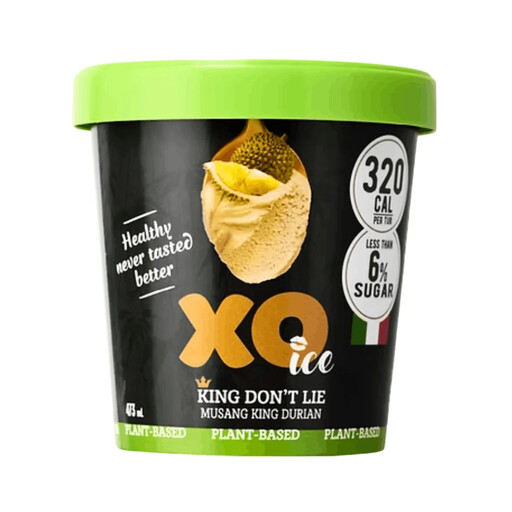
This plant-based durian gelato is an option to examine if you want a frozen dessert after dinner. Check its exact pack for fat content and any low-fat claim; “plant-based” does not answer either question.
 No image available
The 473 ml gelato is a frozen-dessert option for after dinner. Check the exact pack for its fat figure, any low-fat claim, serving instructions and allergen declaration, including information about coconut and possible milk traces.
No. “Less fat” is a relative claim, not proof of a low-fat claim. GOV.UK guidance says a solid food using a low-fat claim must contain no more than 3 g fat per 100 g, so check the exact product’s claim and nutrition panel.
Start with a product that carries that claim, such as M&S Low Fat Birthday Cake Ice Cream, then check its pack for serving size, sugars and allergens. Do not substitute a “light” tub solely because it claims less fat than similar products.
Those descriptions do not establish fat content. Waitrose describes Swedish Glace vanilla frozen dessert as dairy-free and vegan; compare its nutrition panel with other products if fat is also a deciding factor.
Read the ingredient list and allergen declaration on the exact pack, even when a dessert is described as plant-based or dairy-free. Check any warnings about traces as well as the ingredients themselves.
Follow the pack’s frozen-storage instructions. GOV.UK advises keeping a freezer at −18°C and identifies ice cream as a food that carries a best-before date, which concerns quality rather than an automatic safety cut-off when the product has been properly stored.