
24/7 Customer Support

Free returns

Same-day & Next-day Delivery

Quality Guaranteed

Unlock Your Welcome Offers: FREE Delivery | Up to 80% OFF | Free 30-day JoyPlus trial
Download the APP
By Joybuy Product Recommendation Officer
If you are comparing a Lion’s Mane supplement in the UK, marketing language can make the choice unnecessarily difficult. Large “equivalent” doses, impressive extraction ratios and promises about focus or memory do not always tell you what is actually inside the product.
The practical approach is to check the raw material, standardised compounds, serving information and suitability for your diet. This guide highlights common buying traps and matches several options to different UK lifestyles.
A label may show a large milligram figure, but this can refer to the equivalent weight of raw mushroom rather than the amount of extract in the capsule. A product stating “4000mg equivalent” may contain considerably less actual extract after concentration.
Look for both figures where possible:
A higher number is not automatically a better choice. Transparent labelling is more useful than a large headline dosage.
Some supplements use mycelium grown on grain. This is not necessarily unsuitable, but buyers following a clean, gluten-free or low-filler diet may prefer a product made from fruiting bodies only.
Check the ingredients list for terms such as organic Lion’s Mane fruiting body extract or Hericium erinaceus fruiting bodies. Also look for grain carriers, starches and unnecessary bulking ingredients if these matter to you.
Lion’s Mane is often marketed for focus, memory and mental clarity. These are areas of interest for many shoppers, but food supplements should not be presented as treatments for brain fog, cognitive decline or medical conditions. Individual responses can vary, and supplements do not replace sleep, a balanced diet or professional medical advice.
Under UK advertising principles, a product description should not be treated as independent proof of a health outcome. Concentrate on measurable features such as the formula, extraction method, capsule material and declared active compounds.
For shoppers seeking a Lion’s Mane fruiting body extract, the label should identify the mushroom material directly. Fruiting-body products may suit people who want to avoid grain-grown biomass or who prefer a more clearly defined ingredient source.
Organic certification can also matter. If you are looking for organic Lion’s Mane, check whether the product description and packaging identify the certification rather than relying only on the word “organic” in a product title.
Polysaccharides and beta-glucans are commonly listed on Lion’s Mane labels. A standardised percentage gives you a more consistent way to compare products than mushroom weight alone.
For example, Osavi lists 600mg of fruiting-body extract per capsule, standardised to at least 40% polysaccharides and 120mg beta-glucans. Vita London lists a 12:1 extract with minimum 50% polysaccharides and 10% beta-glucans per daily serving. These figures are product specifications, not guarantees of a particular personal result.
Lion’s Mane capsules are convenient for commuting, office use and travel. Tablets can be a practical alternative if you prefer a compact format. Lion’s Mane powder is more flexible because it can be mixed into smoothies, porridge, yoghurt or soup, but it may have a noticeable earthy flavour and requires accurate measuring.
For vegan shoppers, check for a hydroxypropyl methylcellulose (HPMC) capsule shell. If you follow a gluten-free, dairy-free or allergen-conscious diet, review the complete ingredient list and the label warnings before purchase.
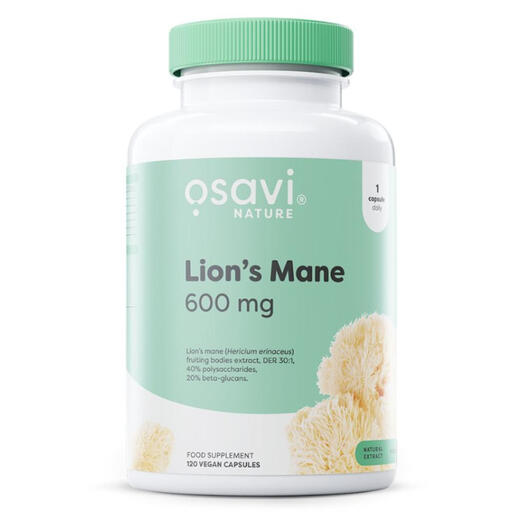
Why This Fits Their Persona: A straightforward one-capsule format suits UK adults trying Lion’s Mane for the first time without adding a complex routine.
The label identifies fruiting-body extract and provides polysaccharide and beta-glucan figures instead of relying only on a large equivalent dose.
600mg extract per capsule, minimum 40% polysaccharides, minimum 120mg beta-glucans and a vegan HPMC shell.
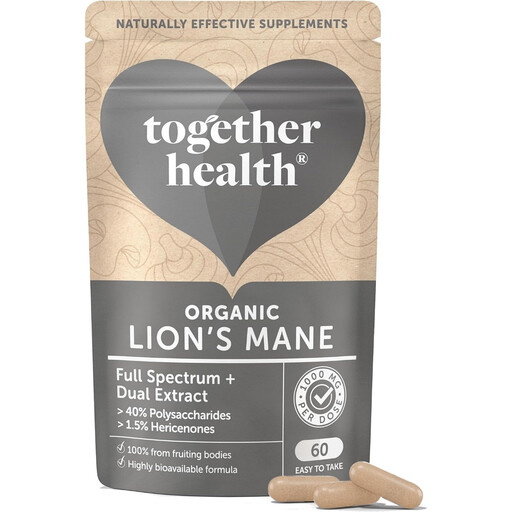
Why This Fits Their Persona: Suitable for shoppers prioritising organic fruiting bodies, a detailed active profile and a dual-extract formulation.
It specifies 100% organic fruiting bodies and separates the 20:1 dual extract from the 1:1 full-spectrum extract.
Two-capsule serving with over 40% polysaccharides, more than 30% beta-glucans and a vegan capsule shell.
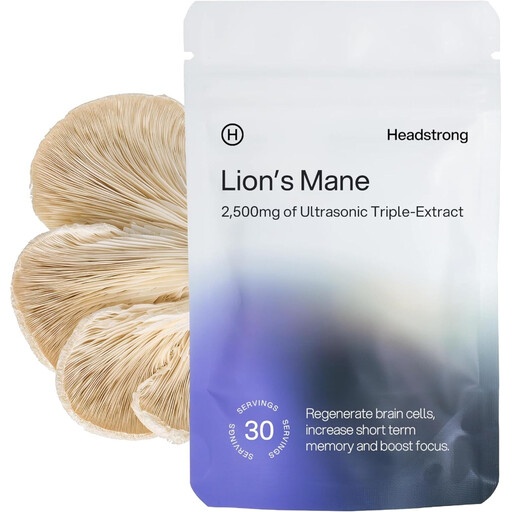
Why This Fits Their Persona: The single-capsule daily format may suit busy professionals or students who prefer a simple daytime routine.
The product information states that it uses organic fruiting body extract without grain mycelium fillers and declares its active-compound quantities.
2500mg extract per capsule, minimum 120mg hericenones plus erinacines and minimum 180mg beta-glucans.
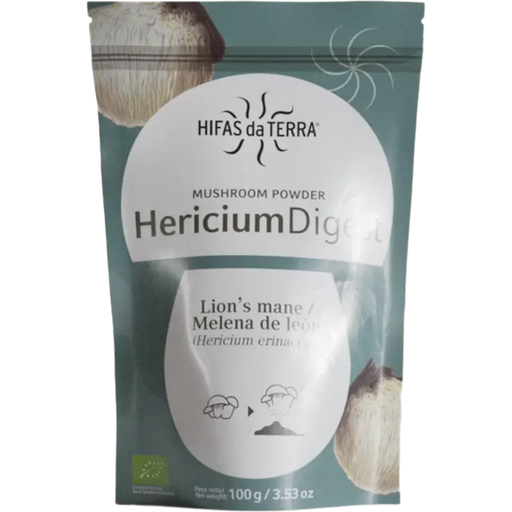
Why This Fits Their Persona: A useful choice for adults who prefer adding a measured powder to smoothies, yoghurt, soups or porridge.
The ingredient is listed as organic Lion’s Mane powder, with a recommended measured serving rather than an unclear capsule-equivalent claim.
Organic powder format, 51.8g fibre per 100g and 23.17% beta-glucans, with no dairy, gluten, soy or added sugar listed.
Follow the serving instruction on the product label. Capsules are generally swallowed with water, while powders can be mixed into food or drink. Do not exceed the stated daily intake. Taking a product consistently at the same time may make it easier to maintain a routine.
This depends on the pack size and serving. A 60-capsule product taken at one capsule daily lasts approximately 60 days; a two-capsule serving lasts approximately 30 days. Powder packs vary according to whether you use 1g, 5g or another labelled serving, so calculate the approximate cost per day before buying.
No. Check the allergen information and warnings carefully. If you are pregnant, breastfeeding, under the stated minimum age, taking prescription medication or under medical supervision, seek advice from a qualified healthcare professional before use. Stop taking the product if you experience an adverse reaction.
Always read the supplied label because ingredients, packaging and directions can change. A Lion’s Mane supplement should complement a varied diet and healthy lifestyle, not replace medical care or prescribed treatment.