Choose a powered stereo pair if placing the performers and crowd across separate left and right speakers matters most, and you have room for both speakers and their connection. A one-box wireless speaker suits a simpler streaming setup; if you want Dolby Atmos Music on the Sonos Era 300, you will also need Wi-Fi, a supported service and compatible content. Whichever layout you choose, check your source connections and plan listening levels with nearby homes in mind.
Who each setup suits
Listeners with room for a stereo pair
If the positions of instruments and crowd sounds are central to your enjoyment of a concert album, you may prefer two speakers placed apart. Check that you have suitable positions and a practical route for the connection between them.
Streamers who want less hardware
If you mainly stream music in a shared living area, a one-box speaker may be easier to place than a separated pair. Check its app, Wi-Fi and Bluetooth options against the services and devices you actually use.
Listeners balancing connections and neighbours
If a TV, computer or turntable is part of your setup, the available inputs may decide which system works. In a flat, speaker position and restrained bass levels matter alongside those connections.
What matters when choosing
For live albums in an open-plan flat, decide whether you can accommodate a separated pair before comparing connections, placement and listening controls.
One-box wireless speaker
Choose it when: Fewer speaker positions and app-based streaming matter more to you than a conventional separated stereo layout.
Allow for: On the Sonos Era 300, Dolby Atmos Music depends on Wi-Fi, a supported service and compatible content; ordinary stereo albums do not gain that format simply by playing through it.
Powered stereo pair
Choose it when: You can place left and right speakers apart and want that layout for conventional stereo concert recordings.
Allow for: Both speaker positions need planning, including the interspeaker connection and a safe cable route through the room.
| Concern |
What to check when buying |
Who this matters to |
| Stereo presentation |
Decide whether you mainly play conventional stereo or compatible Dolby Atmos Music, and measure possible spacing for a pair. |
If I listen for where performers and crowd sounds sit in a recording, I want space for separate left and right speakers. Around 36% of consumers put stereo presentation first. |
| Neighbour-aware listening |
Plan speaker positions and check the available level or equaliser controls before adding bass equipment. |
In a flat, I want to enjoy a concert album without letting prominent bass disturb nearby homes; roughly 29% of consumers make considerate playback their primary concern. |
| Source connections |
Match each TV, computer, optical source or turntable output to the exact model's input; check any required adapters. |
If I switch between a TV and my music sources, I need the connections to work with my equipment. For about 21% of consumers, source compatibility comes first. |
| Space and cabling |
Measure furniture clearance, power-socket positions and the route and length of any interspeaker cable. |
If two speakers would crowd my furniture or leave a cable across a walkway, I need a workable layout before choosing a system; around 14% of consumers prioritise space and setup. |
Buying pitfalls
-
Assuming every live album uses Dolby Atmos Music
Sonos says the Era 300's Dolby Atmos Music route requires Wi-Fi, a supported streaming service and compatible content. A conventional stereo recording remains a separate listening consideration.
Check the formats available for the albums you play, and listen to familiar stereo tracks before making spatial-audio support your deciding factor.
-
Treating a line input as a TV connection
Sonos says the Era 300's wired line-in requires a separately sold Line-In Adapter and 3.5 mm auxiliary cable, and is not intended for TV.
If TV audio matters, check the television's output and the exact speaker system's supported connection. KEF specifies HDMI ARC for the LSX II LT.
-
Adding bass without planning for nearby homes
KEF specifies a subwoofer output on the LSX II LT, and Ruark specifies one on the MR1 Mk3. Bass expansion makes placement and listening levels more important in a flat.
Start with a practical speaker position and moderate levels. Consider a subwoofer only if you can position and use it without avoidable disturbance.
-
Choosing a pair before measuring the room
Ruark includes a 3-metre interspeaker cable with the MR1 Mk3; KEF offers an optional 8-metre C-Link cable for the LSX II LT. Neither detail replaces measuring your intended route.
Mark out both speaker positions, power access and walkway clearance before ordering.
A longer cable or suitable stands may be needed if the planned positions cannot use the supplied arrangement.
Relevant brands to consider
Sonos
The Era 300 is a one-box option for app-based Wi-Fi listening and compatible Dolby Atmos Music.
- Sonos specifies Wi-Fi, Bluetooth, AirPlay 2 and Trueplay room tuning for the Era 300.
- Dolby Atmos Music needs compatible content and a supported service. The wired line-in needs separately sold accessories and, according to Sonos, is not intended for TV.
KEF
The LSX II LT is a compact powered stereo pair for listeners who can accommodate two speaker positions and want streaming alongside direct connections.
- KEF specifies HDMI ARC, USB-C, optical input, Bluetooth, AirPlay 2, Google Cast and a subwoofer output for this model.
- Plan an interspeaker cable route. KEF offers the longer 8-metre C-Link cable as an optional accessory.
Ruark
The MR1 Mk3 is a compact active stereo pair for a setup that may include a computer, optical source or moving-magnet turntable.
- Ruark specifies USB-C audio, line and optical input, a built-in moving-magnet phono stage and a subwoofer output; a 3-metre interspeaker cable is included.
- Ruark's 48 Hz–22 kHz typical in-room response is a model specification, not a promise of the same bass presentation in every open-plan flat.
Joybuy tabletop speaker options
These Edifier tabletop speakers suit shoppers considering a single-speaker starting point for music. If separate left and right placement is your priority, check the playback and pairing arrangements before choosing either model.
 No image available
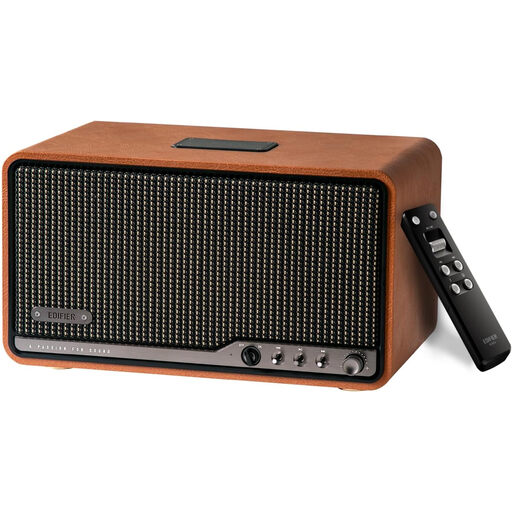
Edifier S300 wireless tabletop speaker (Brown)
Consider this model if you want to start with a wireless, multi-room tabletop speaker rather than place a stereo pair immediately.
If separate left and right playback matters, confirm the requirements for adding and pairing a second S300 before ordering.
View on Joybuy
 No image available
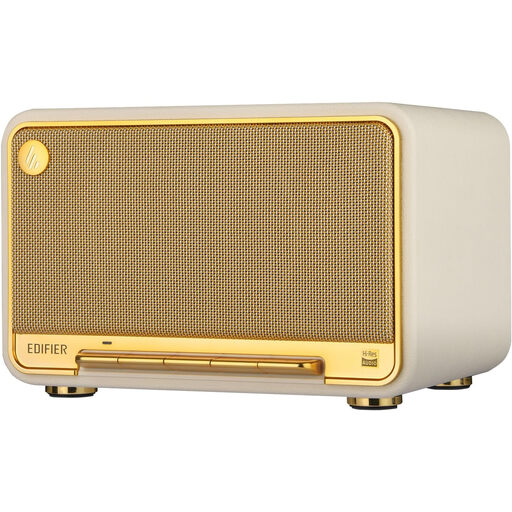
Edifier D32 tabletop wireless speaker
Consider this model if a tabletop speaker with both wireless listening and wired source options fits your setup.
Listed features include Bluetooth 5.3, AirPlay 2, USB-C and AUX inputs, 2.1 acoustic architecture and a 60 W RMS rating.
Confirm its left and right playback arrangement if separated stereo presentation is central to your live-album listening.
View on Joybuy
Common questions
Should I choose one speaker or a stereo pair for live albums?
Choose a powered stereo pair if separate left and right placement is important to you and practical in your room. A one-box speaker makes more sense if simpler placement and streaming matter more; audition familiar stereo recordings rather than assuming a spatial-audio feature will change every album.
Which setup can connect to a TV or turntable?
Match the input to the equipment: KEF specifies HDMI ARC for a compatible TV on the LSX II LT, while Ruark specifies a moving-magnet phono stage on the MR1 Mk3. Sonos says the Era 300's separately adapted line-in is not intended for TV.
Where should I put speakers in a flat?
Choose stable positions that leave a safe cable route and allow considerate listening levels. Welsh Government guidance suggests keeping speakers away from neighbours' walls and raising them from the floor where possible; use the positions that are safe and practical in your own room.
Does listening before 11pm rule out a noise complaint?
No. GOV.UK says councils in England must investigate complaints about noise that could be a statutory nuisance, so the time alone is not a reason to disregard the effect on neighbours. Keep volume and bass considerate whenever you listen.
Which accessories and guarantee terms should I check?
Check what your chosen connection and speaker positions require before ordering. Sonos sells the Era 300 line-in adapter and 3.5 mm cable separately; KEF offers an optional longer cable for the LSX II LT. Ruark includes a 3-metre interspeaker cable with the MR1 Mk3, while the guarantee stated by Ruark's own shop should not be assumed to be another seller's policy.


