What to check before choosing
For a TV shared between console play and ordinary viewing, decide which game modes you will use, then assess screen size and picture quality from the household’s usual seats.
| Concern |
What to check |
Who this matters to |
| Console performance |
Check 4K 120Hz and VRR support on the intended HDMI input, including any receiver or switch in the connection path. |
If I play games with a 120Hz mode, I want that mode to work through the TV rather than merely getting a picture. Around 33% of consumers would put console performance first. |
| Screen size and seating |
Measure the usual viewing distance and check the screen’s physical width and stand or mounting position. |
When the whole household uses the sofa, I need a screen that works from the regular seats, not just my gaming position. Room fit would come first for around 27% of consumers. |
| Picture in the room |
Compare exact models for reflections and picture quality under the room’s usual daytime and evening lighting. |
If films and dark game scenes share time with daytime TV, I care about how the picture looks in both settings. Around 20% of consumers would make room-dependent picture quality their main concern. |
| Everyday use |
Decide whether supported 120Hz games and VRR are priorities before choosing a TV for ordinary viewing as well as play. |
I do not want a console-focused specification to displace what matters when everyone else uses the TV. For around 20% of consumers, everyday use would take priority. |
Joybuy TVs for living-room use
These LED-family and OLED TVs offer different screen sizes and display types for a shared living room. Compare the named variant with your seating layout, and confirm its intended console mode on the HDMI input you will use.
 No image available
Hisense 55U7QTUK Pro 55-inch Mini LED 4K TV
Consider this 55-inch model if that size fits both the gaming seat and the room’s usual viewing positions.
The product name specifies Mini LED, 4K HDR, VIDAA OS and 165Hz Game Mode Ultra. Check the console-supported mode on the HDMI port you plan to use; the headline refresh-rate figure alone does not establish it.
View on Joybuy
 No image available
TCL 75Q6C 75-inch QD-Mini LED 4K TV
Assess this 75-inch variant against the main seating distance and available wall or stand space before choosing a larger screen.
The product name specifies QD-Mini LED, 4K HDR, Google TV and a 144Hz native refresh rate. Confirm which resolution and refresh-rate combinations its HDMI inputs accept from your console.
View on Joybuy
 No image available
Sony BRAVIA A90 XR42A90K 42-inch OLED 4K TV
This 42-inch OLED model is worth comparing when a smaller screen suits the shared room and OLED picture characteristics are a priority.
The product name specifies 4K HDR and Google TV. Check the exact gaming modes and HDMI port required for your PlayStation or Xbox setup rather than relying on its PlayStation-oriented wording.
View on Joybuy
 No image available
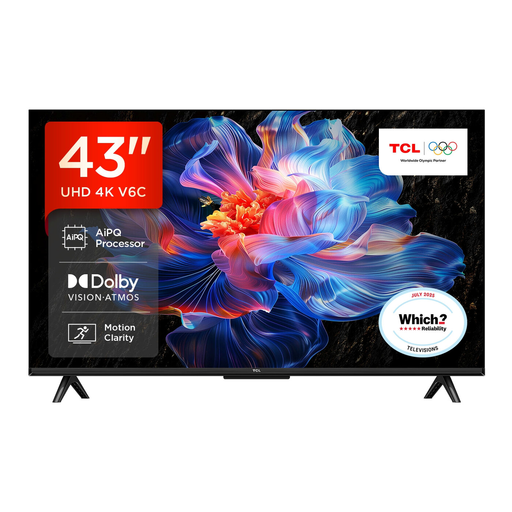
TCL 43V6C 43-inch Direct LED 4K TV
Compare this 43-inch screen with the normal viewing distance if space is limited or the TV will be shared from several seats.
The product name specifies Google TV and a 120Hz Game Accelerator at FHD resolution. Do not treat that FHD mode as confirmation of 4K at 120Hz; check supported input modes if that combination matters to you.
View on Joybuy
 No image available
TCL 55P8K-UK 55-inch QLED 4K TV
Consider this 55-inch QLED model alongside the other 55-inch option if that screen size works for both games and everyday viewing.
The product name specifies 4K HDR Pro and an ONKYO 2.1 sound system. Check the supported resolution and refresh rate on the intended HDMI input before choosing it for a particular console performance mode.
View on Joybuy
Common questions
Do I need an HDMI 2.1 TV to connect a PlayStation or Xbox?
No: Which? says a TV with an HDMI input can connect a games console. HDMI 2.1 becomes relevant to particular modes: Xbox Support specifies an HDMI 2.1 TV and suitable cable for Xbox Series X gaming at 4K and 120Hz, while PlayStation says PS5 VRR needs an HDMI 2.1 VRR-compatible display.
Will every PS5 or Xbox Series X game use a 120Hz TV mode?
No. PlayStation says PS5 120Hz output applies to TVs and games that support a 120Hz frame rate. Check the game’s available modes as well as the TV input and connection path before making 120Hz a deciding feature.
How large should a TV be for a shared living room?
Start with the usual seating distance and include other regular seats, rather than sizing the TV from a temporary gaming position. TCL’s UK guide gives starting points of 43 inches at 1.3 metres, 55 inches at 1.7 metres, 65 inches at 2.0 metres and 75 inches at 2.3 metres; check the proposed screen’s physical fit as well.
Does console gaming on a TV require a TV Licence?
Console gaming alone does not establish a TV Licence requirement in the UK. GOV.UK says a licence is needed if you watch or record live television or use BBC iPlayer, so consider how the household will use the screen beyond games.
How can I check whether a TV supports the console mode I want?
Check the exact model’s supported resolution and refresh rate for the HDMI input you will use, then compare them with the console and game’s available modes. PlayStation describes its PS5 120Hz video-output setting as applying to supported TVs and games; Xbox Support specifies the TV and cable requirements for Xbox Series X at 4K and 120Hz. Include any receiver or switch in the check.


