Who is this for?
The useful distinction is whether the carton will stay unopened in your bag or whether you will need somewhere cold to keep it after drinking some.
Gym-goers carrying an unopened dairy-free drink
A long-life carton offers a way to carry a drink before opening when its label permits ambient storage. Koko, Tesco and Sainsbury’s list long-life or UHT coconut drinks, but their opened cartons need refrigeration.
Shoppers checking sugar and allergens
Koko’s unsweetened long-life drink is listed by Tesco as free from dairy and soya. Tesco’s and Sainsbury’s own-label long-life coconut drinks are sweetened, so the word “coconut” alone will not tell you whether a carton meets a no-added-sugar preference.
People using a plant drink regularly
If coconut drink is replacing milk more often, compare the exact pack’s calcium, iodine and vitamin declarations. The UK government’s SACN and COT assessment says the nutrient content of plant-based drinks varies considerably.
What should you check?
Start with storage and how you will use the carton, then compare the ingredients and nutrition information that matter to your snack.
| Priority | What to check | Your needs |
|---|
| Storage |
Check that the unopened carton permits storage without refrigeration. Read its refrigeration temperature and use-by instructions for after opening; Koko and Tesco specify use within 5 days. |
I can carry an unopened carton, but I need access to a fridge if I leave some for later. |
| Sugar |
Read the ingredients and sugars line per 100ml or serving. Tesco lists Koko’s unsweetened drink at 0.2g sugars per 100ml; Tesco’s and Sainsbury’s own-label long-life drinks are sweetened. |
If I want no added sugar, I need to check the exact drink rather than rely on its coconut flavour. |
| Fortification |
Check the exact pack for calcium, iodine, vitamin D and B12. Tesco and Sainsbury’s list iodine in their own-label drinks; Tesco’s Koko listing names calcium, vitamin D2 and B12. |
For a drink I use regularly in place of milk, I want to know which nutrients the carton actually lists. |
| Protein |
Compare the protein line on the same per-100ml or per-serving basis. Tesco lists 1.2g per 100ml for Koko and 1.3g per 250ml for its own-label drink. |
If protein is the purpose of my post-workout snack, I’ll choose a separate protein-containing food rather than rely on the drink alone. |
| Allergens |
Read the precise allergen statement, including manufacturing warnings. Waitrose lists soya in Alpro Coconut Barista; Sainsbury’s says its own-label coconut drink is not suitable for customers with a soya allergy because of manufacturing methods. |
A dairy-free description does not answer every allergy question I might have. |
Brand and retailer references
These examples describe particular coconut drinks or retailer ranges, not every product sold under each name.
Koko
Tesco lists Koko Dairy Free Unsweetened Alternative Longlife Drink as a 1L option for an unopened carton when avoiding added sugar and soya matters.
- Tesco lists 0.2g sugars and 1.2g protein per 100ml, and labels this product free from dairy and soya.
- After opening, refrigerate it and consume it within 5 days.
Tesco
Tesco Long Life Coconut Original is a sweetened 1L UHT drink with added calcium, iodine, vitamin B12 and vitamin D2.
- Its listed fortification lets shoppers check for iodine on this specific carton.
- Tesco lists 5.9g sugars and 1.3g protein per 250ml; refrigerate after opening and use within 5 days.
Sainsbury’s
Sainsbury’s Sweetened Long Life Coconut Drink is an ultra-heat-treated 1L drink listing calcium, iodine, vitamin D and B12.
- Sainsbury’s lists 300mg calcium and 56.3µg iodine per 250ml for this product.
- It is sweetened, and Sainsbury’s says it is not suitable for customers with a soya allergy because of manufacturing methods.
M&S
M&S Creamy Coconut Drink is another carton to compare if calcium, iodine and vitamin fortification are priorities.
- M&S lists calcium, iodine, vitamin B12 and vitamin D for this drink.
- M&S says to refrigerate it at 0°C to +5°C after opening and consume it within 5 days; its allergy statement says it is not suitable for people with a milk allergy.
Alpro
Alpro Coconut Barista with soya is formulated for coffee and iced drinks, which is a narrower use than a plain gym-bag drink.
- Waitrose lists 1.5g protein per 100ml for this particular barista drink.
- It contains soya and Waitrose lists 3.3g sugars per 100ml; keep it refrigerated after opening.
Waitrose
Waitrose carries distinct long-life coconut drinks rather than one Waitrose coconut-drink formulation.
- Its Plenish Organic Unsweetened Long Life Coconut Drink listing describes a UHT drink with no added sugar.
- The listed Plenish carton requires refrigeration after opening and use within 4 days. Check its own fortification label rather than assuming it matches another drink.
Joybuy coconut drink options
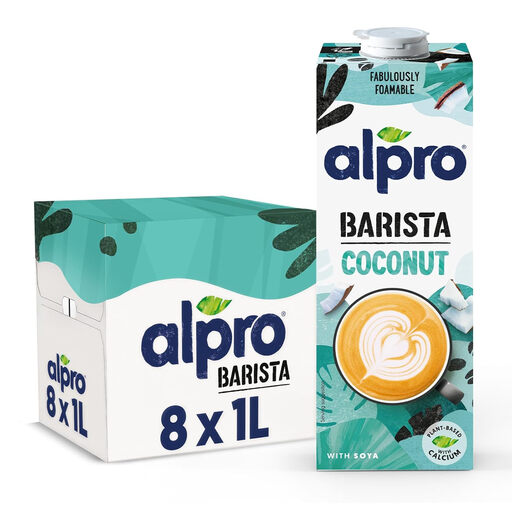
The Joybuy option here is a multipack of long-life, barista-style coconut drink. Its coffee-focused formulation and soya content matter if you want a plain drink or need to avoid soya.
 No image available
Alpro Barista Coconut Long Life Drink, 8 x 1L
The unopened long-life cartons suit carrying before refrigeration, provided you can store any opened carton in a fridge. The Joybuy listing describes a barista drink containing soya, with 1.5g protein per 100ml and added calcium and vitamins B2, B12 and D. Refrigerate after opening and use within 5 days; choose a separate protein-containing food if protein is the purpose of the snack.
View on Joybuy
Common questions
Can I keep a long-life coconut drink in my gym bag?
You can carry an unopened carton if its label permits storage without refrigeration. Once opened, follow its refrigeration and use-within instructions: Koko and Tesco specify 5 days, while Waitrose lists 4 days for its Plenish Organic Unsweetened Long Life Coconut Drink. Do not leave an opened carton in an unrefrigerated gym bag.
Which of these drinks has no added sugar?
Koko Dairy Free Unsweetened Alternative Longlife Drink is an option to check: Tesco lists it as unsweetened, with 0.2g sugars per 100ml. Tesco’s and Sainsbury’s own-label long-life coconut drinks are sweetened, so read the ingredients of the exact carton.
Are coconut drinks fortified in the same way?
No. The UK government’s SACN and COT assessment says plant-based drinks vary considerably in nutrient content. Tesco and Sainsbury’s list iodine in their own-label long-life coconut drinks, while Tesco’s Koko listing names calcium, vitamin D2 and B12; check the exact pack if a particular nutrient matters to you.
Is coconut drink enough on its own for a protein-focused snack?
Check the protein amount before using it for that purpose. Tesco lists 1.2g per 100ml for Koko, and Waitrose lists 1.5g per 100ml for Alpro Coconut Barista with soya. If you intend the snack to provide protein, choose a separate protein-containing food alongside the drink.
Does dairy-free mean a coconut drink suits every allergy?
No; check the allergen statement for the exact product. Tesco lists Koko’s unsweetened drink as free from dairy and soya, but Alpro Coconut Barista contains soya. Sainsbury’s warns that its own-label long-life coconut drink is not suitable for customers with a soya allergy because of manufacturing methods, and M&S marks its Creamy Coconut Drink as unsuitable for people with a milk allergy.


