What should you check before choosing?
Start with the food and guests’ flavour preferences, then check how the chosen tea is prepared and what it contains.
| Priority | What to check | Your needs |
|---|
| Body and milk |
Look for a stated robust, malty or full-bodied profile. Check the individual blend rather than relying on the words “breakfast tea”. |
I’m serving a cooked savoury brunch and want a fuller-flavoured black tea for guests who add milk. |
| Flavour |
Compare the blend’s flavour description and ingredients. Twinings describes its English Breakfast loose tea as having a light finish; Earl Grey is a bergamot-flavoured alternative. |
For a mixed menu, I’d start with an unflavoured black tea and make a separate Earl Grey pot if guests want bergamot. |
| Preparation |
Follow the pack’s leaf dose and steeping time. For black tea, the UK Tea & Infusions Association advises water at 90–98°C; Ringtons suggests one teaspoon per cup and three to five minutes for its loose tea. |
I’m making several cups at once, so I want a method I can repeat without guessing the amount of tea or brewing time. |
| Guest preferences |
Read the exact blend’s ingredients and any allergen information. Ask whether guests want caffeinated tea or would prefer a decaffeinated option. |
Some guests may avoid particular ingredients or limit caffeine; I’d check the pack rather than assume all loose teas are alike. |
Which brands offer relevant blends?
These brands’ ranges include different directions for a brunch pot; choose by the particular blend and its preparation guidance, not the brand name alone.
Twinings
Its loose-leaf range includes English Breakfast and Earl Grey.
- Twinings describes its English Breakfast loose tea as flavourful with a light finish.
- Choose Earl Grey separately if bergamot flavour is a guest preference rather than a shared one.
Yorkshire Tea
Its range includes loose Yorkshire Tea, Yorkshire Gold and a hard-water blend.
- The loose black-tea options give hosts a familiar style for a shared teapot.
- Check which blend you are buying, particularly if local water hardness affects your choice.
Whittard of Chelsea
Its loose-tea catalogue includes English Breakfast, Earl Grey and Tippy Assam.
- The range lets hosts consider both unflavoured breakfast tea and a bergamot-flavoured option.
- Check each blend’s description and brewing directions rather than treating the range as one tea style.
Fortnum & Mason
Its loose-leaf range includes a 250g Breakfast Blend caddy.
- Fortnum & Mason describes that blend as robust and malty, with a strong, full-bodied brew.
- Those flavour descriptions apply to its Breakfast Blend, not every tea in the range.
Bettys
Its loose-tea range includes Breakfast Tea and Tea Room Blend variants for soft or hard water.
- Bettys describes its Breakfast Tea as a strong, malty Assam.
- Check the named blend and water variant; they are not interchangeable descriptions of every Bettys tea.
Ringtons
Its loose-tea range includes a Breakfast Loose Tea for teapot brewing.
- Ringtons describes that tea as full-bodied and malty and suggests one teaspoon per cup, steeped for three to five minutes.
- Use the directions on the particular pack if choosing another Ringtons blend.
Joybuy tea for this brunch
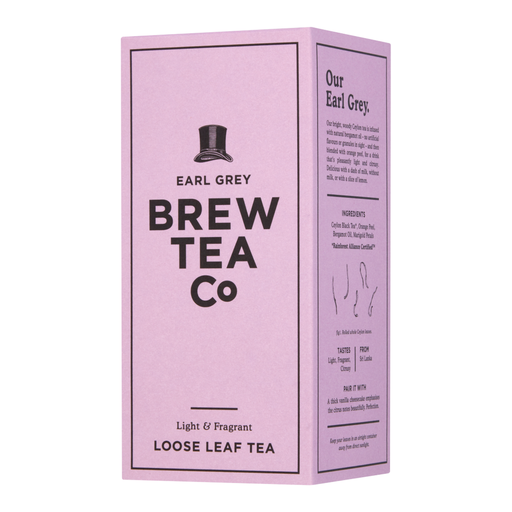
This loose-leaf Earl Grey is an option for guests who want a bergamot-flavoured tea alongside the main brunch pot.
 No image available
Brew Tea Co Earl Grey loose-leaf tea, 113g
Consider this Earl Grey for guests who want a flavoured alternative to the main black-tea pot. It is a 113g loose-leaf tea; check its pack for the leaf dose and steeping time before brewing.
View on Joybuy
Common questions
Which loose-leaf tea goes with a cooked brunch?
A robust, malty breakfast blend is a reasonable starting point if guests want a fuller-flavoured black tea, particularly with milk. Fortnum & Mason, Bettys and Ringtons each describe specific breakfast teas in those terms; choose according to the flavour your guests prefer, not as though those descriptions were comparative tasting results.
How much loose tea should I put in a shared pot?
Follow the chosen tea’s pack directions and scale the stated dose to the number of cups. For its loose tea, Ringtons suggests one teaspoon per cup and a three-to-five-minute steep; do not assume that method applies to every blend.
What water temperature should I use for loose black tea?
The UK Tea & Infusions Association advises 90–98°C for black tea. Check the individual pack’s brewing directions as well, especially if making more than one tea style.
What should I check before serving flavoured tea to guests?
Read the ingredients and allergen information for the exact blend, then ask whether guests want its added flavour. An Earl Grey containing bergamot flavouring is a different choice from an unflavoured black tea, so offering separate pots lets guests choose.


