Desk-lunch loose-leaf tea drinkers
If you have a short break, check where the tea will sit and whether you can measure leaves, brew them and clean up at work.


Choose loose-leaf tea in a pre-filled caddy if you want tea and a storage container in one purchase; choose loose tea and a separate jar if you already have a clean container intended for food contact. Neither removes the need to measure, brew and separate the leaves, so tea bags may fit a short desk lunch better if time or washing-up space is limited.
The right format depends as much on your lunch routine and storage space as on the tea you choose.
If you have a short break, check where the tea will sit and whether you can measure leaves, brew them and clean up at work.
If you already have a suitable jar, loose tea sold without a caddy gives you a way to refill it rather than choosing a pre-filled container each time.
A decorative caddy can be part of the purchase, but you will still need a practical way to brew the loose leaves at your desk.
Decide whether loose-leaf preparation fits your break, then choose between tea supplied in a caddy and a separate container for loose tea.
Choose it when: You want to buy loose tea and its storage container together.
Bear in mind: A caddy does not replace the tools or time needed to brew loose leaves.
Choose it when: You have a clean, food-contact container and want to refill it with loose tea.
Bear in mind: Decanting and cleaning the jar add steps to the routine.
Choose it when: Measuring and separating leaves will not fit your lunch break.
Bear in mind: This means choosing a format other than the loose-leaf tea considered here.
| Priority | What to check | Your needs |
|---|---|---|
| Storage format | Check whether the tea comes in a caddy or needs a separate container. If desk space matters, check the exact container’s external dimensions and lid. | I want somewhere to put the tea at work without sourcing another container, or I already have a jar I can refill. |
| Brewing routine | Check the instructions for your tea and whether hot water, a measure and an infuser, strainer or teapot are practical at work. Twinings specifies two to four minutes for its English Breakfast loose-tea caddy; Ringtons advises three to five minutes for its loose tea. | My break needs to leave enough time to brew the leaves and clear away the equipment. |
| Jar suitability | For a separate jar, check that it is intended for food contact, clean and able to protect the tea from contamination. GOV.UK gives food-contact marking and contamination protection as criteria in its guidance for food businesses. | If I decant tea, I want a container suitable for storing food rather than choosing a decorative jar just because it has a lid. |
| Pack size | Compare the stated tea weight with how often you expect to drink it and the space available. A larger pack also means committing to more of one blend. | For a blend I have not tried, I would rather choose an amount that fits my desk space and likely use. |
Brand preparation instructions call for measured leaves and several minutes of brewing. You also need a way to remove the leaves from the drink.
Before buying, check that hot water and an infuser, strainer or teapot are available, and that you can clean up afterwards. If not, consider tea bags or another simpler format.
Appearance alone does not tell you whether a particular caddy will fit a drawer or stay closed when carried between locations.
Check the exact item’s size, lid construction and care instructions if desk storage or carrying it matters.
A container used for decanting tea needs to keep its contents protected from contamination. GOV.UK’s food-business guidance identifies food-contact marking as a container-selection check; it does not establish a separate legal rule for a personal desk jar.
Choose a clean jar intended for food contact rather than relying on its appearance or lid alone.
Named ranges include different tea weights, such as Twinings’ 100g English Breakfast caddy and Fortnum & Mason’s 250g Celebration Blend caddy. The amount you can store and expect to use matters more than how the container looks on a shelf.
If the blend is new to you or desk space is tight, compare the stated weight and container size before committing to a larger format.
These brand ranges provide examples of loose tea, caddies and refill choices; check the individual product when container details matter.
Offers loose tea in caddies as well as empty tea-storage jars.
Offers loose Yorkshire Tea and Yorkshire Gold for buyers choosing how to store the tea separately.
Lists loose-tea pouches and filled caddies, allowing a choice between refilling a container and buying tea with one.
Lists decorative loose-leaf caddies and tins, including 125g and 250g formats.
Offers loose-leaf caddies, including Tea Room Blend, Breakfast Tea and Earl Grey formats.
Offers loose-leaf teas for buyers who plan to choose their own storage method.
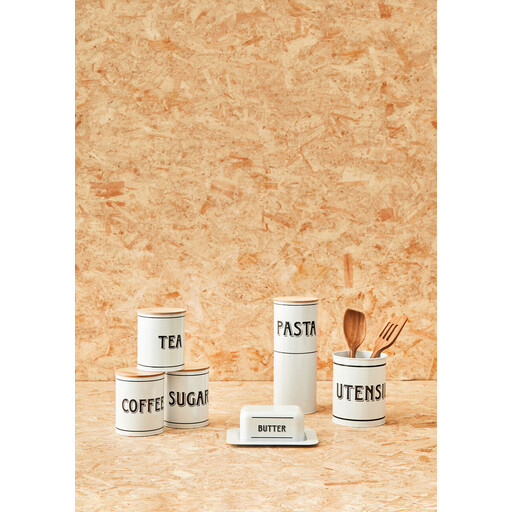
This separate tea canister is an option if you are buying loose tea and arranging your own desk storage. Check that it is suitable for food contact before using it for tea.
 No image available
A separate storage vessel for a loose-tea-and-container setup. Check food-contact suitability before storing tea in it, and check the lid and capacity against how you intend to use it.
No. A pre-filled caddy combines tea and storage in one purchase, but loose tea can also be kept in a suitable food-contact container. Either way, you still need to measure, brew and separate the leaves.
Choose a clean jar intended for food contact and able to protect the tea from contamination. GOV.UK gives those container criteria in guidance for food businesses; the guidance does not, by itself, establish a legal requirement for a jar at a personal desk.
Follow the instructions for the tea you buy and allow additional time to measure the leaves and clear up. Twinings specifies a two-to-four-minute brew for its English Breakfast loose-tea caddy, while Ringtons advises a three-to-five-minute steep for its loose tea.
Not necessarily. An infuser or strainer can also keep leaves out of the finished drink; choose an approach you can use and clean at your desk or in a shared kitchen.
Some are intended for continued storage: Twinings says its caddies can be used after the original tea is finished. Check the individual caddy’s condition and cleaning instructions before reusing it for food.