Parents comparing smaller portions
If the calories in one packed bar are the starting point, compare the labelled eating portion rather than the per 100g figure. Some wrappers contain a twin-bar portion.


For a secondary-school packed lunch, compare the calories in the portion that will actually be eaten, then check sugars, fibre and the current allergen label. Kellogg's UK lists 83 kcal for a 20g Rice Krispies Snack Bar, while Waitrose & Partners lists 116 kcal for a 30g Graze Cocoa Vanilla Oat Boost; neither figure alone establishes whether a bar suits the pupil or the school's policy.
If the calories in one packed bar are the starting point, compare the labelled eating portion rather than the per 100g figure. Some wrappers contain a twin-bar portion.
A lower calorie figure does not describe the rest of the bar. Compare sugars and fibre for the same portion, and consider what else is going into lunch.
Compare the current pack's ingredient and precautionary allergen statements with the pupil's requirements and the individual school's packed-lunch policy.
Start with the portion inside the wrapper, then compare its nutrition declaration and whether that particular bar can be packed for school.
| Priority | What to check | Your needs |
|---|---|---|
| Portion calories | Read kcal per labelled portion, not just per 100g. Check whether the wrapper holds one bar or a two-bar serving. | I want to know the calories in what will actually go into the lunchbox, especially if both bars in a twin pack are likely to be eaten. |
| Sugars and fibre | Compare grams of sugars and fibre for that same portion. Kellogg's UK lists 5.8g sugars and 0.6g fibre for its 20g Rice Krispies Snack Bar; Waitrose & Partners lists 2.7g sugars per 30g Graze Cocoa Vanilla Oat Boost, with 17g fibre per 100g. | Calories matter to me, but I also want to see how the bars differ in sugars and fibre without treating one figure as a complete judgement on lunch. |
| Allergens and school policy | Read both the ingredient list and any may-contain statements on the current pack. Check the specific product against the pupil's requirements and the school's policy. | Before packing a bar, I need to know whether its cereal, milk, soya or nut declarations create an issue for the pupil or at school. |
A 20g single bar and a 42g twin-bar serving are different amounts to eat, even when both labels also show figures per 100g.
Use the energy declaration for the portion you expect to pack and check how many bars that portion includes.
Those descriptions do not settle whether a particular bar meets an allergy-related requirement or a school's packed-lunch policy.
Check the current pack's contains and may-contain statements, then compare them with the pupil's requirements and the school's rules.
A bar's calorie count says little about the other foods included in the packed lunch.
Choose the bar in the context of the whole lunch rather than making it the main food by default.
These figures describe the named products and portions, not every bar made by each brand.
The Rice Krispies Snack Bar is a compact example for comparing single-bar portions.
The Cocoa Vanilla Oat Boost offers a different portion and nutrition profile from the smaller Kellogg's example.
Crunchy Oats & Honey is worth comparing as a twin-bar portion rather than as a single small bar.
The Peanuts, Almonds & Cocoa Protein Bar is a gluten-free-labelled example where nut ingredients are relevant to the decision.
The Original Oat Protein Flapjack is a 50g option for comparison with smaller cereal bars.
These cereal bars offer different pack and portion formats to consider for a secondary-school lunch. Check each current pack's per-bar nutrition and allergen declaration before deciding what to pack.
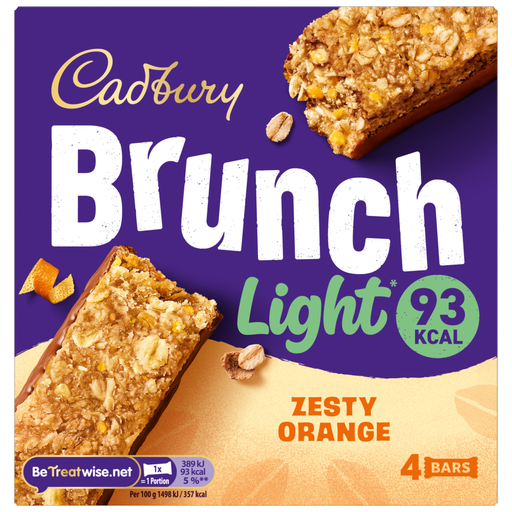 Image unavailable
For a packed lunch, check the energy per bar rather than treating the 104g pack as one portion. Read the current allergen declaration against school requirements.
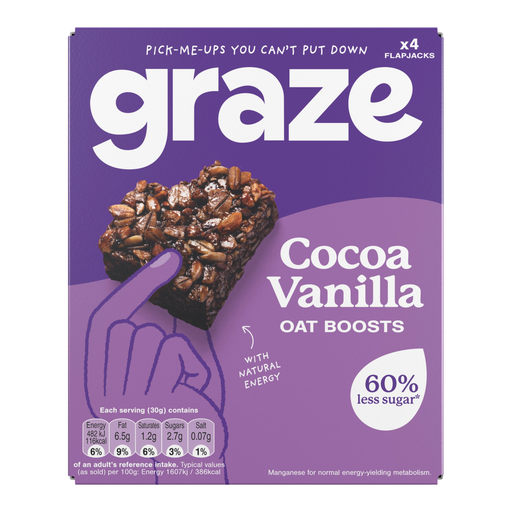 Image unavailable
Compare a 30g portion's calories, sugars and fibre with other single-bar portions. This is a different product from the Graze Cocoa Vanilla Oat Boost discussed above, so use this pack's own nutrition and allergen label.
 Image unavailable
The 21.5g bar size makes the per-bar declaration the useful figure for lunchbox comparison. Check its sugars, fibre and allergen statements as well as its energy.
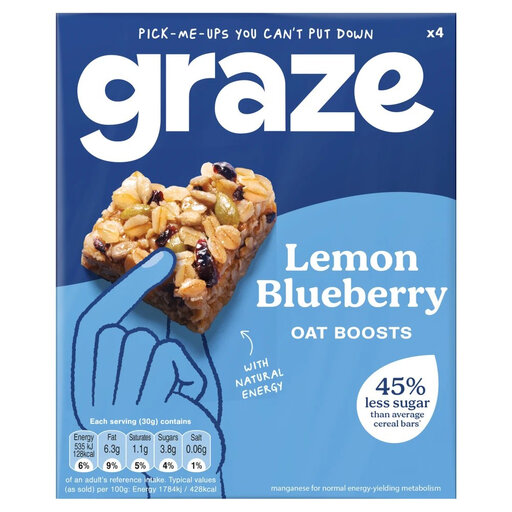 Image unavailable
Use the declaration for one 30g portion when comparing it with other bars. Check this flavour's own ingredients and may-contain statement rather than assuming it matches another Graze product.
 Image unavailable
For one 20g bar in a packed lunch, compare its own per-bar nutrition declaration with other small portions. It is not the Rice Krispies Snack Bar cited above, so check this product's label separately.
Compare kcal for the portion that will be eaten, including both bars if the labelled serving is a twin pack. For example, Kellogg's UK lists 83 kcal for one 20g Rice Krispies Snack Bar, while Nature Valley UK lists 196 kcal for its two-bar, 42g Oats & Honey serving; those figures describe different amounts of food.
The Department for Education describes those standards as applying to food and drink provided in state-funded schools in England, not as a list of permitted items in every home-packed lunch. Check the individual school's packed-lunch and allergy policies before including a bar.
No: an oat-based description is not a gluten-free declaration. Nature Valley identifies oat gluten in its Oats & Honey product, while Eat Natural labels its Peanuts, Almonds & Cocoa Protein Bar gluten free. Check the exact current pack and any other relevant allergen statements.
Use it to compare options, then read the physical pack when buying and packing the bar. The current label is where to check the portion, nutrition figures, ingredients and allergen statements for the product you have.