Fewer calories do not make crisps a suitable everyday toddler snack: NHS guidance advises avoiding salty foods, including crisps, for babies and young children. If you decide to offer crisps occasionally, compare the calories, salt and saturated fat in the amount served; a lower-calorie packet and a no-added-salt option address different concerns.
Who is this for?
Parents considering an occasional crisp
If you have decided to offer crisps occasionally, the calories, salt and saturated fat in the amount served are more useful for comparing packets than a front-of-pack description alone. NHS guidance still advises avoiding salty foods such as crisps for young children.
Parents focusing on salt
A no-added-salt crisp, a reduced-salt crisp and a lower-calorie crisp answer different questions. Compare the stated salt per serving alongside the calories rather than treating those descriptions as interchangeable.
Staff choosing snacks for an England school
School food provision calls for a setting-specific check. It is a different decision from what a parent may choose to serve occasionally at home.
What should you check?
Decide whether crisps are appropriate for the occasion before comparing packets; then use the amount you would actually serve as the basis for the label check.
| Priority | What to check | Your needs |
|---|
| Snack choice |
NHS guidance advises avoiding salty foods, including crisps, for babies and young children. A lower-calorie label does not change what kind of snack it is. |
For an everyday toddler snack, I would rather choose something other than crisps. |
| Salt |
Read salt per packet or serving and check the exact flavour. Walkers lists 0.17g per 25g pack of Lightly Salted; Tyrrells lists 0.02g per 30g serving of Naked (no salt). |
If I occasionally offer crisps, salt matters to me as well as calories. I do not want to assume that “lightly salted” means no added salt. |
| Amount served |
Compare calories for the amount offered, noting pack size. Walkers lists 96 kcal per 22g Oven Baked Sea Salt pack, while Tyrrells lists 156 kcal per 30g Naked serving; those are different amounts of food. |
A sharing bag makes me think about the portion I would serve, not just the figures printed for one suggested serving. |
| Other label details |
Check saturated fat per serving, ingredients and the allergen statement for the precise flavour. NHS guidance also cautions against giving young children too many foods high in saturated fat, including crisps. |
Before offering a particular flavour, I want to read its own label rather than rely on what another product from the brand contains. |
Common mistakes
-
Reading an adult reference-intake percentage as a toddler allowance
A percentage based on an adult reference intake does not establish an appropriate toddler portion.
Look at the calories, salt and saturated fat in the amount you plan to offer, and keep the NHS guidance on crisps for young children in view.
-
Choosing by calories alone
Walkers lists 96 kcal and 0.19g salt per 22g Oven Baked Sea Salt pack; Tyrrells lists 156 kcal and 0.02g salt per 30g Naked serving. The lower-calorie and lower-salt figures belong to different products and serving sizes.
Decide which concern you are comparing, then check both figures for the amount you would serve.
-
Assuming “baked” or “less salt” means toddler-focused
Walkers describes its Oven Baked crisps as having 50% less fat than regular potato crisps and its Lightly Salted crisps as having 45% less salt than the average regular potato crisp. These are comparisons with other crisps, not assessments of their role in a toddler’s diet.
Use those descriptions as prompts to read the full label, not as a reason to make crisps a routine snack.
Brand and product-line references
These figures refer to named flavours and serving sizes, not every crisp made by each brand. Per-100g figures and per-pack figures should not be treated as the same serving.
Walkers
Two Walkers ranges illustrate why a baked crisp and a reduced-salt crisp need separate label checks.
- Walkers lists 96 kcal, 0.19g salt and 0.3g saturates per 22g pack of Oven Baked Sea Salt.
- Its Lightly Salted pack lists 0.17g salt but 132 kcal per 25g pack; the figures also use different pack sizes.
Tyrrells
Naked (no salt) is a distinct option when comparing listed salt rather than calories alone.
- Tyrrells lists 0.02g salt per 30g serving of Naked, with potatoes and sunflower oil as its ingredients.
- The same serving lists 156 kcal; “no salt” is not a calorie description.
Kettle Chips
KETTLE Lightly Salted provides per-100g figures for a conventional crisp comparison.
- KETTLE Chips lists 516 kcal and 0.7g salt per 100g of Lightly Salted.
- Check the amount served before comparing these per-100g figures with another brand’s per-pack figures.
Seabrook
Sea Salted has a stated single-bag size, making its pack figures straightforward to read.
- Seabrook Crisps lists 164 kcal, 0.4g salt and 0.8g saturates per 31.8g bag.
- That bag is larger than the 22g Walkers Oven Baked Sea Salt pack, so a comparison also needs to account for the amount served.
McCoy's
Salted is another conventional crisp to compare by its exact flavour label.
- McCoy's lists 533 kcal and 1.3g salt per 100g of Salted.
- Use its per-100g figures with the amount you intend to serve, and check the pack’s allergen statement.
Real Crisps
REAL Sea Salt has both per-100g nutrition and a listed 35g bag format.
- REAL Hand Cooked Crisps lists 515 kcal and 1.3g salt per 100g of Sea Salt.
- If choosing the 35g bag, check its serving information rather than reading the per-100g values as per-bag amounts.
Joybuy crisp options
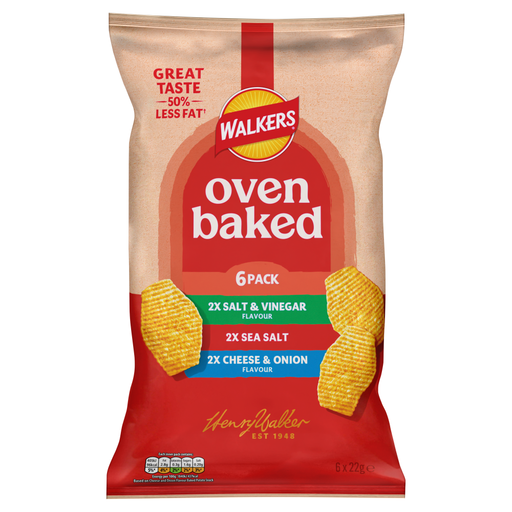
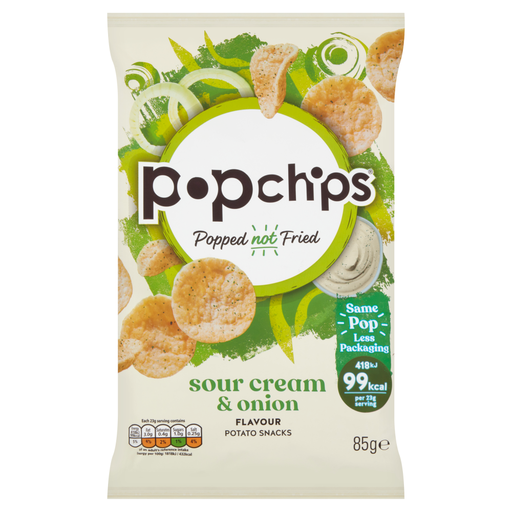
These options are a baked-crisp variety multipack and a flavoured sharing bag. For an occasional choice, check the exact flavour and amount served rather than treating either format as an everyday toddler snack.
 No image available
Walkers Oven Baked Variety Pack 6 x 22g
The multipack contains individual 22g bags. Because it is a variety pack, check the nutrition, ingredients and allergens for the particular flavour before deciding how much to serve.
View on Joybuy
 No image available
PopChips Sour Cream & Onion 85g
This 85g sharing bag needs portioning if you want to compare the amount served with an individual packet. Read the Sour Cream & Onion nutrition and allergen label before offering it.
View on Joybuy
Questions about crisps for toddlers
Does a lower-calorie packet make crisps an everyday toddler snack?
No. NHS guidance advises avoiding salty foods, including crisps, for babies and young children, and cautions against giving them too many foods high in saturated fat. A lower calorie figure does not settle those concerns.
What should I compare if I occasionally offer crisps?
Compare calories, salt and saturated fat in the amount you would serve, then check that flavour’s ingredients and allergen statement. For example, Walkers lists 96 kcal and 0.19g salt per 22g Oven Baked Sea Salt pack, while Tyrrells lists 156 kcal and 0.02g salt per 30g Naked serving; neither figure alone decides whether to serve it.
Does “baked” or “lightly salted” mean a crisp is intended for toddlers?
No. Walkers’ statements that Oven Baked has 50% less fat than regular potato crisps and Lightly Salted has 45% less salt than the average regular potato crisp compare those products with other crisps. Check the full label and the amount served rather than treating either description as toddler-specific guidance.


