Marathon trainees watching snack calories
If you want protein in a portable snack, compare calories per whole bar. Keep that choice separate from what you use to supply carbohydrate during long runs.


Choose a protein bar by its whole-bar calories and protein if you want a portable recovery or between-meal snack during marathon training. Do not rely on a low-sugar protein bar as your main fuel for a long run: UK Sports Institute guidance distinguishes the carbohydrate needs of longer, harder exercise from the role of a post-exercise snack. Check the bar’s carbohydrate, ingredients and your tolerance as well as its calories.
If you want protein in a portable snack, compare calories per whole bar. Keep that choice separate from what you use to supply carbohydrate during long runs.
Check the exact flavour’s vegan labelling alongside its protein, calories, carbohydrate and ingredients; a protein-bar range can contain different formulations.
Read the ingredients and allergen information on the exact pack. If a bar contains sweeteners, try it during ordinary training before deciding whether it suits you near a run.
Decide whether the bar is for a snack or for exercise first; then compare whole-bar nutrition and the exact ingredients.
| Priority | What to check | Your needs |
|---|---|---|
| Running fuel | Check carbohydrate per serving and whether the product is intended for use before or during exercise. UK Sports Institute guidance notes that longer, harder exercise calls for more carbohydrate. | For a long run, I need a carbohydrate-fuelling plan I have practised, rather than assuming a protein-led snack will do the same job. |
| Whole-bar nutrition | Compare kcal and protein for the bar you will eat, not just values per 100 g. Check carbohydrate too if the snack follows prolonged training. | I want to know what one bar contributes to my food plan. After intense or prolonged exercise, UK Sports Institute recovery guidance describes a snack containing both carbohydrate and protein, plus fluids, followed by a meal. |
| Ingredients and tolerance | Read the exact flavour’s ingredients, allergen information and sweetener warnings. Barebells warns that excessive consumption of its Soft Salted Peanut Caramel bar may have laxative effects. | A familiar bar is easier to plan around than trying a sweetener-containing product for the first time before an important run. |
| Dietary fit | Confirm vegan suitability and ingredients on the specific pack. Tesco lists its TREK Choc Caramel bar as suitable for vegans; PhD gives separate nutrition information for its Smart Plant Vanilla Fudge bar. | If I need a vegan option, I want the exact bar to meet that requirement without overlooking its serving size or allergens. |
A bar chosen mainly for protein and snack calories may not provide the carbohydrate you intend to use during prolonged exercise.
Plan and practise carbohydrate-focused food or drink for long runs separately. UK Sports Institute guidance links greater carbohydrate needs with longer and harder exercise.
Different bar sizes can change how much you consume in one serving. Tesco lists TREK Choc Caramel at 159 kcal per 44 g bar, while PhD lists Smart Bar Choc Brownie at 250 kcal per 64 g bar.
Compare whole-bar values for the flavour and pack you intend to eat.
Some bars list polyols, and Barebells warns that excessive consumption of its Soft Salted Peanut Caramel bar may have laxative effects.
Read the ingredients and warnings, then try the exact bar during ordinary training rather than introducing it before a key run.
Serving nutrition and ingredients are product-specific: PhD, for example, publishes separate values for its Choc Brownie Smart Bar and Vanilla Fudge Smart Plant bar.
Check the nutrition panel, ingredients and dietary labelling for the flavour and pack you are buying.
Grenade’s Carb Killa range includes protein-led snack bars. Compare the exact flavour rather than treating the range as one nutrition profile.
PhD offers Smart Protein Bars and a separate Smart Plant range.
Myprotein offers a Soft Protein Bar among its snack-bar formats.
Barebells sells several protein-bar formats, whose nutrition and ingredients differ by product.
Quest describes its protein bars on its US site; use the exact UK pack for a purchase decision.
Tesco is a retailer carrying protein bars from different brands, rather than a protein-bar manufacturer.
These bars are options to compare for recovery or between-meal snacking during marathon training, not a substitute for a practised long-run fuelling plan. Check each flavour’s whole-bar nutrition and ingredients before choosing.
 No image available
A 50 g bar to compare for between-meal or post-training snacking. Check the Double Chocolate nutrition panel and ingredients if calories, sweeteners or allergens affect your choice.
 No image available
Another 50 g Soft Core flavour for a snack after training or between meals. Use this flavour’s own label to compare whole-bar calories, protein and ingredients.
 No image available
A 50 g Peanut Butter variant to consider for snack use. Read its exact allergen information as well as the whole-bar nutrition before selecting it.
 No image available
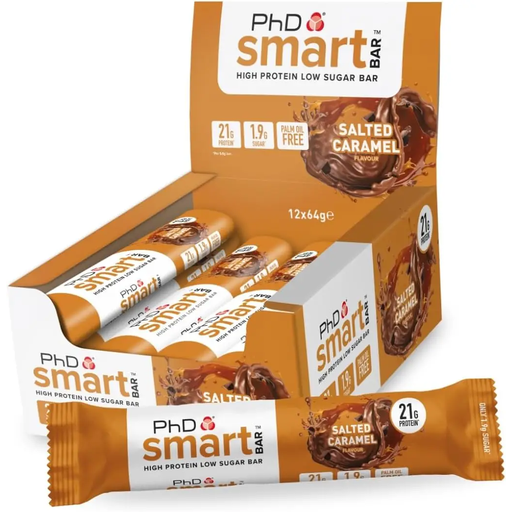
This 64 g Salted Caramel bar is an option to assess for a post-training or between-meal snack. Confirm this variant’s nutrition, ingredients and vegan status on its own pack rather than applying details from another PhD bar.
 No image available
A 60 g bar to compare with smaller servings when choosing a snack. Check its own whole-bar calories, carbohydrate and ingredients; the Caramel Chaos figures elsewhere in this article describe a different Grenade product.
Do not assume it can. UK Sports Institute guidance says longer and harder exercise calls for more carbohydrate; choose and practise a carbohydrate-focused fuelling plan for long runs instead of relying on a protein-led snack.
A bar can be a portable snack after training or between meals. For recovery after intense or prolonged exercise, UK Sports Institute guidance describes carbohydrate and protein with fluids soon after exercise, followed by a meal; check whether the bar fits that broader plan.
Start with kcal per whole bar, then compare protein, carbohydrate, ingredients and serving size for the exact flavour. For example, Tesco lists TREK Choc Caramel at 159 kcal per 44 g bar, while PhD lists Smart Bar Choc Brownie at 250 kcal per 64 g bar; those figures describe different products, not a market-wide ranking.
Yes. Check the ingredients and allergen information on the exact product and pack you intend to use; a brand name or range description does not establish what every flavour contains.
Try the exact bar during ordinary training rather than introducing it immediately before a race or key long run. Some bars contain polyols, and Barebells warns that excessive consumption of its Soft Salted Peanut Caramel bar may have laxative effects.