Calorie-conscious casual 5k runners
You want a snack that fits your calorie plans, while recognising that a lower-calorie protein bar is not necessarily the carbohydrate-focused snack you want just before running.


A low-calorie protein bar makes more sense as a portable snack after a 5k or between meals than as an automatic choice immediately before running. University College London Hospitals NHS Foundation Trust advises carbohydrate and protein with minimal fat for a snack 60–90 minutes before training, but faster-acting carbohydrate when only 15–30 minutes remain. Compare the whole bar’s nutrition with your timing and usual meal pattern rather than choosing by its protein claim alone.
You want a snack that fits your calorie plans, while recognising that a lower-calorie protein bar is not necessarily the carbohydrate-focused snack you want just before running.
You are comparing bars for their protein contribution and convenience, rather than expecting one to serve as immediate pre-run fuel.
You need to check the exact flavour for allergens, dietary suitability and ingredients such as polyols, particularly if you plan to eat it near a run.
Start with when you will eat, then compare nutrition per whole bar and check the exact flavour’s ingredients.
| Priority | What to check | Your needs |
|---|---|---|
| Timing and carbohydrate | Check carbohydrate per bar and how long remains before running. University College London Hospitals NHS Foundation Trust advises carbohydrate and protein with minimal fat at 60–90 minutes, or faster-acting carbohydrate at 15–30 minutes. | If I am eating shortly before the start, I want a snack chosen for that timing rather than for its protein claim. If I ate recently, I will consider whether I need another snack at all. |
| Calories and protein | Compare energy and protein per whole bar, not just per 100 g or the front-of-pack wording. Myprotein UK lists 92 kcal and 4.8 g protein for its 30 g Cereal Bar, while its Lean Layered Bar has fewer than 140 calories and 15 g protein; check the exact flavour. | I want to know whether a lighter snack or a larger protein contribution matters more for this occasion. |
| Polyols and fat | Read the polyol ingredients, amount where stated, serving size and fat per bar. The NHS notes that some polyols can have a laxative effect in large amounts; University College London Hospitals NHS Foundation Trust advises minimal fat for a snack 60–90 minutes before training. | Close to a run, I would rather use a bar I already know agrees with me than try an unfamiliar flavour. |
| Dietary fit | Check the current pack’s ingredients, allergen statement and any vegan claim for the precise flavour. A vegan label does not establish that a bar is free from soya or peanuts. | If I avoid particular ingredients, I need the individual bar to meet that requirement; the brand name alone is not enough. |
Tesco lists its 60 g Grenade OREO Protein Bar at 233 kcal, 10 g fat and 17 g polyols despite its low-sugar positioning. A sugar claim alone does not tell you whether its nutrition suits your planned snack.
Compare energy, carbohydrate, protein, fat and polyols per whole bar. If only 15–30 minutes remain before running, consider the faster-acting carbohydrate advised by University College London Hospitals NHS Foundation Trust instead.
Myprotein UK lists 4.8 g protein in its 92 kcal Cereal Bar, compared with 15 g in its Lean Layered Bar at fewer than 140 calories. These are different snack choices, not interchangeable protein servings.
Decide whether calories, protein or pre-run carbohydrate matters for this particular snack, then compare the exact flavours per bar.
The NHS says some polyols can have a laxative effect in large amounts. Individual tolerance matters when deciding whether to eat a polyol-containing bar near a run.
Check the ingredients and try the exact product and portion during ordinary training before relying on it near an event.
Ingredient lists differ between products: Tesco’s Grenade OREO listing identifies milk, soya and wheat ingredients and a possible-nuts warning, while PhD’s vegan Smart Plant Vanilla Fudge lists soya and peanut paste.
Read the current ingredient and allergen statement whenever you change product line or flavour.
These examples illustrate differences between particular bars and ranges; a brand name alone does not establish the nutrition or ingredients of another flavour.
Its UK product pages include bars with different calorie and protein amounts.
Tesco’s listing for the 60 g OREO Protein Bar provides an example where protein and low sugar take precedence over minimising calories.
Its Smart Bar and Smart Plant ranges include conventional and vegan-labelled variants.
Its UK Cookies & Cream product page describes a confectionery-style protein bar.
Quest describes dairy-based protein bars that contain sugar alcohols.
Its protein-bar category brings together different bar formats and brands.
These Grenade multipacks are options for a protein-containing snack after a 5k or between meals. Check each flavour’s current per-bar nutrition and ingredients if your main aim is a lower-calorie snack; a protein bar is not automatically the right choice immediately before running.
 No image available
A multipack to consider for an after-run or between-meal protein snack. Check the Double Chocolate pack’s per-bar calories, carbohydrate and polyols before deciding whether it also suits your plans around a run; check the milk and soya allergen information.
 No image available
This Golden Caramel multipack is another choice for a protein-containing snack away from the start of a run. Compare its own per-bar nutrition rather than assuming it matches Double Chocolate, and check the pack for polyols, milk and soya.
 No image available
For a between-meal or after-run snack, compare this flavour’s per-bar calories and carbohydrate with your intended use. The Peanut Butter variant requires particular attention to its peanut, milk and soya ingredients; check the pack for polyols too.
 No image available
This is a protein-focused alternative when minimising calories is not the main priority. Tesco lists the 60 g Grenade OREO bar at 233 kcal, 21 g protein and 17 g polyols per bar; check the current pack’s nutrition and allergen statement before use near a run.
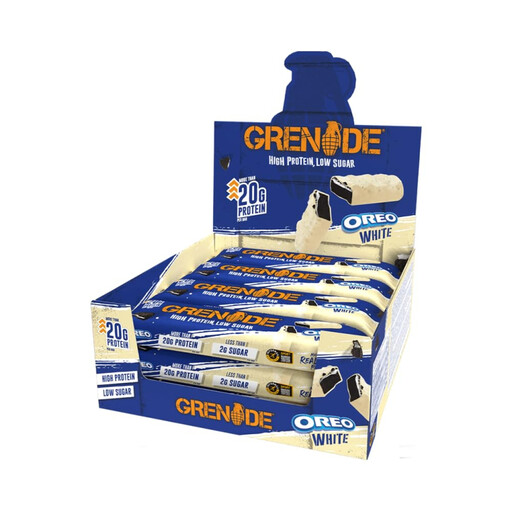 No image available
Consider this multipack if you want a protein-bar snack after running or between meals. Check the White OREO flavour’s own calories, carbohydrate and polyols per bar rather than applying the figures for OREO Flavour; also read its milk, soya and wheat allergen information.
Not automatically: University College London Hospitals NHS Foundation Trust advises faster-acting carbohydrate for a snack 15–30 minutes before exercise. At 60–90 minutes, its guidance calls for carbohydrate and protein with minimal fat. Check the bar’s nutrition and your usual tolerance rather than assuming its protein or low-sugar claim makes it suitable for either window.
Compare calories per complete bar alongside protein and carbohydrate, rather than treating “low calorie” as a fixed amount for every snack. Myprotein UK lists 92 kcal and 4.8 g protein for its cited Cereal Bar, fewer than 140 calories and 15 g protein for Lean Layered, and 152 kcal and 18 g protein for its cited Lean Protein Bar; check the exact flavour before buying.
Some polyols can have a laxative effect when consumed in large amounts, according to the NHS, so check a bar’s ingredients and portion if tolerance is a concern. Tesco lists 17 g polyols in its 60 g Grenade OREO bar. Try an unfamiliar product during ordinary training rather than immediately before an event.
No. Read the current ingredients and allergen statement for the exact flavour and pack. Tesco’s Grenade OREO listing identifies milk, soya and wheat ingredients and says the bar may contain nuts; PhD labels Smart Plant Vanilla Fudge vegan, but its ingredients include soya and peanut paste.
Follow your individual glucose-management plan rather than a general protein-bar rule. University College London Hospitals NHS Foundation Trust says exercise snack needs can depend on glucose level and trend, insulin on board, and the type and duration of activity; discuss your circumstances with your diabetes team.