Calorie-conscious revisers
If you plan to eat a complete bar at your desk, its kcal per bar is more useful for that decision than a prominent protein or sugar claim. Check the serving size as well as the energy figure.


For a calorie-conscious revision snack, compare the energy value for the whole bar before choosing by protein or sugar claims. Tesco lists 206 kcal and 20 g protein for a 60 g Myprotein Cookie Crumble bar, while PhD lists 238 calories for a Smart Protein Bar; check the exact flavour and pack label, including ingredients and warnings, before treating either figure as the right choice for you.
If you plan to eat a complete bar at your desk, its kcal per bar is more useful for that decision than a prominent protein or sugar claim. Check the serving size as well as the energy figure.
A portable bar may be convenient between study sessions or around training. Compare its protein contribution with its energy and other nutrition information rather than judging it by protein alone.
Allergen declarations, precautionary statements and polyol warnings can determine whether a bar is suitable for you, regardless of its calorie figure. Read them for the exact flavour you intend to buy.
Start with the portion you would actually eat, then compare its nutrition information and check the ingredients before ordering a multipack.
| Priority | What to check | Your needs |
|---|---|---|
| Energy per bar | Read kcal for the complete bar and its stated weight. If bar sizes differ, distinguish the per-bar figure from the per-100 g figure. | I plan to eat one whole bar during revision, so I want to compare the energy in that portion rather than rely on a per-100 g figure. |
| Protein and sugars | Compare protein and sugars on the same per-bar basis as energy. Check the nutrition panel for the exact flavour; a low-sugar or no-added-sugar claim does not state its calorie value. | Protein matters to me, but I also want to know the calories and sugars in the bar I would buy. |
| Ingredients and warnings | Read the highlighted allergens, any “may contain” statement and any polyol warning. Check the ingredients if you follow a particular diet. | Before I keep a multipack at my desk, I need to know whether its ingredients and warnings fit my requirements. |
| Pack format | Confirm the flavour, bar weight and number of bars in a multipack. Recheck the current product listing before ordering. | I want individually portioned snacks, but the pack needs to contain the flavour and bar size I meant to choose. |
Sugar information does not tell you the energy value of a whole bar, which is the portion you may eat during a break.
Compare kcal per complete bar first, then use the same serving basis to assess protein and sugars.
Some low-sugar bars contain polyols. GOV.UK food-warning guidance specifies a laxative-effect warning when a product contains over 10% polyols; Grenade’s Salted Caramel product page carries a warning about excessive consumption.
Read the warning on your chosen flavour, particularly if you plan to eat bars repeatedly during a long study session.
A favourable protein figure does not settle whether a bar fits an allergy or dietary restriction. Ingredients and precautionary allergen statements can differ between products.
Check the exact pack’s ingredients, highlighted allergens and “may contain” wording before ordering several bars.
The flavour, pack format and availability shown on a retailer listing may change between choosing a product and placing an order.
Confirm the current flavour, bar count and availability on the product page before checkout.
These references help you compare particular bars and labels; a brand name alone does not establish a calorie value for every flavour.
Its Layered Protein Bar range includes the Cookie Crumble 60 g bar listed by Tesco.
PhD describes its Smart Protein Bar range as a protein snack with less than 2.5 g sugar per bar.
Grenade’s Salted Caramel bar is one example in its dessert-style protein-bar range.
Barebells describes its Cookies & Cream bar as containing 20 g protein with no added sugar.
Quest publishes nutrition information for its S'Mores bar on a US-market product page.
Tesco is a retailer rather than a protein-bar manufacturer. Its product listings can be used to inspect named flavours and their stated serving information.
These Joybuy listings are multipacks of Grenade and PhD bars to consider for individually portioned revision snacks. Compare the nutrition label for each named flavour rather than applying figures from another bar in the same range.
 No image available
The 50 g bar format makes the portion clear for a revision break. Check this flavour’s kcal and protein per bar, along with its allergen information and any polyol warning, before choosing the 12-bar pack.
 No image available
This pack contains 50 g bars for portion-by-portion comparison. Read the Golden Caramel label for energy and protein per bar, and check its ingredients and polyol warning if those affect your choice.
 No image available
If you are considering this 50 g bar as a desk snack, compare its whole-bar energy and protein figures with other flavours. Check the Peanut Butter pack’s peanut and other allergen declarations, plus any polyol warning, before ordering twelve.
 No image available
These 60 g bars come in a four-pack. Because the bar size differs from the 50 g Soft Core packs above, compare kcal per complete bar as well as protein, and read the Oreo Flavour ingredients and warnings.
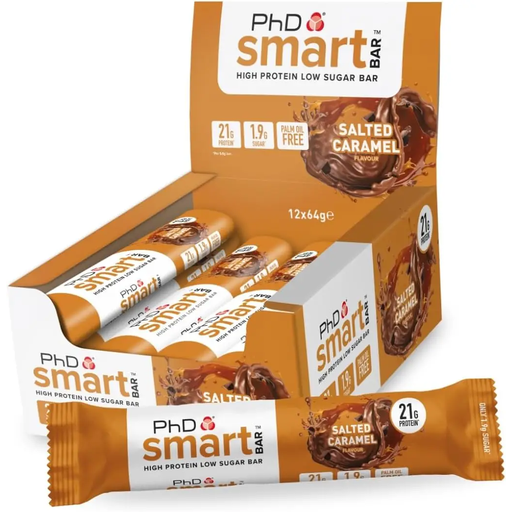 No image available
This is a 12-pack of 64 g Salted Caramel bars. Use this flavour’s own per-bar nutrition label when comparing it with the PhD range-page figures or smaller bars, and check its allergen and polyol information.
Compare kcal per whole bar first, then protein and other nutrition values for that same portion. Tesco lists 206 kcal and 20 g protein for a 60 g Myprotein Cookie Crumble bar; PhD lists 238 calories for a Smart Protein Bar. Check the exact flavour’s label before using either figure to make a purchase decision.
No: a sugar claim does not give the bar’s energy value. PhD’s Smart Bar page, for example, states less than 2.5 g sugar per bar and gives a separate figure of 238 calories. Read both figures for the particular bar you plan to eat.
Read the exact bar’s ingredient list, highlighted allergens and any “may contain” statement before buying. GOV.UK guidance says allergens must be highlighted in the ingredients list; do not assume that different flavours or brands use the same ingredients.
Some bars contain polyols. GOV.UK food-warning guidance specifies a laxative-effect warning for products containing over 10% polyols, and Grenade’s Salted Caramel page carries a warning about excessive consumption. Read the warning on the exact pack you choose.
Grenade states that its Salted Caramel bar is not suitable for children under 14. Check the warning on the particular bar rather than assuming the statement applies to every protein bar.