Parents adding a small snack
A bar may fit alongside a main lunch item, rather than taking its place. Check the calories for one complete bar and whether its ingredients fit the child’s needs and the school’s policy.


A protein bar can be an optional snack in a school packed lunch, but it should not replace the main lunch item: NHS lunchbox guidance recommends building that item around foods such as bread, rice, pasta or potatoes. If a smaller snack is the aim, compare calories for the whole bar rather than relying on a low-sugar or high-protein claim, then check the ingredients, allergens and the school’s packed-lunch policy.
A bar may fit alongside a main lunch item, rather than taking its place. Check the calories for one complete bar and whether its ingredients fit the child’s needs and the school’s policy.
A low-sugar claim does not tell you the calories for the whole bar. Compare serving size and the nutrition panel, including sugars and polyols, for the exact flavour you intend to pack.
Milk, soy, peanuts, other nuts, gluten-related ingredients and gelatine may affect the choice. Read the current wrapper, including any may-contain statement, and check the school’s packed-lunch rules.
Start with the lunch as a whole, then compare bars by their complete serving and screen the exact product against dietary needs and school rules.
| Priority | What to check | Your needs |
|---|---|---|
| The main lunch | Plan the main item before adding a bar. NHS lunchbox guidance suggests a base such as bread, rice, pasta or potatoes; consider fruit or vegetables and other lunch components too. | I want a snack that fits alongside lunch, not a protein claim standing in for the meal. |
| Whole-bar calories | Compare kcal per complete bar and its weight, not just a per-100 g figure. Myprotein UK lists 96 kcal per 30 g Crispy Square; Tesco lists 129 kcal per 35 g Grenade Salted Caramel bar. | If I am looking for a smaller snack, the amount in the bar I will actually pack matters more than its front-of-pack wording. |
| Sugars and polyols | Read the sugars and polyols lines separately. Tesco lists 0.8 g sugars and 11 g polyols per 35 g Grenade Salted Caramel bar; a low sugars figure does not describe all its ingredients. | I want to understand what is in a low-sugar bar before putting it in a lunchbox. |
| Ingredients and school rules | Check the exact flavour’s ingredients, declared allergens and may-contain statements on the wrapper. Confirm the school’s current packed-lunch policy, including any restrictions concerning nuts. | A bar needs to fit the child’s dietary requirements and the rules at their school, even if its serving size suits the lunch. |
Low sugar does not establish that a full-size bar is low in calories. PhD lists 238 kcal for its 64 g Cookies & Cream Smart Bar, while Myprotein UK lists 96 kcal for a 30 g Crispy Square.
Compare kcal, sugars, polyols, protein and weight for the complete serving you intend to pack.
Protein content alone does not supply the variety described in NHS lunchbox guidance or the Department for Education’s guidance on a balanced diet.
Choose the main lunch item and other components first; consider a bar only as an addition that fits the finished lunch.
Polyols have their own place in the carbohydrate breakdown. Tesco lists 11 g per 35 g Grenade Salted Caramel bar, while PhD lists 20 g per 64 g Cookies & Cream Smart Bar.
Read the current nutrition panel, ingredients and any pack warning rather than using the sugars figure as a summary of the bar.
Allergen and may-contain statements differ between products, and the bar being packed must meet both the child’s requirements and the school’s policy.
Check the physical wrapper for the exact flavour before packing it, and confirm the school’s current rules.
These named products illustrate differences in serving size and labels; a brand’s inclusion does not establish that every product it sells suits a school lunch.
The Crispy Square Protein Snack is a 30 g snack-format square rather than a full-size bar.
The Salted Caramel 35 g bar provides a small-bar comparison with a different protein amount.
Cookies & Cream is a 55 g bar for comparing a larger serving with smaller snack formats.
The 64 g Cookies & Cream Smart Bar shows why a sugars figure and a calorie figure need separate checks.
Tesco’s protein-bar listings provide examples of differing pack and bar sizes, not a single nutritional standard for the category.
These peanut-based multipacks are options to assess against the lunchbox criteria above. Check calories per individual bar on the current pack, and do not pack either where peanuts conflict with the child’s needs or the school’s policy.
 No image available
This peanut bar needs an ingredients and school-policy check before it goes in a packed lunch. The pack contains four 40 g bars; compare the nutrition information for one bar when judging snack size.
 No image available
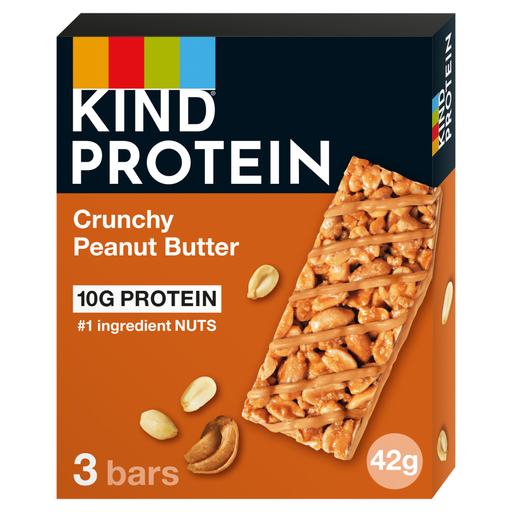
Check whether a peanut-based bar is permitted at school and suitable for the child before considering this multipack. It contains three 42 g bars; use the per-bar label figures, rather than the multipack weight, to compare servings.
No: treat it as an optional snack, not the main lunch item. NHS lunchbox guidance recommends basing that item on foods such as bread, rice, pasta or potatoes, with other lunch components alongside it.
No. PhD lists 238 kcal for a 64 g Cookies & Cream Smart Bar despite its low-sugar positioning, while Myprotein UK lists 96 kcal for a 30 g Crispy Square. Compare the calories, sugars, polyols and weight of each complete serving.
Read the ingredients and any separate polyols figure as well as total sugars. For example, Tesco lists 11 g polyols per 35 g Grenade Salted Caramel bar; the sugars figure alone does not describe that ingredient choice.
Only if it meets the child’s dietary needs and the individual school’s packed-lunch policy. Check the current wrapper for declared allergens and may-contain statements, then confirm the school’s rules before packing it.
No. The NHS distinguishes free sugars from naturally occurring sugars in milk, fruit and vegetables. Read the nutrition panel and ingredients together rather than treating the pack’s total-sugars figure as a free-sugars figure.