Cooking curry, soup or sauce for one
If your recipe uses close to 200ml, a small culinary can may avoid leaving much of a 400ml can to store. Check the quantity your recipe actually calls for.


For a single curry, soup or sauce, choose culinary coconut milk labelled light or reduced fat, then compare fat and saturates on the nutrition panel and consider how much the recipe uses. A 200ml can may leave less unused milk if the recipe needs roughly that amount; a 400ml can makes more sense when you can use the remainder within its storage instructions. A coconut drink is a different product type, not an automatic substitute for canned cooking milk.
If your recipe uses close to 200ml, a small culinary can may avoid leaving much of a 400ml can to store. Check the quantity your recipe actually calls for.
A light or reduced-fat description does not tell you how much saturated fat your portion contains. Compare the nutrition panels and the quantity you will add.
Check which type a recipe calls for before picking a beverage-style coconut drink in place of culinary coconut milk.
Start with the product type and recipe quantity, then compare nutrition labels on a consistent basis and check what happens to any remainder.
| Priority | What to check | Your needs |
|---|---|---|
| Cooking product | Check whether the pack is culinary coconut milk or a coconut drink. Follow the recipe if it specifies one type. | For my curry or soup, I want the type of coconut milk the recipe calls for, not a drink chosen solely for its fat figure. |
| Fat and saturates | Compare fat and saturates per 100ml between liquid-labelled products, or per 100g between weight-labelled products. Account for the amount used; do not treat the two bases as identical. | A reduced-fat label alone will not tell me how much fat and saturates go into my serving. |
| Pack size | Match 200ml or 400ml to the recipe quantity. Check the pack’s instructions for refrigerating and using any remainder. | If I cook for one, I would rather buy an amount I can use than open a larger can without a plan for it. |
Tesco Groceries lists Kingfisher Oriental Light Coconut Milk at 8.0g fat and 6.3g saturates per 100ml. Using the full 200ml can doubles those amounts from the coconut milk.
Read the nutrition panel and work from the quantity your recipe uses, rather than the front-of-pack description.
Opened-pack instructions differ: Marks & Spencer says to transfer unused contents to a non-metallic container, refrigerate and eat within 2 days; Sainsbury’s says to refrigerate its light coconut milk and use it within 3 days.
Choose a smaller pack when it matches your recipe, or plan when you will use the remainder and follow the instructions on your can.
Unused coconut milk may go to waste if you cannot use it within the pack’s storage period.
Alpro Coconut Original and Koko Original Like Milk are presented as milk alternatives. A recipe expecting culinary coconut milk may turn out differently with a drink.
Check the recipe and product type before substituting; do not decide by the fat figure alone.
A value per 100ml and one per 100g are not the same measurement basis. Whole-pack and per-serving figures can also conceal how much you will actually use.
Compare like-for-like declarations where possible, then check the recipe amount against the chosen pack.
These examples illustrate product types and label checks; brand inclusion does not imply that every product in its range has the same nutrition or storage instructions.
Tesco Groceries lists its own light coconut milk alongside other culinary options, including a 200ml Kingfisher light can.
Sainsbury’s lists a 400ml light coconut milk for cooking.
Waitrose lists Essential Reduced Fat Coconut Milk in a 400ml pack.
Marks & Spencer lists standard and reduced-fat coconut milk on the same per-100g nutrition basis.
Koko sells both a resealable Cuisine coconut milk for cooking and a separate coconut drink.
Alpro describes Coconut Original as a plant-based drink rather than canned culinary coconut milk.
This 400ml reduced-fat culinary coconut milk is an option for a one-person curry, soup or sauce when you can plan for any remainder.
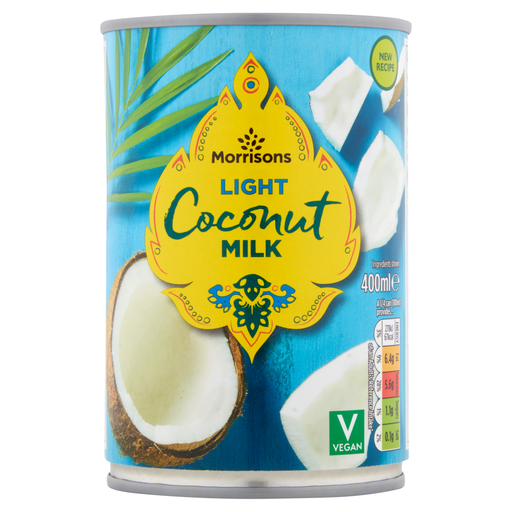 Image unavailable
A culinary coconut milk for a curry, soup or sauce; the 400ml can may leave some for another meal when cooking one portion. Follow the pack’s instructions for storing the remainder, and check its current nutrition panel for fat and saturates.
No. Check saturates on the nutrition panel and how much you will use. Marks & Spencer lists 8.2g saturates per 100g for its Reduced Fat Coconut Milk; a reduced-fat description does not replace checking the portion added to your meal.
Choose the size that fits your recipe and plans for the remainder. A 200ml can is convenient when the dish uses roughly that amount; with a 400ml can, check the product’s opened-pack storage instructions before planning another meal.
Use one if the recipe calls for a beverage-style milk alternative or you are willing to change the result. Alpro and Koko describe their coconut drinks as milk alternatives, while culinary coconut milk serves a different role in curries and soups.
Compare fat and saturates on the same per-100ml or per-100g basis for like-for-like products, then consider the amount going into the recipe. GOV.UK explains that front-of-pack traffic-light labels can also show fat, saturates, sugars and salt at a glance.