Shoppers who want separate packs
Two-biscuit packs can be easier to put in a lunch box or set aside for a snack. Check the fat in the biscuits you plan to eat as well as the packaging format.


Choose Schär custard creams if separate two-biscuit packs are the priority, but do not mistake the wrapping for a low-fat biscuit: Schär states 19 g fat per 100 g, compared with the NHS food-label guideline of 3 g or less per 100 g for low total fat. If separate packs are unnecessary, compare the fat per 100 g on standard packets and work out the amount in the serving you intend to eat. A prescribed fat limit calls for your care team’s advice, not a judgement based on pack size.
Two-biscuit packs can be easier to put in a lunch box or set aside for a snack. Check the fat in the biscuits you plan to eat as well as the packaging format.
A standard packet may suit you if you can divide it yourself. Compare fat per 100 g before using per-biscuit figures, which can reflect different biscuit sizes.
If a healthcare professional has given you a specific limit, use that advice when assessing a biscuit portion. Separate wrapping does not establish whether it fits your plan.
Start with the fat figure for the biscuit, then check how many biscuits come in each inner pack and how much you expect to eat.
| Priority | What to check | Your needs |
|---|---|---|
| Fat per 100 g | Compare total fat on the same per-100 g basis. NHS food-label guidance puts low total fat at 3 g or less per 100 g; Schär states 19 g per 100 g for its portion-packed custard creams. | I want to know whether the biscuit itself meets a low-fat label guideline, rather than judging it by the size of its wrapper. |
| Intended serving | Check the weight of the biscuits you will eat alongside the per-100 g figure. Use that weight to calculate the fat in your serving; per-biscuit figures alone are not a like-for-like comparison across different biscuits. | A smaller serving may matter to me even when the biscuits are not low fat per 100 g. |
| Separate packs | Check the number of inner packs and biscuits in each. Asda describes Schär’s 125 g format as five individual packs containing two biscuits each; a standard outer packet is a different format. | I need biscuits already divided for carrying or for setting aside one pack at a time. |
| Other dietary requirements | Check ingredients and allergen information on the pack received. Schär describes its custard creams as gluten-free and vegan; neither description tells you their fat content. | If I have another dietary requirement, I need to check it separately from the fat figure. |
Schär’s separate packs contain biscuits stated at 19 g fat per 100 g. The wrapping defines a portion; it does not change the biscuit’s fat concentration.
Read the fat-per-100 g figure when assessing a low-fat description, then consider the amount you intend to eat.
Biscuits and labelled serving sizes can differ, so a per-biscuit figure may not compare equal amounts of food.
Compare per 100 g first, then use the weight of your planned serving to work out its fat content.
Schär’s gluten-free and vegan descriptions address different requirements from total fat; the product states 19 g fat per 100 g.
Check each requirement separately, including the ingredients and nutrition information on the pack received.
These examples distinguish separate portions from standard packets; the figures apply to the particular products named, not every biscuit a brand makes.
A custard cream option for shoppers who need separate packs.
A standard custard cream packet for shoppers who do not need separate wrapping.
A standard 400 g custard cream packet, rather than a stated portion-pack format.
Its own-label standard custard creams are distinct from the Schär portion packs listed by Asda.
A branded standard-packet example for comparing nutrition labels.
Its 165 g Extra Cream Custard Creams are a different formulation to consider if the biscuit style matters to you.
Its Tasties Custard Creams listing describes a 300 g packet.
This Schär option addresses the separate-pack part of the custard cream decision. Check its fat figure independently of the packaging when shopping for a low-fat diet.
 No image available
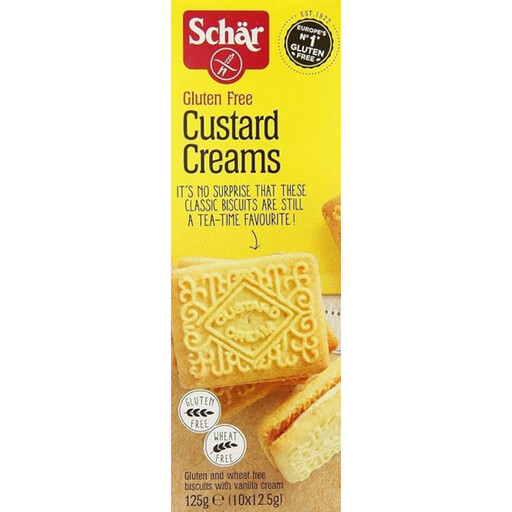
The separate portions suit a snack you want to carry or set aside: Asda describes this 125 g format as five packs of two biscuits. Schär states 19 g fat per 100 g, so do not treat the portion packaging as a low-fat claim. Check the ingredients on the pack if the gluten-free formulation or other dietary requirements matter to you.
No. The NHS low-total-fat food-label guideline is based on fat per 100 g, not biscuits per wrapper: it is 3 g or less per 100 g. Schär states 19 g fat per 100 g for its portion-packed custard creams.
Compare total fat per 100 g first. Then use the weight of the biscuits you expect to eat to work out the fat in that serving; a per-biscuit figure alone may describe a different-sized biscuit.
Follow the instructions on the pack you buy. The checked Tesco and Sainsbury’s custard cream listings advise airtight storage after opening, so dividing a standard packet into servings does not remove the need to store the remainder as directed.
No. A two-biscuit wrapper does not determine whether its contents fit an individual prescribed limit. Oxford University Hospitals NHS Foundation Trust directs its minimal-fat-diet guidance at people given a specific limit by a healthcare professional; use the advice given to you when assessing a portion.