One- or two-person dessert shoppers
If custard is for one evening, a ready-to-serve pack with a manageable serving suggestion may be more useful than a larger carton. ASDA Groceries suggests two servings for its 400g Light Custard tin.


For custard with one or two TV-dinner desserts, a 400g low-fat tin is a practical starting point; consider a larger ready-to-serve carton if you expect to use several portions and can store leftovers as its label directs. Compare the nutrition per 100g as well as the pack size: ASDA Groceries lists 1.6g fat but 8.3g sugars per 100g for its Light Custard tin, so a lower-fat label does not settle every part of the choice.
If custard is for one evening, a ready-to-serve pack with a manageable serving suggestion may be more useful than a larger carton. ASDA Groceries suggests two servings for its 400g Light Custard tin.
If these are your main considerations, compare the per-100g figures on the exact product rather than relying on the word “light”. The NHS gives separate food-label thresholds for total fat and saturated fat.
A larger pack may suit custard served across more than one meal, provided its contents can be used in line with the opened-pack instructions. Tesco Groceries lists reduced-fat own-label cartons in 500g and 1kg sizes.
Start with the nutrient you want to compare, then decide how much custard you will serve and whether the remaining pack will be used.
| Concern | What to check | Who this matters to |
|---|---|---|
| Fat and saturates | Compare both figures per 100g on the exact tin or carton. The NHS defines low fat for foods as no more than 3g fat per 100g and low saturated fat as no more than 1.5g saturates per 100g. | If fat is my main consideration, I want to compare custards on the same per-100g basis before deciding how much to serve. About 36% of consumers put fat and saturates first. |
| Pack size and leftovers | Check the net weight, suggested servings and storage instructions after opening. | For dessert with one other person, I would rather choose a pack that fits the evening than leave much of it unused. About 29% of consumers prioritise portion fit and avoiding leftovers. |
| Sugars and energy | Read sugars and kcal per 100g separately from fat, then consider the amount you will pour. The NHS defines low sugars for foods as no more than 5g per 100g. | A reduced-fat label would not answer my questions about sugars or energy. Roughly 21% of consumers make checking those figures their primary concern. |
| Repeat servings | Consider a larger pack only if you expect to use several portions and can follow its opened-pack storage directions. | When custard is planned for more than one meal, I want enough in the pack without committing to a tin for each serving. Around 14% of consumers put flexibility for repeat servings first. |
A lower fat figure does not establish a lower sugars figure. ASDA Groceries lists 1.6g fat and 8.3g sugars per 100g for its Light Custard tin, compared with 1.4g fat and 12g sugars per 100g for its 30% Less Fat carton.
Read fat, saturates, sugars and energy as separate entries on the nutrition panel.
ASDA Groceries suggests two servings for its 400g Light Custard tin and four portions for its 500g 30% Less Fat carton. Their stated portions are therefore not the same size.
Compare the per-100g figures first, then use the amount you intend to serve to judge your portion.
A carton intended for several servings may leave more custard than one or two diners want that evening.
Check the serving information and opened-pack storage directions before choosing the larger format.
Custard left unused beyond the pack’s storage instructions may have to be discarded.
The Bird's example identified by Premier Foodservice is a ready-to-serve 12 × 1kg format, while the M&S examples are whole-milk or luxury custards. Neither is a like-for-like example of a low-fat tin.
Check the precise product name, format and nutrition panel rather than using the brand alone to make the comparison.
A ready-to-serve option when you want to compare a branded low-fat tin with light custard in other pack formats.
Own-label ready-to-serve options in both tinned and carton formats.
An own-label carton range to consider if you expect to use custard over several servings.
A reference point if a larger ready-to-serve format is also under consideration.
A contrasting custard range rather than a direct example of low-fat tinned custard.
These ready-to-serve custards cover different TV-dinner plans: a larger Ambrosia pack for repeat servings, a 500g Morrisons option and a 400g Ambrosia low-fat tin. Check each pack’s nutrition and serving information when comparing them.
 Image unavailable
Consider this 1kg pack if you expect to serve custard more than once. For a single TV dinner, decide how you would use and store the remainder, and check the exact pack’s nutrition panel before comparing it with a tin.
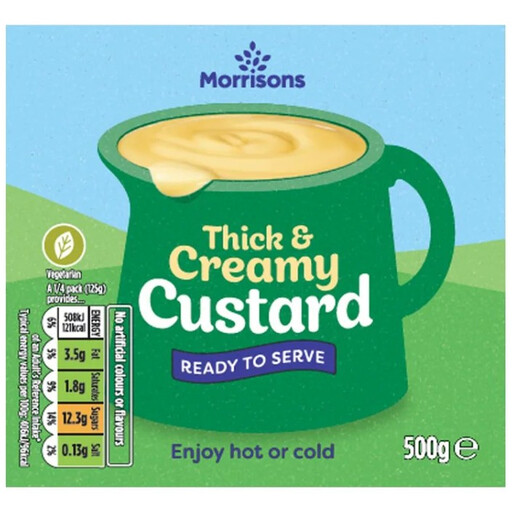 Image unavailable
This 500g ready-to-serve option is described as a tub rather than a tin. If low fat is your priority, compare its current per-100g panel with the tinned options and follow the pack’s directions for any custard left after dinner.
 Image unavailable
This 400g low-fat can fits the tinned format at the centre of the TV-dinner choice. Check its own per-100g fat, saturates and sugars figures and its serving guidance before comparing it with another custard.
No. The NHS sets a separate low-sugars threshold for foods of 5g or less per 100g. ASDA Groceries lists 8.3g sugars per 100g for its Light Custard tin and 12g per 100g for its 30% Less Fat carton, so check sugars independently of fat.
Use the fat figures per 100g on both packs before looking at serving figures. The NHS defines low fat for foods as 3g or less per 100g and low saturated fat as 1.5g saturates or less per 100g; a pack’s suggested serving may differ from the amount you use.
Do not assume that a low-fat custard is milk-free. ASDA Groceries identifies milk in its cited custards, and Premier Foodservice lists milk as an allergen in Bird's ready-to-serve custard. Check the current allergen statement on the exact product before choosing it.
A 400g tin is a practical choice when one or two people want custard that evening; ASDA Groceries suggests two servings for its Light Custard tin. Choose a larger carton when you expect to use several portions and can follow its opened-pack storage instructions.
Use it as a starting point, then read the per-100g nutrition panel and serving information. The Food Standards Agency reports that consumers use traffic-light labels to assess nutrients including fat and sugar; checking the full panel also lets you compare custards with different suggested portion sizes.