What matters when comparing meals?
Compare the nutrition information first, then consider the portion and whether the meal can be stored and prepared as directed.
| Priority |
What to check |
Your needs |
| Total fat |
Read total fat per 100g, then the amount for the prepared pack. NHS food-label guidance defines low fat as 3g or less per 100g; a calorie-controlled name does not establish the fat content. |
I’m choosing a lower-fat meal and want to compare packs of different sizes on the same basis. |
| Salt and saturated fat |
Check both separately from total fat, using the per-100g and whole-pack figures. Tesco Groceries lists 1.07g salt for its prepared Chicken Curry and Rice pack and 1.34g for its prepared Calorie Controlled Lasagne pack. |
A lower total-fat figure alone does not answer my questions about salt or saturated fat in the meal I’ll serve. |
| Portion suitability |
Compare pack size, energy and protein information with the recipient’s appetite and any individual advice. NHS malnutrition guidance should take precedence over a generic reduced-fat goal when poor intake or weight loss is a concern. |
The person eating the meal has a poor appetite or has lost weight unintentionally, so I need individual advice before choosing by fat content. |
| Preparation |
Read the exact from-frozen directions, including the permitted appliance and any standing time. Check that the person serving the meal has the equipment and can complete the steps safely. |
A carer may prepare dinner, or the recipient may need to manage it independently. |
| Ingredients |
Check the delivered pack’s ingredients and highlighted allergens before serving. Tesco Groceries notes that reformulation can change ingredients, nutrition and allergen information. |
For an allergy or prescribed diet, I need the information on the pack that will actually be used. |
Which retailer ranges are relevant?
Retailer ranges can help narrow a search, but the nutrition panel on the exact frozen meal determines whether it meets a lower-fat goal.
Tesco
Tesco Groceries lists frozen Chicken Curry and Rice and Calorie Controlled Lasagne products with individual nutrition information.
- The listed total-fat values are 1.2g and 1.7g per 100g respectively. Both meet the NHS definition of low fat for foods.
- Their prepared-pack salt figures are 1.07g and 1.34g respectively. Check the current pack rather than treating either product name as a full nutrition assessment.
Iceland
Iceland has a frozen ready-meal range and describes its MyProtein range as including lower-fat meals.
- The frozen ready-meal category offers a starting point for comparing individual labels.
- Iceland’s description of a range does not establish the fat, salt, allergens or cooking method of every product in it.
Waitrose
Waitrose lists frozen ready meals, including 400g beef lasagne and cottage pie products.
- Individual frozen-meal listings provide products to assess for portion and preparation suitability.
- Use the exact product’s nutrition label to decide whether it fits a reduced-fat requirement.
M&S
M&S lists frozen ready meals and separately identifies Count on Us and Eat Well among its ready-meal lines.
- Its frozen-meal category provides a place to check individual products.
- Do not assume a product in a separately named ready-meal line is frozen or meets a reduced-fat target; check the exact pack.
Joybuy product options
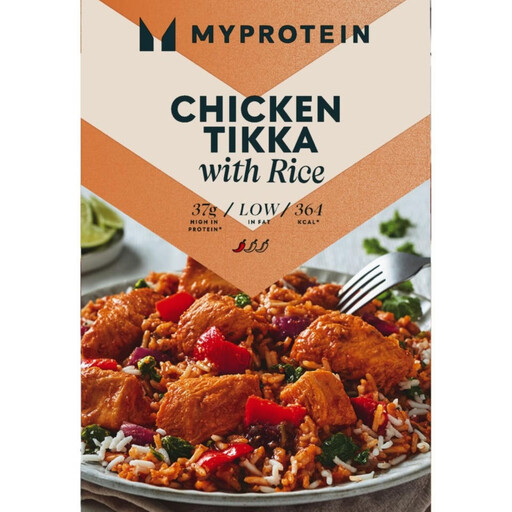
This 350g chicken tikka option is relevant to a frozen-meal routine. Compare its pack information with the recipient’s dietary needs and the way the meal will be prepared.
 No image available
Myprotein Chicken Tikka 350g
For a meals-on-wheels-style routine, check whether the 350g portion fits the recipient’s appetite and whether the person serving it can follow the pack’s heating instructions. Read the delivered pack’s nutrition and allergen information before serving.
View on Joybuy
Frequently asked questions
What counts as low fat on a frozen-meal label?
NHS food-label guidance defines low fat for foods as 3g total fat or less per 100g. Compare that figure between meals, then check the prepared-pack value to see how much fat is in the portion being served.
Does low fat also mean low salt?
No. Fat and salt need separate checks: Tesco Groceries lists 1.2g fat and 0.34g salt per 100g for its Chicken Curry and Rice, and 1.7g fat and 0.41g salt per 100g for its Calorie Controlled Lasagne. Check the whole-pack figures too when the full pack will be eaten.
Should someone with a poor appetite choose a reduced-fat meal?
Not as a default. NHS malnutrition guidance describes dietary approaches that may include fortified foods higher in calories and protein. If the person has a poor appetite, is losing weight unintentionally or may be malnourished, ask a GP, dietitian or care team for individual advice.
Can every frozen ready meal be microwaved?
Do not assume it can. Read the exact pack’s from-frozen instructions and check that the person preparing the meal has the required appliance and can follow every step.
Which allergen information should I use?
Use the ingredient and allergen declaration on the delivered pack before serving. Tesco Groceries notes that reformulation can change ingredients, nutrition information and allergens, so an earlier online listing should not replace the pack check.


