Retirement-shop buyers serving hot drinks
Buyers looking for water-prepared drinks with stated fat and saturates per mug, clear ingredients and a format that works for regular service.


For a retirement shop, compare hot chocolates using the fat and saturates in a serving prepared as directed, then consider sugars, ingredients and whether a jar or sachet suits the way drinks are served. Twinings lists 0.8g fat per water-prepared Options Belgian Choc sachet; Sainsbury’s and Tesco list 0.9g and 1.0g respectively for their water-prepared servings. The Malnutrition Task Force cautions that low-fat eating is not always appropriate for older people with a small appetite or unintentional weight loss.
Buyers looking for water-prepared drinks with stated fat and saturates per mug, clear ingredients and a format that works for regular service.
Customers who want to compare the drink as prepared, rather than the powder alone. A low-fat option is not automatically suitable for someone with a small appetite or unintentional weight loss, as the Malnutrition Task Force cautions.
Customers or carers choosing between a measured sachet and a jar, or checking milk, barley and sweetener information before a drink is bought or served.
Start with figures for each drink made as directed; then choose a format and check the current pack for ingredients.
| Priority | What to check | Your needs |
|---|---|---|
| Nutrition labels | Compare fat, saturates, sugars and energy per stated water-prepared serving. Check whether any other figure describes powder or the finished drink. | I want figures I can compare before choosing a drink. In a Northern Ireland survey of 611 people interviewed from September to November 2024, the Food Standards Agency and Ipsos Northern Ireland reported that 49% actively used traffic-light labelling when shopping for food; this was not a hot-chocolate-specific measure. |
| Individual suitability | Consider the drink within the person’s wider food intake. A medically prescribed very-low-fat diet needs individual clinical guidance, not a choice based on the front of a pack. | For someone with a small appetite or unintentional weight loss, I would not assume a lower-fat drink is the right choice. The Malnutrition Task Force cautions that low-fat eating is not always recommended in those circumstances. |
| Ingredients | Read the current pack for milk and cereals containing gluten. Check sweetener and phenylalanine statements where relevant; Ovaltine Light contains barley, while Twinings lists a phenylalanine statement for Options Belgian Choc sachets. | Before serving a drink, I need to know which ingredients matter to the customer, rather than assuming that “low fat” means dairy-free or gluten-free. |
| Serving format | Check the stated powder quantity and water volume. Compare a jar’s preparation directions with an individually measured sachet, then check the current pack and local stock. | A jar may fit routine preparation, while a sachet gives me a measured portion for one drink. Either way, staff need directions they can follow consistently. |
Labels can emphasise different measures. Tesco Groceries lists 1.3g fat and 3.1g sugars for a water-prepared serving of Galaxy Light; Twinings lists 0.8g fat and 5.7g sugars for its water-prepared Options Belgian Choc sachet.
Compare fat, saturates, sugars and energy on each product’s stated preparation basis, choosing the figures relevant to the shop’s purpose.
The Malnutrition Task Force cautions that low-fat eating is not always recommended for people with a small appetite or unintentional weight loss.
Offer a low-fat choice without presenting it as suitable for everyone. Leave individual dietary concerns to the customer’s clinician or dietitian.
The products described here include milk-containing drinks; Sainsbury’s lists barley in Ovaltine Light, and Twinings gives a phenylalanine statement for Options Belgian Choc sachets.
Keep current packs available to check ingredients before selling or serving each product. Do not infer allergen suitability from a low-fat description.
A product that fits the desired nutrition profile still needs to be available when the shop orders it. Pack information can also change.
Check local stock, pack size and the current label before making it a regular line.
Tesco Low Fat Hot Chocolate is a 300g instant jar prepared with water.
Sainsbury’s Low Calorie Instant Fairtrade Hot Chocolate comes in a 250g jar for water-based preparation.
M&S Low Calorie Instant Hot Chocolate provides figures for a serving and for the prepared drink.
Options Belgian Choc sachets provide a measured portion for water-based preparation.
Galaxy Light Instant Hot Chocolate is a water-prepared branded option.
Cadbury Highlights is an instant hot chocolate with nutrition figures for water-based preparation.
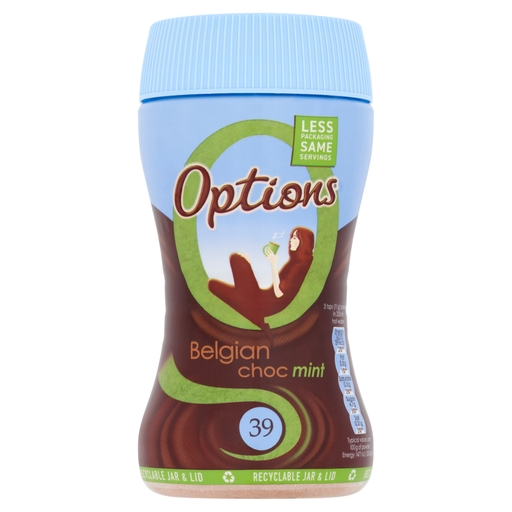
This Joybuy option is a mint variant in a 220g pack. It is distinct from the Options Belgian Choc 11g sachet discussed above, so use its own current pack when assessing a serving.
 No image available
Consider this mint variant if the shop wants that flavour alongside its other hot drinks. Check its own serving directions and nutrition label rather than applying the figures for Options Belgian Choc sachets; milk and phenylalanine information also needs checking on the current pack before serving.
No: compare the same stated basis. Tesco Groceries gives figures for 11g powder made with 200ml hot water, while M&S provides a fat figure per 100g of prepared drink; those are not interchangeable per-mug measurements.
No. The Malnutrition Task Force cautions that low-fat eating is not always recommended for people with a small appetite or unintentional weight loss. A medically prescribed very-low-fat diet also calls for individual guidance from a healthcare professional or dietitian, as Oxford University Hospitals explains.
The serving figures cited here describe preparation with water. If staff use milk, those figures no longer describe the finished drink; check the milk used and the resulting ingredients and nutrition information before serving.
Check each current pack for its full ingredients and allergen information. The products described here include milk-containing drinks; Sainsbury’s lists barley in Ovaltine Light, and Twinings gives a phenylalanine statement for Options Belgian Choc sachets.