Hosts making cold drinks and food
If oat drink is going into iced coffee, cereal or BBQ food prep, compare the fat declaration as well as the carton’s intended uses and storage instructions.


For a low-fat oat drink, start with fat per 100 ml: the nutrition-claim conditions published by legislation.gov.uk set a limit of 1.5 g per 100 ml for a low-fat claim on liquids. Oatly Semi declares 1.4 g per 100 ml, while Alpro Oat No Sugars declares 1.5 g per 100 ml and 0 g sugars; choose between them according to how you will use the drink and whether sugars matter to the recipe. M&S Only 3 Ingredients declares 0.5 g fat per 100 g, a different labelling basis, and needs refrigeration.
If oat drink is going into iced coffee, cereal or BBQ food prep, compare the fat declaration as well as the carton’s intended uses and storage instructions.
Fat and sugars are separate entries on the nutrition panel. Alpro UK declares 1.5 g fat and 0 g sugars per 100 ml for Alpro Oat No Sugars; check the exact variant before choosing it for a less-sweet drink or recipe.
Read the exact carton before serving guests with coeliac disease or an oat or wheat allergy. M&S states that its Only 3 Ingredients and Semi oat drinks are not suitable for coeliacs or people with a wheat allergy; the Food Standards Agency also identifies oats as an allergen in their own right.
Start with the nutrition panel, then check whether the drink’s flavour, storage instructions and allergen statement fit the food and drinks you plan to serve.
| Priority | What to check | Your needs |
|---|---|---|
| Fat content | Read fat per 100 ml for liquid drinks. The conditions published by legislation.gov.uk set 1.5 g per 100 ml as the limit for a low-fat claim on liquids. Keep declarations per 100 g distinct rather than treating the figures as interchangeable. | I want the carton’s fat declaration to support my low-fat choice, regardless of whether its name says “Semi”, “No Sugars” or “Barista”. |
| Sugars and flavour | Compare sugars per 100 ml separately from fat. Alpro UK declares 0 g sugars per 100 ml for Alpro Oat No Sugars; do not assume another low-fat variant has the same declaration. | For a savoury recipe or less-sweet cold drink, I need to know what the particular carton says about sugars. |
| Planned use | Check whether the product is presented for cooking, cold serving or coffee. Minor Figures lists 3.7 g fat per 200 ml for Organic Barista Oat, equivalent to 1.85 g per 100 ml; its coffee-focused texture does not make it a low-fat choice. | I’m making iced coffee or BBQ food, so I want a drink suited to that use without assuming every barista carton has the same fat content. |
| Storage | Check whether the carton needs chilling before opening, how to store it afterwards and when the opened drink must be used. | If I’m shopping ahead or have limited fridge space, the carton’s storage instructions need to fit my BBQ plans. |
| Allergens and fortification | Read the exact allergen statement and any listed calcium, iodine or vitamin additions. M&S describes Only 3 Ingredients Oat Drink as unfortified and says it is not suitable for coeliacs or people with a wheat allergy. | I need to check suitability for everyone being served rather than assuming “dairy-free” settles an oat, gluten or wheat concern. |
Barista describes a use, not a fat level. Minor Figures Organic Barista Oat declares 3.7 g fat per 200 ml, equivalent to 1.85 g per 100 ml.
If low fat is the priority, compare fat per 100 ml on the specific barista carton before choosing it for coffee.
Oatly UK declares 1.4 g fat per 100 ml for Oatly Semi, but it is not the same product as a No Sugars variant. Fat and sugars need separate checks.
For a less-sweet drink or savoury recipe, read both lines on the current nutrition panel.
The Food Standards Agency identifies oats as an allergen, and M&S says its Only 3 Ingredients and Semi oat drinks are not suitable for coeliacs or people with a wheat allergy.
Check the exact carton and its allergen statement before adding oat drink to shared food or drinks.
A chilled drink needs suitable storage while you prepare for the event. Instructions for opened cartons also differ between products.
Check the temperature and opened-carton instructions before deciding when to shop or serve.
Oatly offers distinct Semi, No Sugars and other oat-drink variants; the name of the variant matters when comparing nutrition panels.
Alpro Oat No Sugars is an option for comparing fat and sugars together.
M&S lists both an unfortified Only 3 Ingredients oat drink and a fortified Semi oat drink.
Minor Figures describes Organic Barista Oat in terms of coffee texture and microfoam.
These cartons include No Sugars-labelled oat drinks for cold serving and a barista variant for iced coffee. Check the current pack’s fat, sugars, storage and allergen information against your menu.
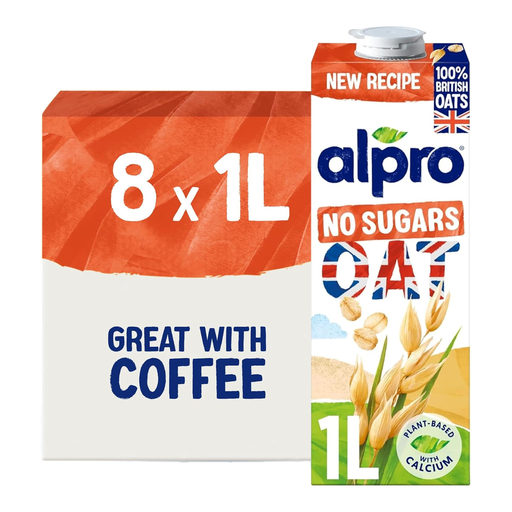 No image available
A long-life multipack to consider for cold drinks or cereal. If avoiding sugars matters, check the current carton’s sugars declaration as well as fat per 100 ml; check its allergen statement before serving guests.
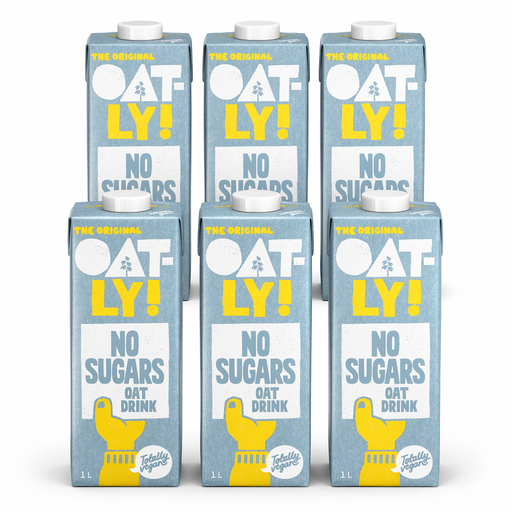 No image available
A multipack to consider when planning chilled drinks for a gathering. Read the current carton for its fat and sugars declarations, storage instructions and allergen information.
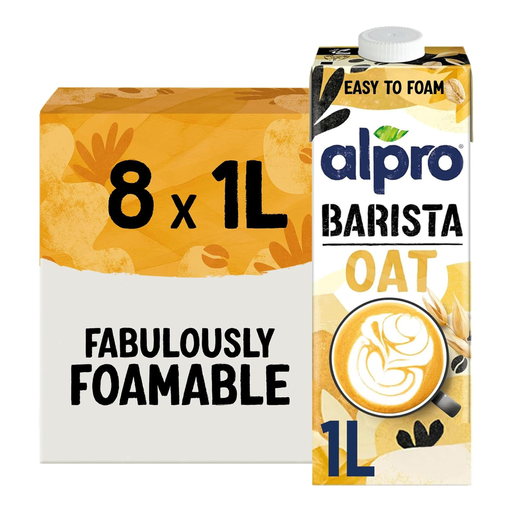 No image available
A coffee-focused long-life multipack to consider for iced coffee. “Barista” alone does not establish its fat or sugars level: compare both per 100 ml on the current carton, and check the allergen statement before serving.
For a liquid, the nutrition-claim conditions published by legislation.gov.uk specify no more than 1.5 g fat per 100 ml for a low-fat claim. Read the fat line for the exact drink rather than relying on “Semi”, “No Sugars” or “Barista” in its name.
Use it where the recipe allows an oat-drink substitution, and choose a variant whose sugars and flavour suit the dish. Follow the carton’s storage instructions before serving prepared food or drinks.
No. Check the exact product’s allergen and gluten information: M&S states that its Only 3 Ingredients and Semi oat drinks are not suitable for coeliacs or people with a wheat allergy. The Food Standards Agency also identifies oats as an allergen in their own right.
A barista variant may suit coffee preparation, but check its fat declaration if low fat is your priority. Minor Figures Organic Barista Oat declares 3.7 g fat per 200 ml, equivalent to 1.85 g per 100 ml; do not assume all barista drinks have that same figure.
Follow the temperature and opened-carton instructions on the exact product you buy. Check them before shopping ahead or making drinks for guests, particularly if fridge space is limited.