Post-workout smoothie makers
If you want a lower-fat liquid base, compare cartons per 100ml. Plan the rest of the snack separately if you also want a protein-containing food.


Choose an oat drink by comparing fat and protein on the same nutrition-panel basis, but do not count on a low-fat carton alone to supply the protein in a post-workout snack. University College London Hospitals NHS Foundation Trust describes carbohydrate-and-protein snacks around exercise; if that is what you are putting together, pair the drink with a protein-containing food and check fortification and allergens on the exact carton.
If you want a lower-fat liquid base, compare cartons per 100ml. Plan the rest of the snack separately if you also want a protein-containing food.
If oat drink is taking the place of a dairy drink in your routine, check the specific carton for calcium, iodine and vitamins. The UK Office for Health Improvement and Disparities reports that nutrient content varies considerably across plant-based drinks.
A barista carton may suit your coffee routine, but its nutrition panel still needs checking against your low-fat preference. Minor Figures Barista Oat, for example, lists 4.3g fat per 200ml.
Start with fat and protein on a consistent label basis, then check sugars, fortification and suitability for anyone who will drink it.
| Priority | What to check | Your needs |
|---|---|---|
| Protein in the snack | Read protein per 100ml and consider what food will accompany the drink. University College London Hospitals NHS Foundation Trust describes carbohydrate-and-protein snacks around exercise; what you need depends on your activity and circumstances. | I want oat drink as part of a post-exercise snack, with a separate protein-containing food if the drink does not serve that purpose. |
| Fat and sugars | Compare total fat on the same per-100ml basis, and read sugars separately. Oatly Chilled Oat Drink No Sugars lists 1.5g fat per 100ml; Minor Figures Barista Oat lists 4.3g per 200ml. These are figures for those specific products, not their entire ranges. | Keeping fat lower matters to me, even if I sometimes buy oat drink for coffee. I would check each carton rather than assume a barista version has the same figures as another variety. |
| Fortification and suitability | Check the labelled calcium, iodine and vitamins, then read the ingredients and allergen statement. The UK Office for Health Improvement and Disparities reported in 2025 that plant-based drinks vary considerably in nutrient content. | If I use oat drink instead of dairy, I want to know what this carton contains and whether its allergen statement fits the people who will drink it. |
Fat and protein answer different questions. Oatly Chilled Oat Drink No Sugars lists 1.0g protein per 100ml, while University College London Hospitals NHS Foundation Trust describes snacks that combine carbohydrate and protein around exercise.
Decide what else you will eat with the drink if you want a protein-containing snack.
Coffee use does not tell you how a drink fits a low-fat preference. Minor Figures Barista Oat lists 4.3g fat per 200ml, whereas Oatly Chilled Oat Drink No Sugars lists 1.5g per 100ml.
Compare the figures on the same volume basis before deciding whether coffee texture or a lower fat figure matters more to you.
The UK Office for Health Improvement and Disparities reports considerable variation in the nutrient content of plant-based drinks. A brand name alone does not establish what is in a particular carton.
When fortification matters to you, read that product’s label for calcium, iodine and the vitamins you want to compare.
Suitability is product-specific: M&S states that its Plant Kitchen Semi Oat Drink is not suitable for people with coeliac disease, milk allergy or wheat allergy.
Read the ingredients and allergen statement on the exact carton, particularly if you need to avoid oats, gluten, wheat or milk.
These examples show why it is worth comparing individual cartons rather than treating every drink from a brand as nutritionally alike.
Its Chilled Oat Drink No Sugars is one labelled option to compare for a lower-fat liquid base.
Its Oat No Sugars drink offers a no-sugars option to compare with other oat drinks.
Barista Oat is a coffee-focused drink, making it relevant if one carton needs to serve both coffee and other uses.
Plant Kitchen Semi and Plant Kitchen Barista illustrate why the variant matters.
Tesco’s oat-drink category includes its own oat drink alongside other brands, offering several labels to compare.
These oat drinks include no-sugars cartons for a post-exercise snack and a barista carton for shoppers who also want a coffee-use option. Check each pack’s nutrition and allergen information against your own requirements.
 Image unavailable
A no-sugars, long-life oat drink to consider as the liquid part of a post-exercise snack. Compare fat and protein per 100ml on the pack, and choose a separate protein-containing food if you need one alongside it.
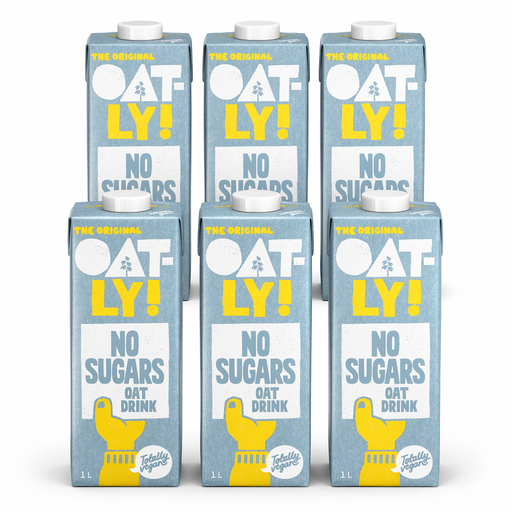 Image unavailable
A six-carton no-sugars option if oat drink is part of your post-exercise routine. Check this pack’s fat, protein and fortification figures rather than applying those of a different Oatly variant.
 Image unavailable
A long-life barista oat drink to consider if the same carton will also be used for coffee. For post-exercise use, compare its fat, sugars and protein per 100ml with the other cartons you are considering; barista use alone does not settle that choice.
Not if you expect the drink to provide the snack’s protein component: Oatly Chilled Oat Drink No Sugars lists 1.0g protein per 100ml, and M&S Plant Kitchen Semi lists 0.2g per 100g. University College London Hospitals NHS Foundation Trust describes carbohydrate-and-protein snacks around exercise, so consider a separate protein-containing food if that is the kind of snack you want.
Compare total fat using the same nutrition-panel basis, then check sugars, protein and any fortification that matters to you. Oatly Chilled Oat Drink No Sugars lists 1.5g fat per 100ml, while Minor Figures Barista Oat lists 4.3g per 200ml; do not compare those numbers without accounting for the different serving volumes.
Choose by the particular carton’s nutrition panel as well as whether you want it for coffee. Minor Figures Barista Oat lists 4.3g fat and 0.7g protein per 200ml; those figures describe that product, not every barista oat drink.
No. The UK Office for Health Improvement and Disparities reports that nutrient content varies considerably among plant-based drinks. Check calcium, iodine and other listed nutrients on the exact carton you plan to use.