Parents replacing a usual dairy drink
If an oat drink will regularly take the place of dairy milk, check its added nutrients as well as its fat declaration. Storage between packing and lunchtime also matters.


For a secondary-school packed lunch, consider fat content alongside fortification, storage and the pupil’s allergen needs. M&S Only 3 Ingredients Oat Drink lists 0.5g fat per 100g but is unfortified and needs refrigeration; Oatly Oat Drink Semi lists 1.4g per 100ml, contains added calcium and iodine, and can be stored at room temperature before opening. The figures use different weight and volume bases, so check the exact carton rather than treating them as a precise like-for-like ranking.
If an oat drink will regularly take the place of dairy milk, check its added nutrients as well as its fat declaration. Storage between packing and lunchtime also matters.
An unopened ambient carton and a drink that must stay chilled call for different lunch arrangements. Check the instructions on the carton being packed, particularly if it will be opened before school.
Use the exact product’s ingredients and allergen statements, together with the school’s allergy arrangements. An oat-based or vegan description does not establish suitability for an individual pupil.
Start with the exact carton’s nutrition and storage information, then check its allergen wording against the pupil’s needs. The awareness figures below come from a December 2023 Ipsos UK online survey reported by the Food Standards Agency: its 821 screened adult respondents, aged 16–75 in England, Wales and Northern Ireland, had or shopped for someone with a food hypersensitivity to animal-origin allergens; the figures do not measure oat-drink purchases.
| Priority | What to check | Your needs |
|---|---|---|
| Declared fat | Read fat per 100g or per 100ml on each carton. M&S lists 0.5g per 100g for Only 3 Ingredients; Oatly lists 1.4g per 100ml for Semi. Keep the different measurement bases in view. | I want to consider a lower-fat drink without assuming that its fat figure tells me whether it has added nutrients. |
| Added nutrients | Check the exact variant for added calcium, iodine and vitamins. M&S says Only 3 Ingredients is not fortified; Oatly lists calcium, iodine, vitamin D2, riboflavin and B12 for Semi. The NHS identifies plant-based drinks with added calcium as a calcium source. | If this drink regularly replaces dairy milk, I want to account for calcium and other nutrients across the pupil’s diet, rather than judging the drink by fat alone. |
| Lunch storage | Check whether the carton is ambient before opening or must stay chilled. M&S specifies 0°C to +5°C for Only 3 Ingredients; Oatly says Semi can be stored at room temperature before opening. Follow the pack’s instructions after opening. | The drink may sit in a lunch bag until midday, so I need a storage arrangement that meets the instructions for the carton I choose. |
| Allergen wording | Read the current ingredients, allergen and precautionary statements; check the school’s allergy arrangements. M&S states that its Semi Oat Drink is not suitable for people with milk allergy, coeliac disease or wheat allergy. | I cannot use a vegan label as a substitute for an allergen check. In the Food Standards Agency’s survey, 53% of respondents with a food hypersensitivity and 50% of those shopping for someone with one already knew that vegan products might pose a cross-contact risk; these are awareness figures, not school-lunch preferences. |
| Pack format | Check the carton size and how an opened carton must be stored. The Joybuy multipacks below contain 1L cartons, not individual lunch-sized portions. | If I am packing one drink for lunch, I need to plan the portion and what happens to the opened carton. |
M&S Only 3 Ingredients Oat Drink has a low declared fat figure but is not fortified. That distinction matters if the drink is regularly replacing dairy milk.
Compare the fat declaration and added nutrients on the same carton, and consider the other suitable sources of calcium in the pupil’s diet.
M&S Only 3 Ingredients requires refrigeration at 0°C to +5°C, while Oatly Semi can be stored at room temperature before opening.
Check the instructions before packing. For a chilled product, arrange storage that meets its stated temperature requirement rather than assuming an ordinary lunch bag will do so.
The Food Standards Agency warns that vegan labelling is not a substitute for allergen information. M&S specifically labels its Semi Oat Drink as unsuitable for people with milk allergy.
Read the current carton’s ingredients and precautionary statements, and follow the school’s arrangements for a pupil with a diagnosed allergy.
Sugar and fat are separate entries on a nutrition panel. A no-sugars variant’s name does not establish how its fat content compares with another oat drink.
Check fat per 100ml or per 100g separately, along with any added nutrients that matter to this choice.
These examples illustrate differences between particular oat drinks; a brand name alone does not establish the nutrition, storage or allergen details of every variant.
Its Semi and No Sugars oat drinks address different label checks for a packed lunch.
Its Only 3 Ingredients and Semi oat drinks show why fat, fortification and allergen wording must be considered separately.
Oat Original and Oat No Sugars are distinct long-life variants, including the multipacks listed below.
Everyday Oat is a fortified oat drink that can be assessed against the same packed-lunch criteria.
Tesco’s oat-drink listings include own-label and branded variants.
These long-life oat-drink multipacks are options to assess for a secondary-school packed lunch. Each contains 1L cartons, so check how a serving will be packed and how the remainder must be stored after opening.
 No image available
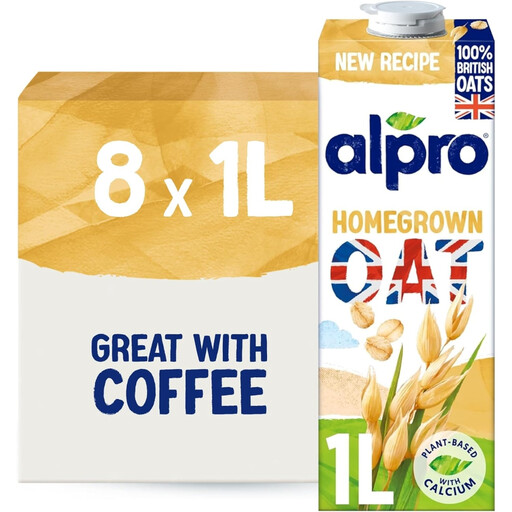
For a lunch drink where declared fat and added nutrients are both being checked, this listing gives 1.2g fat per 100ml and lists calcium, iodine and vitamins B2, B12 and D2.
Store unopened in a cool, dry place and follow the carton’s instructions after opening. The listing identifies oats among cereals containing gluten; check the current pack’s full allergen wording, particularly for a pupil with milk allergy or a gluten-related restriction.
 No image available
This variant suits a comparison of an ambient-before-opening carton with added nutrients: the listing specifies calcium, iodine and vitamins B2, B12 and D2, alongside 1.5g fat per 100ml.
Store unopened in a cool, dry place and refrigerate after opening as directed. The listing identifies oats among cereals containing gluten; read the current pack’s full allergen wording before packing it for a pupil with an allergy or gluten-related restriction.
 No image available
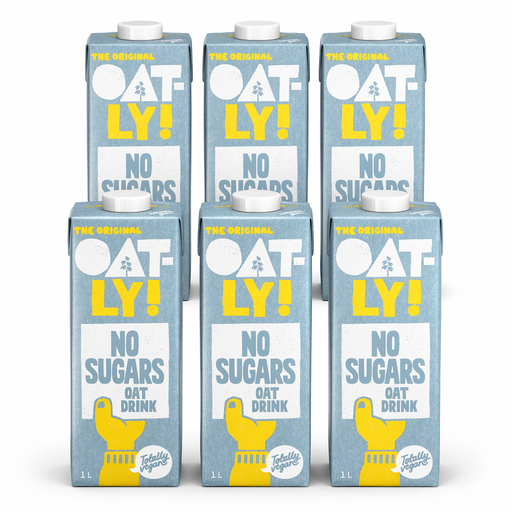
If the No Sugars variant appeals, check its fat separately: this listing declares 1.5g per 100ml and names calcium, iodine, vitamin D2, riboflavin and B12.
The listing describes ambient storage until opening and gives refrigeration instructions afterwards. It identifies oats as an allergen; check the current carton’s full allergen and precautionary wording for the pupil’s needs.
 No image available
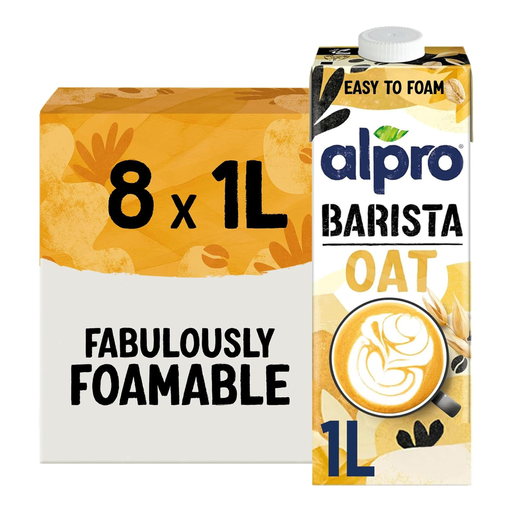
This is the coffee-oriented option in the list, though its listing also describes other drinks. It declares 1.4g fat per 100ml and lists calcium and vitamins D2 and B2.
Store unopened in a cool, dry place. The listing identifies oats among cereals containing gluten; check the current carton’s full allergen wording and whether this variant suits what the pupil will drink at lunch.
No. M&S Only 3 Ingredients Oat Drink lists 0.5g fat per 100g, but M&S says it is not fortified. If an oat drink regularly replaces dairy milk, check added calcium and other nutrients alongside the pupil’s wider diet; the NHS identifies plant-based drinks with added calcium as a calcium source.
Check the exact carton before packing it. Oatly says its unopened Semi drink can be stored at room temperature, whereas M&S says Only 3 Ingredients Oat Drink must be kept at 0°C to +5°C. Opening a carton may change its storage requirements.
A vegan label does not establish milk-allergy suitability. The Food Standards Agency advises checking allergen and cross-contact information, and M&S explicitly labels its Semi Oat Drink as unsuitable for people with milk allergy. Read the current carton and follow the school’s allergy arrangements.
Check the exact oat drink’s allergen statement rather than assuming all oat drinks are suitable. M&S labels its Semi Oat Drink as unsuitable for people with coeliac disease or wheat allergy. The Food Standards Agency also notes that oats must still be identified as an allergen when used in a product labelled gluten-free.