Households stocking up on low-fat oat drink
If you use oat drink in cereal, tea, smoothies or cooking, unopened storage and how quickly you use each carton after opening matter alongside the fat figure.


For a cupboard stock-up, choose an oat drink whose current label confirms both unopened ambient storage and no more than 1.5 g total fat per 100 ml—the UK condition for a low-fat claim on a liquid, published by legislation.gov.uk. Then compare sugars, fortification and the instructions for opened cartons; a chilled drink with less fat may be less practical if fridge space or the time allowed after opening is limited.
If you use oat drink in cereal, tea, smoothies or cooking, unopened storage and how quickly you use each carton after opening matter alongside the fat figure.
Compare cartons for calcium, iodine, vitamin D and B12 fortification as well as fat and sugars. Formulations differ, so a familiar brand name is not enough to identify what is in a particular drink.
For a household or workplace making frequent coffees, a barista formulation may be relevant. Check its total fat and storage instructions separately rather than assuming coffee-focused drinks meet the same requirements as everyday cartons.
Filter cartons by total fat and unopened storage first, then use the nutrition, ingredient and storage labels to decide which format fits your routine.
| Priority | What to check | Your needs |
|---|---|---|
| Total fat | Read total fat per 100 ml, not just saturated fat or wording such as “semi”. Legislation.gov.uk publishes a limit of 1.5 g per 100 ml for a low-fat claim on a liquid. | I want to compare drinks against the same low-fat condition before ordering several cartons. |
| Storage and use | Check where unopened cartons must be kept, their best-before dates and the instruction after opening. Marks & Spencer says its chilled Only 3 Ingredients Oat Drink must be used within 3 days of opening; Tesco says 5 days for its Long Life Oat Original. | Cupboard space is available, but fridge space is limited—or I need enough time to finish each opened carton. |
| Fortification | Compare the carton for calcium, iodine, vitamin D and B12 rather than assuming every oat drink contains them. The NHS advises people following a vegan diet to consider fortified dairy alternatives; UK government guidance notes that plant-based drinks vary in nutrient content. | If oat drink regularly replaces dairy in my shopping, I want to know whether the particular carton is fortified. |
| Sugars | Read sugars per 100 ml on the current carton. Keep that figure distinct from total carbohydrate, and check the exact variant rather than relying on a range name. | I want the sugar figure for the drink I will actually buy, especially when choosing between an everyday and a no-sugars variant. |
| Coffee use | If you want a barista drink, check its total fat independently. Joybuy lists Alpro Barista Oat Long Life at 1.4 g per 100 ml; Minor Figures lists 4.3 g per 200 ml for its Barista Oat. | Most of these cartons will go into coffee, but I still want the chosen formulation to meet my fat limit. |
| Allergens | Read the current allergen statements and look for an explicit gluten-free claim if required. The Food Standards Agency says a gluten-free claim has a maximum of 20 mg/kg gluten and that oats remain an allergen. | Before committing to a multipack, I need to check that this specific drink suits the relevant allergy or gluten requirement. |
They are different figures. Legislation.gov.uk sets the low-fat condition for a liquid at no more than 1.5 g total fat per 100 ml; Tesco lists 1.6 g per 100 ml for its Long Life Oat Original.
Use the total-fat line per 100 ml when filtering cartons for this low-fat purchase.
Marks & Spencer instructs buyers to refrigerate its Only 3 Ingredients Oat Drink and use it within 3 days of opening. A lower fat figure does not remove those storage requirements.
For a cupboard stock-up, choose cartons with confirmed ambient storage instructions; otherwise, make sure the quantity fits your fridge and usual rate of use.
Cartons you cannot store as directed or finish in time may go to waste.
Marks & Spencer states that its Only 3 Ingredients Oat Drink is not fortified. Other oat drinks list added calcium, iodine or vitamins, so the two types are not interchangeable on that measure.
If oat drink routinely replaces dairy for you, compare the ingredients and nutrition information for the nutrients that matter to your purchase.
Oats remain an allergen, and Marks & Spencer states that its Only 3 Ingredients Oat Drink is not suitable for coeliacs or people with a wheat allergy.
Check the current carton for an explicit gluten-free claim where needed, along with its full allergen and precautionary statements.
These examples illustrate differences between specific oat-drink lines; they do not mean every product from a brand has the same nutrition or storage instructions.
Its No Sugars long-life and Barista Oat drinks address different everyday and coffee uses.
Oatly describes its Oat Drink Semi as an everyday drink that can be stored at room temperature before opening.
Its own-brand Oat Drink is a fortified option for shoppers using that supermarket.
Its Semi Oat Drink and Only 3 Ingredients Oat Drink have different storage and fortification requirements.
Tesco Long Life Oat Original is a cupboard-storage option with added nutrients.
Its Barista Oat is positioned for coffee use and sold in case quantities.
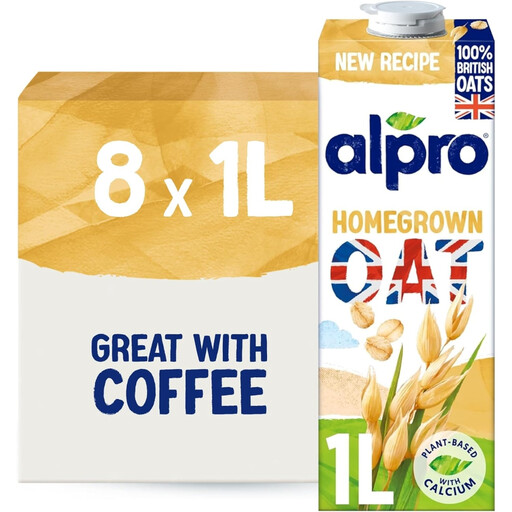
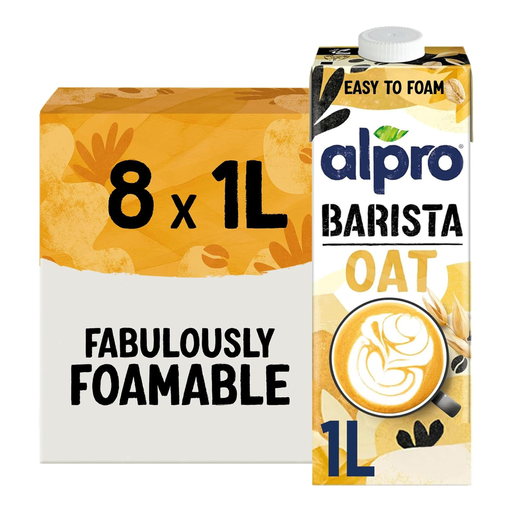
These Alpro long-life multipacks cover everyday and coffee-focused cupboard stock-ups. Compare their individual labels and opened-carton instructions before choosing a case.
 No image available
An everyday 8 x 1L cupboard-stock option for households that can finish each opened carton within 5 days.
The product information lists 1.5 g fat and 3.2 g sugars per 100 ml, plus calcium, iodine and vitamins B2, B12 and D2. Store unopened cartons in a cool, dry place; refrigerate after opening.
Oats are identified in the allergen information. Check the current carton if gluten or another allergen matters to your purchase.
 No image available
This 8 x 1L barista formulation is the coffee-focused option in the selection; its stated fat figure still meets the low-fat condition for liquids.
The product information lists 1.4 g fat and 3.0 g sugars per 100 ml. The UHT cartons have cool, dry unopened storage instructions; refrigerate an opened carton and use it within 5 days.
Its coffee-focused formulation does not establish that it suits every everyday use. Oats are identified in the allergen information, so check the current carton where necessary.
 No image available
This 8 x 1L long-life pack offers another cupboard-stock option, with a stated 1.2 g fat per 100 ml.
The product information lists calcium, iodine and vitamins B2, B12 and D2. Store unopened cartons in a cool, dry place; refrigerate after opening and use within 5 days.
If sugars are a deciding factor, check the current carton: the listed nutrition figure and accompanying sugar wording do not agree. Oats are identified in the allergen information.
Legislation.gov.uk publishes a limit of no more than 1.5 g total fat per 100 ml for a low-fat claim on a liquid. Check total fat on the current carton; a statement about saturated fat alone does not answer that question.
It can be if you have cupboard space but limited fridge space: choose a carton whose label confirms ambient storage before opening. Chilled drinks need refrigeration, and opened-life instructions differ—Marks & Spencer specifies 3 days for its Only 3 Ingredients Oat Drink, while Tesco specifies 5 days for Long Life Oat Original.
Yes—compare the specific cartons rather than assuming their added nutrients are alike. The NHS advises people following a vegan diet to consider fortified dairy alternatives, and UK government guidance notes that nutrient content varies between plant-based drinks; check for calcium, iodine, vitamin D and B12 on the label.
No. The Food Standards Agency says a gluten-free claim requires no more than 20 mg/kg gluten in the food as sold, while oats remain an allergen. Check the current pack for a gluten-free claim if needed and read its other allergen statements; Marks & Spencer says its Only 3 Ingredients Oat Drink is not suitable for coeliacs.
Do not assume that a low fat figure establishes suitability for that use. Sainsbury's states that its Oat Drink is not suitable as a main milk-drink alternative for children under 3; check the specific product guidance and seek appropriate professional advice about a child's dietary needs.