Low-fat top-up shoppers
If you need a carton soon, compare the fat figure per 100 ml rather than relying on words such as “semi”. Check whether the pack needs refrigeration and whether its size fits the shop you planned.


For a low-fat oat drink, start with the fat figure per 100 ml: UK rules permit a low-fat claim for a liquid containing no more than 1.5 g per 100 ml. Then choose a carton that fits how you will use it—check fortification if it regularly replaces dairy, storage instructions for a quick top-up, and preparation advice for tea or coffee. A barista label alone does not tell you whether a drink meets the low-fat limit.
If you need a carton soon, compare the fat figure per 100 ml rather than relying on words such as “semi”. Check whether the pack needs refrigeration and whether its size fits the shop you planned.
Look beyond the fat figure when oat drink often replaces dairy. GOV.UK’s 2025 assessment notes that plant-based drinks vary considerably in nutrient content, so check the particular carton for calcium, iodine and vitamins.
If hot drinks are the main use, read the carton’s mixing instructions as well as its nutrition panel. Tesco and Sainsbury’s give specific advice for avoiding separation with their standard oat drinks; a barista formula is not automatically low fat.
For a quick top-up, establish whether the drink meets your low-fat requirement, then check the pack you can store and use in time.
| Priority | What to check | Your needs |
|---|---|---|
| Fat content | Read fat per 100 ml on the current carton. Under the UK low-fat claim rule published on legislation.gov.uk, a liquid must contain no more than 1.5 g per 100 ml to carry that claim. Do not use “barista” or “semi” as a substitute for the figure. | I want a low-fat oat drink, so I need a per-100-ml figure I can compare across cartons. |
| Fortification | Check the exact pack for added calcium, iodine and vitamins. GOV.UK’s 2025 assessment reports considerable variation in plant-based drinks; Marks & Spencer says its Only 3 Ingredients Oat Drink is not fortified. | If I use oat drink regularly instead of dairy, its nutrient information matters alongside the fat figure. A short ingredient list is a separate preference. |
| Storage and quantity | Check whether the pack is chilled or can be stored unopened in a cupboard. Read its after-opening refrigeration and use instructions, and confirm whether the listing is for one carton or a multipack. | I need the quantity to fit my fridge space and what I expect to use over the next few days—not just the size of each carton. |
| Hot drinks | Read product-specific mixing advice. Tesco says to add its oat drink before hot liquid and not mix it with boiling water; Sainsbury’s advises letting water cool slightly before adding its drink. | Tea or coffee is part of my usual top-up, so I want to know how to use this particular drink without assuming a barista version is necessary. |
| Allergen information | Read the current allergen statement, including any gluten or soya warnings. The Food Standards Agency notes that oats must still be identified as an allergen even when a food is labelled gluten-free. | If someone in my household avoids an allergen, “dairy-free” does not answer whether this carton is suitable for them. |
Barista drinks vary. Minor Figures lists 3.7 g fat per 200 ml for Organic Barista Oat, while Marks & Spencer lists 3.3 g per 100 g for its Barista Oat Drink. Neither figure should be treated as a general rule for all barista products.
If low fat is essential, check the individual drink’s fat figure per 100 ml against the UK liquid low-fat limit of 1.5 g per 100 ml before buying for coffee.
Marks & Spencer says its Only 3 Ingredients Oat Drink contains water, oats and sea salt and is not fortified. A simple recipe and added nutrients are different selection criteria.
If oat drink regularly replaces dairy, compare the exact carton’s calcium, iodine and vitamin information rather than judging it by the front of the pack.
Marks & Spencer says to consume Only 3 Ingredients Oat Drink within three days of opening; Ocado’s listing for Oatly Semi Chilled says approximately five days. Those instructions can affect whether a carton suits a small top-up.
Check the storage and after-opening directions on the pack you buy, then choose a quantity you expect to use within its stated period.
An oat drink may carry other allergen information. The Food Standards Agency identifies oats as an allergen, and Sainsbury’s flags a soya-allergy limitation arising from its manufacturing methods for its oat drink.
Read the current carton’s allergen statement for everyone who will drink it. For hot drinks, check its preparation directions separately.
These examples show why the particular recipe and pack matter more than the brand name alone.
Its oat drinks include different fat levels and pack formats, so compare the named variant.
Oat Original is an everyday branded option with a published low-fat claim.
Organic Barista Oat is presented by Minor Figures as a coffee-focused drink.
Tesco Oat Drink is a chilled own-label option to compare for a one-litre top-up.
Sainsbury's Oat Drink is another chilled, fortified one-litre own-label option.
Its Only 3 Ingredients and Barista oat drinks serve different preferences.
These Joybuy listings are multipacks of long-life oat drinks, including everyday and barista-labelled options. They suit a planned cupboard top-up better than a purchase of just one carton; check the current pack information and quantity before ordering.
 No image available
A long-life option if you want individual 1 L cartons for later use. This listing is for eight cartons, not a single-carton top-up; check the current nutrition and storage panels before ordering.
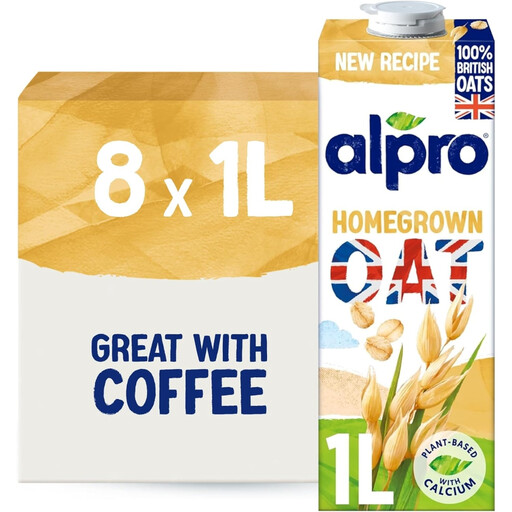 No image available
A long-life Oat Original multipack for households expecting to use several cartons. Alpro publishes a 1.5 g fat per 100 ml figure for Oat Original, exactly at the UK liquid low-fat limit; confirm the nutrition panel on this long-life pack. The purchase is for eight cartons.
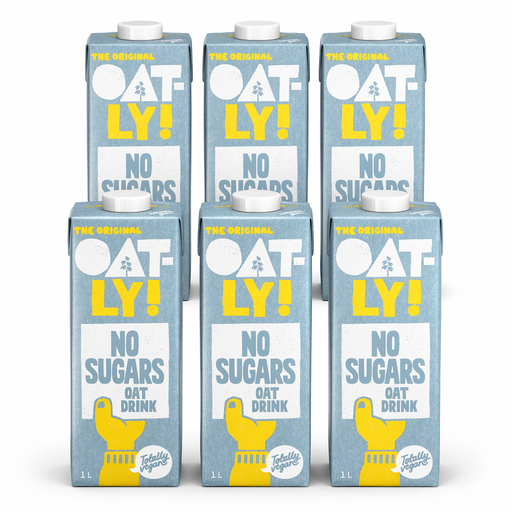 No image available
A six-carton option if you want to keep more than one 1 L oat drink to hand. No Sugars is the product variant name, not a substitute for checking the current sugars and fat figures; confirm the pack’s storage instructions as well.
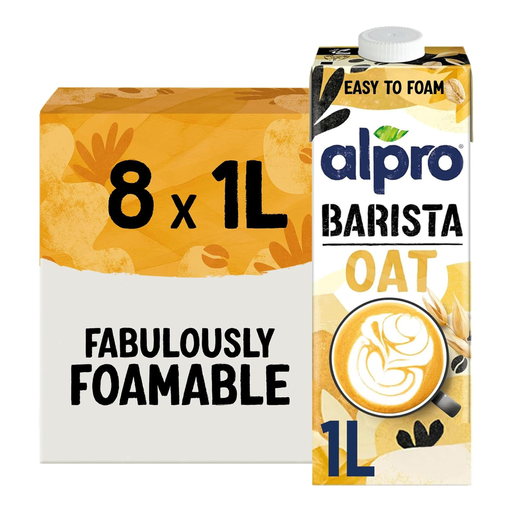 No image available
A coffee-focused long-life option if you also need a multipack. “Barista” does not establish its fat level or how it will perform in your drink: check this variant’s nutrition panel and preparation directions. The listing is for eight 1 L cartons.
Under the UK low-fat claim rule published on legislation.gov.uk, a liquid can carry that claim only if it contains no more than 1.5 g fat per 100 ml. Check the current carton’s per-100-ml nutrition figure; “semi” or “barista” alone does not establish it.
No. GOV.UK’s 2025 assessment reports considerable variation in the nutrient content of plant-based drinks, and Marks & Spencer says its Only 3 Ingredients Oat Drink is not fortified. If you use oat drink regularly instead of dairy, compare calcium, iodine and vitamin information on the exact pack.
No; a low fat figure does not establish whether a drink is suitable as a dairy replacement for a child. Marks & Spencer specifically says its unfortified Only 3 Ingredients Oat Drink is not recommended for that purpose for children under 36 months. Follow product-specific age guidance and seek appropriate professional advice for a child with a medical dietary need.
No. Check the particular carton for a gluten-free statement and other allergen warnings. The Food Standards Agency says gluten-free food must contain no more than 20 mg/kg gluten, while oats must still be identified as an allergen; Minor Figures says its Organic Barista Oat may contain gluten.
Follow the directions for the drink you bought. Tesco advises adding its Oat Drink before hot liquid and not mixing it with boiling water; Sainsbury’s advises letting water cool slightly before adding its Oat Drink. If considering a barista version instead, check its fat figure separately.