Choose a protein-bar multipack by checking total fat per 100g, then the fat in each bar you expect to eat; high protein or low sugar does not establish that a bar is low in fat. For a medically prescribed very-low-fat diet, check the exact flavour against your individual allowance before buying a box: the PhD, Barebells and nākd examples discussed here exceed the NHS low-fat guide of 3g fat or less per 100g. If you are choosing bars to share, check each flavour’s ingredients and allergens as well as its nutrition panel.
Who needs to check what?
People following a clinician-led very-low-fat diet
Check fat per 100g and per bar against the allowance set for you, rather than relying on protein or sugar claims. Oxford University Hospitals NHS Foundation Trust provides separate guidance for people advised to eat no more than 20g of fat a day; that figure is not a target for everyone.
People replacing a chocolate snack
Compare the serving you would actually eat, including its total fat, saturated fat and protein. A multipack is worth considering only once the exact flavour’s nutrition panel fits your intended eating pattern.
Households sharing a mixed box
Check the ingredients, allergens and nutrition for each flavour. Keep individual wrappers available so everyone can identify the bar they are choosing.
What matters when choosing a multipack?
Compare bars on the same per-100g basis first, then check the serving and each flavour in the box. The NHS food-label guide describes 3g total fat or less per 100g as low fat for a solid food; a different personal fat allowance also requires a per-bar check.
| Priority | What to check | Your needs |
|---|
| Total fat |
Read total fat per 100g against the NHS low-fat guide of 3g or less per 100g. Check fat per bar separately, along with the number of bars you plan to eat. |
I need to know whether a bar fits my fat limit, not just whether its front-of-pack claims sound suitable. |
| Saturated fat |
Read saturated fat separately from total fat, using both the per-100g and per-bar figures for the exact flavour. |
If I am comparing two different-sized bars, I want a like-for-like figure as well as the amount in my serving. |
| Protein and sugar |
Check protein and sugars on the full nutrition panel after assessing fat. Neither figure establishes that a bar is low in fat. |
A protein snack may appeal to me, but I do not want a low-sugar claim to stand in for a fat check. |
| Sharing and pack size |
Check the bar count, flavours and each flavour’s ingredients and allergen statement. Keep wrappers with the bars when sharing. |
We may prefer a smaller or mixed box while deciding which flavours everyone can eat and wants to finish. |
What can lead to the wrong choice?
-
Buying a large box on a protein or sugar claim alone
Those claims do not determine fat content. PhD lists 14g fat per 100g for its Smart Protein Bar Choc Brownie, while Barebells lists 15g per 100g for Caramel Cashew; both exceed the NHS low-fat guide.
Compare the exact flavours’ total fat per 100g, fat per bar and saturated fat before committing to a multipack.
-
Comparing only the fat in one bar
Bars of different weights are not directly comparable by their per-bar figures alone. The per-100g figure provides a common basis, while the serving figure shows what one bar contributes.
Use both figures, then account for how many bars you intend to eat.
-
Assuming vegan or no-added-sugar means low fat
Tesco lists 21g fat per 100g for nākd Peanut Butter Protein Bars, despite their vegan and no-added-sugar descriptions. PhD lists 13g fat per bar for Smart Plant Vanilla Fudge.
Use dietary descriptions to check the requirement they actually address, and assess fat on the nutrition panel separately.
-
Sharing mixed bars without checking each flavour
Ingredients can differ within a selection box. Barebells’ Caramel Cashew bar includes milk proteins, cashew and peanut ingredients; the Food Standards Agency explains that precautionary allergen statements communicate possible unintended allergen presence.
Read each flavour’s allergen declaration and keep its original wrapper with the bar.
Brand and retailer references
These examples show why the exact flavour matters; a brand name or product-range description does not establish that every bar in the range is low fat.
PhD
PhD sells Smart Protein Bar multipacks and a separate Smart Plant range.
- PhD lists 21g protein and 9.2g fat per 64g Smart Protein Bar Choc Brownie.
- Its Smart Plant Vanilla Fudge lists 13g fat per 64g bar. Plant-based suitability does not establish low-fat suitability.
Barebells
Barebells offers a Selection Box containing different protein-bar flavours.
- A mixed box lets sharers consider more than one flavour in a single pack.
- Barebells lists 8.1g fat per 55g Caramel Cashew bar. Check that flavour’s ingredients and allergens before sharing it.
Grenade
Grenade offers protein-bar bundles and describes its bar range as high in protein and low in sugar.
- Its bundle range provides a way to consider different pack quantities.
- Protein and sugar descriptions do not establish the fat content of a particular flavour; check its current nutrition panel.
Myprotein
Myprotein’s range includes Layered Protein Bars and twin-pack bar boxes.
- The twin-pack listing specifies two 12-bar boxes, which makes the quantity clear.
- Check the fat and saturated-fat figures for the particular bars and flavours before choosing a larger bundle.
Quest
Quest makes protein bars in several flavours; its S'Mores nutrition information is a US manufacturer example, not a UK multipack label.
- Quest lists 21g protein per 60g S'Mores bar.
- The same US product information lists 7g total fat per bar. Check the label of any specific UK product rather than applying those figures to another pack.
Tesco
Tesco lists protein bars from different brands, including a three-bar nākd Peanut Butter multipack.
- A smaller pack quantity can suit a household trying a flavour before buying more.
- Tesco lists 21g fat per 100g and 9.5g per 45g bar for that nākd product; its other dietary descriptions do not make it low fat.
Protein-bar multipacks on Joybuy
These Grenade and PhD multipacks offer different flavours and box sizes for a protein-bar snack or a shared box. Choose by the exact bar’s fat and saturated-fat figures and your intended serving, rather than treating any of these packs as a low-fat choice on the strength of its name.
 No image available
Grenade Oreo flavour protein bars, 4 × 60g
The four-bar pack provides a smaller quantity to consider before buying more for a household. Check the Oreo flavour’s fat per 100g and per bar, saturated fat and allergens on its label before sharing.
View on Joybuy
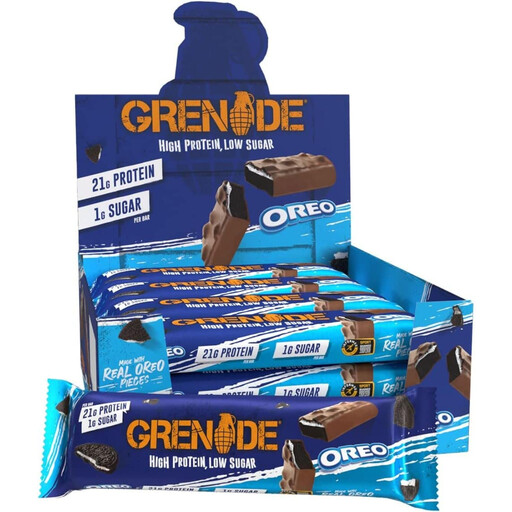 No image available
Grenade Oreo flavour protein bars, 12 × 60g
The 12-bar pack offers more of the Oreo flavour for people sharing or buying a repeat flavour. Compare its exact nutrition and allergen label with the household’s needs before choosing the larger quantity.
View on Joybuy
 No image available
PhD Smart Chocolate Peanut Butter bars, 12 × 64g
This 12-bar box is the Chocolate Peanut Butter flavour. Check its own nutrition panel and allergens: figures for PhD’s Choc Brownie or Smart Plant bars should not be applied to this flavour.
View on Joybuy
 No image available
Grenade Soft Core Double Chocolate, 12 × 50g
These 50g bars offer a different serving size from the 60g Grenade Oreo bars. Use the per-100g figures for a like-for-like fat comparison, then check the fat in one Double Chocolate bar.
View on Joybuy
 No image available
Grenade Soft Core Golden Caramel, 12 × 50g
This 12-bar Golden Caramel pack has 50g bars. Even within the Soft Core range, use the exact flavour’s fat, saturated-fat and allergen information when deciding whether it suits the people sharing it.
View on Joybuy
Questions about low-fat protein bars
What does low fat mean on a UK food label?
The NHS food-label guide describes a solid food with 3g total fat or less per 100g as low fat. Compare that per-100g figure across bars, then read the fat per bar to understand the serving you would eat.
Can an ordinary protein-bar multipack suit a prescribed very-low-fat diet?
Do not assume it will. Oxford University Hospitals NHS Foundation Trust’s guidance for people advised to eat no more than 20g fat a day calls for a particularly strict check; the cited PhD Choc Brownie, Barebells Caramel Cashew and nākd Peanut Butter bars all exceed the NHS guide of 3g fat or less per 100g. Check any proposed bar against the individual allowance given by your healthcare professional.
Does low sugar mean a protein bar is low fat?
No. PhD describes its Smart Protein Bar as low in sugar, but lists 14g fat per 100g for Choc Brownie. Read total fat and saturated fat separately from sugars for the exact flavour you plan to buy.
What should I check before sharing a variety box?
Read each flavour’s ingredients and allergen statement, including any precautionary wording, rather than assuming every bar in the box is alike. The Food Standards Agency explains that precautionary allergen labelling communicates possible unintended allergen presence; keeping each bar in its wrapper helps sharers identify it.


