Shoppers tracking fat per snack
If you plan several days’ snacks at once, compare each bar’s fat amount with the space you have allowed for it. Check the serving size as well as the per-100g figure: the cited bars range from 35g to 64g.


Choose a protein-bar case by the fat and protein amounts for the exact flavour, not by a low-sugar claim. YuBi lists 3.1g fat and 10.5g protein per 35g bar for specified flavours; the cited Myprotein, PhD and Barebells flavours provide at least 20g protein but more fat per bar. Check the flavour label before buying a case: YuBi’s listed 9g fat per 100g is also above the 3g-per-100g criterion that GOV.UK gives for a UK “low fat” claim on solid food.
If you plan several days’ snacks at once, compare each bar’s fat amount with the space you have allowed for it. Check the serving size as well as the per-100g figure: the cited bars range from 35g to 64g.
The cited Myprotein, PhD and Barebells flavours provide at least 20g protein per bar, alongside more fat per bar than YuBi’s specified 35g flavours. Decide whether that trade-off fits your own plan before ordering 12.
If a low-sugar bar appeals to you, read the exact flavour’s ingredients and allergen statement too. Several cited products contain polyols or carry an excessive-consumption warning, which matters when buying a case rather than trying one bar.
Start with the nutrition panel for each flavour in the box, then consider whether you want 12 of one flavour or an assortment.
| Priority | What to check | Your needs |
|---|---|---|
| Fat and protein | Compare fat per bar, bar weight and fat per 100g alongside protein per bar. YuBi lists 3.1g fat and 10.5g protein per 35g bar for specified flavours; cited Myprotein flavours list 6.1g or 6.2g fat and 20g protein per 60g bar. GOV.UK gives 3g fat per 100g as the UK “low fat” claim criterion for solid food. | I want a bar whose full serving fits the amount of fat I have planned for a snack. A smaller bar’s fat figure alone does not tell me how its per-100g value compares. |
| Flavour and pack format | Check whether the case contains one flavour or several, and read the panel for every flavour you intend to eat. Confirm the number and size of bars rather than comparing boxes by count alone. | Before committing to 12 bars, I would rather know whether I like the flavour and whether each one fits my plan. A smaller multipack or an assortment may help me make that decision. |
| Ingredients and warnings | Read the exact flavour’s allergen statement, sweeteners and any excessive-consumption warning. Ingredients can differ between flavours in an assortment. | If I am avoiding an ingredient or am unsure how I get on with a sweetened bar, the details on the bar I will actually receive matter more than a range-wide description. |
They describe different parts of a nutrition panel. For example, Myprotein lists 6.1g or 6.2g fat per 60g bar for two cited Layered Bar flavours, despite the range’s low-sugar positioning.
Compare fat per serving and per 100g for the flavour you are buying. GOV.UK says a solid food making a UK “low fat” claim must contain no more than 3g fat per 100g.
Myprotein’s cited variety-box flavours have different fat amounts. A figure taken from one bar may therefore be unsuitable for planning around another flavour in the box.
Check each included flavour’s panel. If the allowance you have planned is narrow, trying a single bar or smaller multipack before a full case gives you a chance to check both the label and flavour.
A case is harder to use as planned if some flavours do not fit the amounts you allowed for them or you do not enjoy eating them.
The cited products have differing allergen ingredients, and several carry warnings about the laxative effect of excessive consumption. A protein or low-sugar description does not replace the ingredient label.
Read the exact flavour’s packaging for allergens and warnings before buying a case, particularly if you have an allergy or have not tried that bar before.
These are reference points for comparing pack formats and labelled nutrition, not a claim that every flavour in a range has the same values.
YuBi offers 12-bar boxes, including Fudge Brownie. Its published typical nutrition panel gives figures for specified flavours, which should not be assumed to apply to every box.
The Layered Bar Variety Box contains 12 bars for shoppers who want different flavours in one purchase.
PhD’s Smart Protein Bar is offered in a 12-pack, with nutrition that differs between the cited flavours.
Barebells offers a 12-pack selection box with multiple flavours.
Grenade offers a 12-bar selection box as well as boxes of individual flavours, including OREO.
Tesco’s protein-bar range offers a way to consider smaller multipacks alongside single bars and larger boxes.
Quest’s protein-bar range is another reference point for shoppers comparing protein amounts and sweeteners.
These Grenade 12-bar cases offer single-flavour bulk options. If you are controlling fat per snack, compare the exact flavour’s nutrition panel before choosing between them.
 No image available
This single-flavour case suits a plan to stock 12 bars, provided the Double Chocolate nutrition panel fits the fat amount you have allowed per snack. Compare its per-bar and per-100g figures and check the pack’s ingredients before ordering.
 No image available
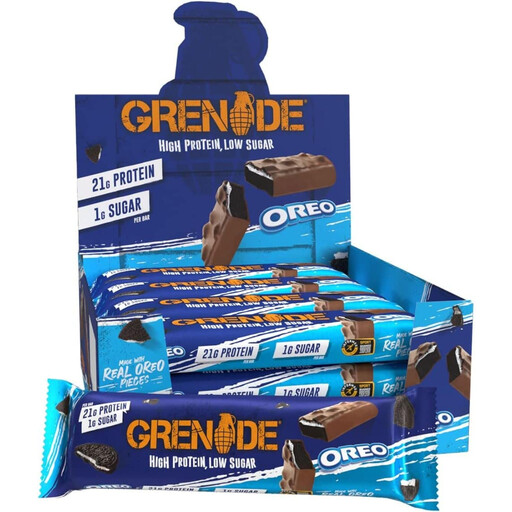
This 12-bar case is an option if you want the 21g protein per OREO bar stated by Grenade and the flavour’s fat amount fits your plan. Each bar is listed as 60g; check its full nutrition and allergen label rather than treating its low-sugar description as a fat figure.
 No image available
Choose this single-flavour 12 × 50g case only after checking the Golden Caramel panel against the fat amount you have planned for each bar. Read the ingredients and allergen statement for this flavour as well.
 No image available
This 12 × 50g case is for shoppers considering Peanut Butter as a repeat flavour, subject to its per-bar fat amount fitting their plan. Check the exact pack’s allergen statement before purchasing, particularly if peanut ingredients are a concern.
No. Sugar and fat are separate nutrition figures. For example, Myprotein’s cited Triple Chocolate and Peanut Pretzel Layered Bars list 6.2g and 6.1g fat per 60g bar. Check both fat per bar and fat per 100g; GOV.UK gives no more than 3g fat per 100g as the criterion for a UK “low fat” claim on solid food.
Do not assume so. YuBi’s cited typical nutrition panel associates 3.1g fat per 35g bar with specified flavours, while its Fudge Brownie listing confirms a 12-bar box. Check the Fudge Brownie label itself before using that figure to plan a purchase.
Some bars contain polyols, and several cited product listings warn that excessive consumption may have a laxative effect. Read the ingredients and warning on the exact flavour, particularly before buying multiple bars you have not tried.