People tracking fat in their food plan
If you account for fat and saturates, compare the nutrition panel per 100g and per bar. A low-sugar claim alone will not answer your question.


Compare total fat per 100g first, then check the amount in the bar you would eat: a high-protein or low-sugar label does not tell you whether a bar is low in fat. Myprotein lists 8.6g fat per 100g for its Lean Layered Protein Bar, which is above the NHS guide of 3g or less per 100g for a low-fat food. If your eating plan calls for foods at or below that level, check the current pack or consider a different snack rather than assuming a protein bar will fit.
If you account for fat and saturates, compare the nutrition panel per 100g and per bar. A low-sugar claim alone will not answer your question.
A ready-to-eat bar may be convenient, but check its protein and fat in the same serving before deciding whether it fits your intended snack.
Check the declaration for the exact flavour and pack you intend to buy. Ingredients, allergen statements and consumption warnings can differ between bars.
When it fits: You want a protein bar and are looking for one with less fat than the other bars you are considering.
The limit: Myprotein lists 8.6g fat per 100g for its Lean Layered bar, still above the NHS low-fat guide of 3g or less per 100g.
When it fits: Your plan requires a snack that meets a specific low-fat threshold.
The check: Compare the nutrition labels of the snacks you might actually eat; their category alone does not establish their fat content.
| Priority | What to check | Your needs |
|---|---|---|
| Total fat | Compare grams of fat per 100g on the same basis. The NHS guide describes 3g or less per 100g as low fat; check saturates separately. | I am limiting fat, so I want to know how the bar compares with that guide before relying on a protein or sugar claim. |
| Serving size | Check the bar weight, then read fat, saturates and protein for the amount you intend to eat. Check calories per bar if you track them. | A per-100g comparison helps me choose between products, but the whole bar is the portion I need to account for. |
| Sugars and sweeteners | Read sugars separately from fat. Check the ingredients and any pack warning about excessive consumption. | I may prefer less sugar, but I do not want to mistake that for less fat or overlook a warning on the bar. |
| Ingredients and allergens | Read the ingredient list, emphasised allergens and any precautionary statement for the exact flavour and pack. | If an ingredient matters to me, I need the declaration for this bar rather than an assumption about the brand. |
ASDA Groceries lists 9.3g fat per 60g bar for Grenade Chocolate Chip Salted Caramel, alongside 21g protein. Those figures answer different label questions.
Compare total fat per 100g first, then check fat and saturates in the bar you plan to eat.
Myprotein lists 8.6g fat per 100g for its Lean Layered Protein Bar. The NHS guide for a low-fat food is 3g or less per 100g.
Use a lower-fat comparison to choose between bars, but check the per-100g figure if your plan calls for a low-fat food.
The cited bars come in different serving sizes: Myprotein lists a 40g Lean Layered bar, while PhD lists a 64g Chocolate Brownie Smart Bar. Their per-bar figures are not a like-for-like measure of fat concentration.
Use per 100g to compare bars, then use the full-bar figures to account for your portion.
Allergen declarations and consumption warnings belong to the particular product, not to every bar carrying the same brand name.
Read the current pack’s ingredients, allergens and warnings when changing flavour or pack.
These examples show why a brand name alone cannot settle a lower-fat choice: compare the named product and serving on its current label.
Its Lean Layered Protein Bar is a relevant within-category comparison for shoppers seeking less fat.
The Chocolate Brownie Smart Bar illustrates why protein and fat need checking together.
Its Salty Peanut bar provides a product-specific comparison rather than a rule for the whole range.
The Chocolate Chip Salted Caramel bar shows why a protein-focused choice may differ from a fat-focused one.
Chocolate Brownie is a named Quest bar to assess by its pack’s nutrition panel.
Tesco is a retailer where shoppers can compare listed protein-bar products, rather than a protein-bar manufacturer.
These Grenade bars are options to examine if you want a portable protein snack and can assess its fat content against your own plan. Check the current nutrition panel before treating any of them as a lower-fat choice.
 No image available
This 12-bar pack offers a 50g portion for a portable snack. If you are limiting fat, compare the current per-100g and per-bar figures before choosing it.
 No image available
This is a 12-pack of 50g bars for shoppers considering a portable protein snack. Check fat and saturates on the Golden Caramel label rather than assuming they match another Soft Core flavour.
 No image available
This 12-pack contains 50g bars. Alongside the fat figures, check the exact pack’s peanut and other allergen declarations if those ingredients matter to you.
 No image available
This four-pack has 60g bars, so compare its per-bar figures with the portion you plan to eat. The high-protein and low-sugar wording in the product name does not establish that it is low in fat.
 No image available
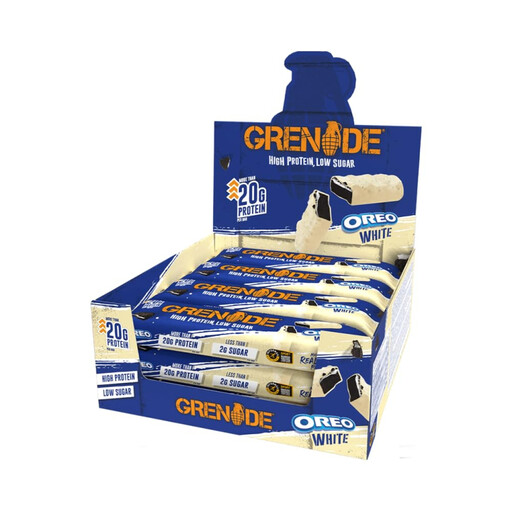
This is a 12-pack of 60g bars. For a fat-focused choice, read the White Oreo nutrition panel per 100g and per bar, and check its own ingredients rather than another flavour’s.
Not necessarily. Myprotein lists 8.6g fat per 100g for its Lean Layered Protein Bar, while the NHS guide describes 3g or less per 100g as low fat. Compare bars with one another, then check the separate low-fat figure if that is what your plan requires.
Use both: per 100g puts bars of different sizes on the same comparison basis, while the per-bar figure tells you the amount in the portion you would eat. Check the stated serving size before comparing per-bar numbers.
A low-sugar description does not establish fat content. ASDA Groceries lists 9.3g fat per 60g Grenade Chocolate Chip Salted Caramel bar; read total fat and saturates separately from sugars on the product you are considering.
Check the current ingredient list, emphasised allergens and any precautionary statement for the exact flavour and pack. Do not assume that two bars from the same brand share an ingredient list.
Some protein-bar labels warn that excessive consumption may have a laxative effect. Read the warning on the specific pack, particularly if you are considering more than one bar.