Who needs to check what?
The relevant allergen determines whether a rice cake is worth considering; its fat content cannot answer that question.
Shoppers managing a milk, sesame or soya allergy
Read precautionary statements alongside the ingredients. Kallo's lightly salted rice cakes may contain all three allergens, and Sainsbury's plain and lightly salted rice cakes are labelled unsuitable for customers with a milk allergy because of manufacturing methods.
Shoppers comparing plain, low-fat rice cakes
Compare fat per 100 g across packs, then make a separate allergen check. Listed plain or lightly salted examples from Kallo, Sainsbury's and M&S have different ingredients and allergy information, even where their fat figures meet the low-fat condition.
People buying for someone else with a food hypersensitivity
Confirm which allergens the person needs to avoid before choosing a flavour or relying on a vegan label. The Food Standards Agency advises that vegan labelling is not a substitute for checking allergen and cross-contact information.
What matters when choosing?
Check allergen suitability first, compare fat on the same per-100 g basis, and repeat both checks if you change flavour or pack.
| Priority | What to check | Your needs |
|---|
| Allergens and cross-contact |
Match both the ingredients and any may-contain statement to the specific allergy. A vegan or gluten-free label does not replace this check; the Food Standards Agency says precautionary allergen labelling communicates a possible cross-contact risk. |
I need to know whether the particular pack fits the allergy I'm shopping for. In a Food Standards Agency-commissioned online survey conducted in December 2023 among adults in England, Wales and Northern Ireland, 53% of respondents with an animal-origin food hypersensitivity, and 50% of those who shopped for someone with one, knew before the survey that vegan products might still be unsuitable because of cross-contact. |
| Comparable fat figures |
Compare fat per 100 g: nutrition-claims rules published by legislation.gov.uk set no more than 3 g per 100 g as the low-fat condition for solid foods. A calorie figure per cake does not establish that a product is low fat or reduced fat. |
I want to compare packs on the same basis, rather than judge them by cake size. In the Food Standards Agency and Ipsos Northern Ireland's 2024 Making Food Better Tracker, 49% of 611 Northern Ireland respondents reported actively using traffic-light labelling when shopping for food; that measures label use, not a preference for rice cakes. |
| Flavour and coating |
Read each variant's ingredient list and fat figure separately. M&S Milk Chocolate Rice Cakes contain milk and soya and list 20.4 g fat per 100 g; the Kallo Marmite rice cakes listed by Asda declare gluten-containing cereals and celery. |
If I switch from plain to chocolate-coated or savoury rice cakes, I need to check that exact flavour rather than carry over my decision from another pack. |
| The pack you receive |
Check the physical pack before eating, particularly after a substitution. Sainsbury's, Asda and M&S advise that online ingredients or allergy information can change. |
When a different pack arrives or I pick another size in store, I want its current label to confirm the ingredients and allergen advice. |
Brand and retailer references
These examples show why nutrition figures and allergen statements must be checked for individual products, not assumed to apply across a brand or retailer.
Kallo
Kallo lists organic lightly salted and unsalted wholegrain rice cakes with less than 3% fat.
- Its product information identifies the ingredients and lists the products as gluten free.
- Both listings warn that the rice cakes may contain milk, sesame and soya.
Sainsbury's
Its plain rice cakes list 2.4 g fat per 100 g; its lightly salted wholegrain version lists 2.7 g.
- Both product pages provide ingredients, nutrition figures and allergy advice.
- Although prepared to a vegan recipe, both are labelled unsuitable for customers with a milk allergy because of manufacturing methods.
M&S
M&S lists lightly salted rice cakes containing wholegrain brown rice and salt, with 2.5 g fat per 100 g.
- The online ingredients offer a starting point for checking the lightly salted product.
- The product page advises reading the pack as information can change. Its separate milk chocolate variety contains milk and soya.
Asda
Asda's listings illustrate how allergen advice varies between flavoured rice cakes.
- Its caramel rice cakes list 2.1 g fat per 100 g, alongside a may-contain warning for milk and sesame.
- Its Kallo Marmite rice-cake listing declares cereals and celery as ingredients and warns of possible milk, sesame and soya cross-contact.
Tesco
Tesco lists Kallo Lightly Salted Wholegrain Low Fat Rice Cakes with 2.8 g fat per 100 g.
- The listing includes a specific may-contain statement for milk, sesame and soya.
- Read the pack before eating rather than relying on the retailer listing alone.
Snack a Jacks
Snack a Jacks describes its range using a per-snack calorie figure.
- The range provides another rice-cake-style snack to assess by its exact product label.
- A per-snack calorie statement does not establish low-fat status or suitability for a particular allergy.
Rice cakes to consider on Joybuy
These options cover a lightly salted wholegrain rice cake and a savoury Marmite-flavoured rice cake. Their different ingredient profiles make the exact pack label important when shopping for an allergy.
 No image available
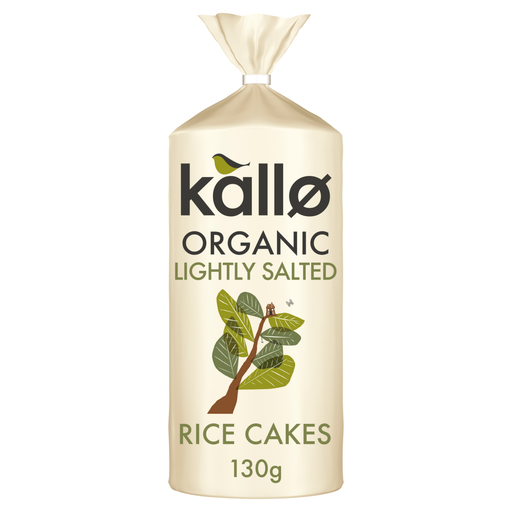
Kallo Organic Lightly Salted Rice Cakes 130g
A lightly salted wholegrain option for comparing plain rice cakes. Kallo lists its organic lightly salted variety as containing less than 3% fat, but warns that it may contain milk, sesame and soya. Check the allergen statement on the pack you receive.
View on Joybuy
 No image available
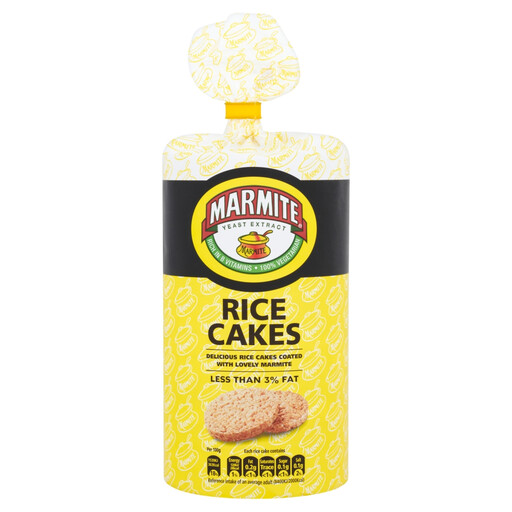
Marmite Rice Cakes 110g
A savoury flavoured option that calls for a different allergen check from a plain rice cake. Asda's listing for Kallo Marmite rice cakes declares barley, celery, oats, rye and wheat, and says they may contain milk, sesame and soya. Check the ingredients, precautionary statement and fat per 100 g on the exact pack before choosing it.
View on Joybuy
Questions about labels and allergens
Does a vegan label make a rice cake suitable for a milk allergy?
No. The Food Standards Agency advises against using vegan labelling as a substitute for allergen information because cross-contact can still matter. Sainsbury's plain and lightly salted rice cakes, for example, are described as prepared to a vegan recipe but unsuitable for customers with a milk allergy because of manufacturing methods.
What does low fat mean on a rice-cake label?
For solid foods, the low-fat labelling condition is no more than 3 g of fat per 100 g under the nutrition-claims rules published by legislation.gov.uk. Compare that figure across products; calories per cake do not establish whether a rice cake meets the fat condition.
Can I rely on a supermarket product page for an allergen check?
Use the page to narrow your choices, then read the physical pack before eating. Sainsbury's, Asda and M&S advise that online ingredients or allergy information can change.
Are gluten-free rice cakes suitable for every food allergy?
No. A gluten-free description does not address every other allergen or cross-contact risk. Tesco's listing describes Kallo's lightly salted low-fat rice cakes as gluten free while warning that they may contain milk, sesame and soya.
What should I do with a may-contain statement for my allergen?
Treat it as relevant to your decision, not as a guarantee that the allergen is absent. The Food Standards Agency explains that precautionary allergen labelling communicates a possible cross-contact risk; check the exact pack and follow the risk-management advice applicable to the person you are shopping for.


