Plain-snack shoppers
If you want rice cakes to eat plain or add toppings to, start with lightly salted products and compare their total fat per 100g. The checked Tesco and Sainsbury’s versions both fall within the NHS low-fat guide.


For a low-fat plain rice cake, Tesco Lightly Salted, Sainsbury’s Lightly Salted Wholegrain and Kallo Organic Lightly Salted each list no more than 3g total fat per 100g, the NHS guide for low-fat foods. Choose among them by the features you will use—such as organic ingredients or a plain topping base—and check salt and allergen information on the current pack. Flavoured varieties need their own per-100g comparison.
If you want rice cakes to eat plain or add toppings to, start with lightly salted products and compare their total fat per 100g. The checked Tesco and Sainsbury’s versions both fall within the NHS low-fat guide.
Kallo’s organic wholegrain range offers another plain option. Check the exact pack’s gluten-free information and precautionary allergen statement rather than assuming that an organic or vegan-recipe product suits every allergy requirement.
If you prefer flavoured or jumbo cakes, compare the particular flavour you intend to buy. Snack a Jacks lists different fat, sugars and salt values across its jumbo flavours, so one variety’s figures cannot stand in for the range.
Start with the per-100g nutrition panel, then check whether the flavour, pack format and allergen statement suit the way you plan to eat the cakes.
| Priority | What to check | Your needs |
|---|---|---|
| Total fat | Read total fat per 100g. The NHS guide for a low-fat food is 3g or less per 100g; Tesco Lightly Salted lists 2.9g, while the checked Sainsbury’s and Kallo lightly salted products list 2.7g. | I want a rice cake that meets the low-fat guide, rather than relying on a “reduced fat” impression or calories per cake. |
| Flavour and salt | Compare salt and sugars for the exact flavour, using per-100g values where available. Per-cake figures can describe different-sized cakes. | A plain cake works for toppings; if I choose a flavoured or jumbo one, I want to know how its label differs. |
| Allergens | Read the current pack’s ingredients and precautionary allergen statement. Kallo warns of possible milk, sesame and soya exposure; Sainsbury’s says its checked vegan-recipe product is unsuitable for customers with a milk allergy because of manufacturing methods. | If an allergen affects my choice, a plain appearance or vegan-recipe description is not enough to establish suitability. |
| Pack format | Check the pack weight and the label’s stated portion. The NHS notes that a manufacturer’s portion may differ from the amount you eat. | I want the nutrition comparison to reflect the cakes and portion I actually plan to use. |
“Reduced” describes a comparison with another product; it does not, by itself, tell you whether a rice cake meets the NHS low-fat guide.
Check total fat per 100g against the NHS figure of 3g or less per 100g, then compare the other nutrition values that matter to you.
Manufacturing precautions differ even between products that look similar. Kallo lists possible milk, sesame and soya exposure, while Sainsbury’s flags a milk-allergy restriction for its checked vegan-recipe product.
Use the current physical pack’s allergen information for the specific variety you are buying.
Cake sizes and flavours differ, so a per-cake figure alone does not provide a like-for-like nutrition comparison.
Compare fat, saturates, sugars and salt per 100g, then look at the number of cakes you expect to eat.
These ranges offer different approaches to plain, organic and flavoured rice cakes; check the individual product rather than applying one variety’s label to a whole brand.
Tesco’s checked 130g Lightly Salted Rice Cakes provide a plain own-label option.
The checked lightly salted wholegrain rice cakes are another plain own-label choice.
Kallo offers organic wholegrain choices, including lightly salted and unsalted rice cakes.
Its jumbo range offers flavoured rice cakes for shoppers who want an alternative to a plain topping base.
M&S has a lightly salted wholegrain rice-cake option alongside other rice-cake varieties.
This organic, lightly salted option is relevant if you want a plain rice cake and are checking total fat alongside ingredients and allergen information.
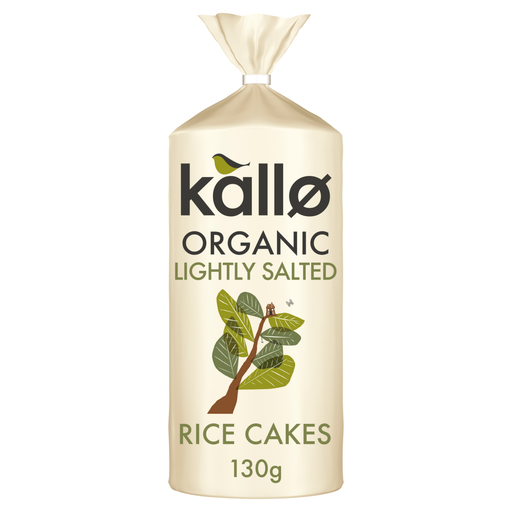 Image unavailable
An organic, lightly salted choice for plain snacking or adding toppings. This product’s information lists 2.7g fat and 0.3g salt per 100g; check the current pack’s allergen statement if milk is a concern.
The NHS guide is 3g or less total fat per 100g of food. The checked Tesco Lightly Salted product lists 2.9g per 100g, and the checked Sainsbury’s and Kallo lightly salted products each list 2.7g per 100g. Check the current pack for the variety you buy.
Do not assume they are: nutrition differs by flavour and cake size. Snack a Jacks lists 0.3g fat per cake for Black Pepper & Sea Salt Jumbo and 1.1g per cake for Chocolate Chip Jumbo. Compare the exact products per 100g before deciding whether they meet the NHS low-fat guide.
Not necessarily. Sainsbury’s says its checked lightly salted wholegrain cakes are prepared to a vegan recipe but are unsuitable for customers with a milk allergy because of manufacturing methods. Read the current pack’s allergen statement for each product.
Use the per-100g values for total fat, saturates, sugars and salt to compare products with different cake sizes. Then check the stated portion against the number of cakes you expect to eat; the NHS notes that a manufacturer’s portion may differ from your own.