Weekly shoppers choosing a plain snack base
If you want rice cakes for snacks or toppings, the fat figure per 100 g helps you assess the product without relying on its name or appearance.


For a plain rice cake to add to a weekly shop, compare fat per 100 g rather than treating every rice cake as low fat. Ocado lists 2.7 g for Kallo Organic Unsalted and 2.8 g for Kallo Lightly Salted Wholegrain, while Marks & Spencer lists 2.5 g for M&S Lightly Salted; all three fall within the 3 g-per-100 g low-fat criterion set out in the nutrition-claims annex on legislation.gov.uk. If salt matters too, compare it separately, and check coated varieties and toppings on their own labels.
If you want rice cakes for snacks or toppings, the fat figure per 100 g helps you assess the product without relying on its name or appearance.
Plain low-fat varieties need not have the same salt content. Ocado lists 0.0 g salt per 100 g for Kallo Organic Unsalted and 0.3 g for Kallo Lightly Salted Wholegrain; Marks & Spencer lists 0.33 g for M&S Lightly Salted.
A plain rice cake lets you choose your own topping, but the topping contributes to the finished snack. Check its label separately if fat, salt or allergens affect your choice.
Start with the fat claim and nutrition panel, then compare salt and any ingredients you plan to add.
| Priority | What to check | Your needs |
|---|---|---|
| Fat claim | Check fat per 100 g. The nutrition-claims annex on legislation.gov.uk sets no more than 3 g fat per 100 g for a low-fat claim on solid food; a reduced-fat claim requires a comparison with a similar product and at least a 30% reduction. | I want to know whether a pack is low fat, without assuming that means its fat content has been reduced against another rice cake. |
| Salt | Compare salt per 100 g as well as fat. Ocado lists 0.0 g for Kallo Organic Unsalted and 0.3 g for Kallo Lightly Salted Wholegrain; Marks & Spencer lists 0.33 g for M&S Lightly Salted. | If I am trying to limit salt from the rice cake itself, an unsalted pack is worth comparing with lightly salted ones. |
| Coatings | Read the finished product’s fat and saturates figures, not just the rice-cake description. Marks & Spencer lists 22.7 g fat and 13.7 g saturates per 100 g for its Milk Chocolate Mini Rice Cakes, versus 2.5 g and 0.5 g for its Lightly Salted Rice Cakes. | For an everyday plain base, I would check a coated pack separately rather than assume it has the same nutrition values. |
| Allergens and storage | Read the current pack’s allergen declaration and instructions for storing it after opening. Ocado’s Kallo Organic Unsalted listing says it may contain milk, soya and sesame seeds. | I need a pack that fits my allergen requirements and can be stored as directed between snacks during the week. |
Coatings change the nutrition values of the finished product. Marks & Spencer lists 2.5 g fat per 100 g for M&S Lightly Salted Rice Cakes, but 22.7 g for its Milk Chocolate Mini Rice Cakes.
Compare the fat and saturates figures on the particular pack you intend to buy.
The nutrition-claims annex on legislation.gov.uk gives these claims different conditions: no more than 3 g fat per 100 g for a low-fat solid food, and at least a 30% reduction against a similar product for a reduced-nutrient claim.
Use the per-100 g figure to assess a low-fat claim; for ‘reduced fat’, also check what comparable product the claim refers to.
Ocado lists 0.0 g salt per 100 g for Kallo Organic Unsalted and 0.3 g for Kallo Lightly Salted Wholegrain, while Marks & Spencer lists 0.33 g for M&S Lightly Salted.
Compare salt independently if it affects which plain variety you choose.
Ocado’s Kallo Organic Unsalted listing carries a may-contain statement for milk, soya and sesame seeds. The current pack is the place to check the declaration for the product in your basket.
Read that declaration before buying and follow the pack’s storage instructions after opening.
Kallo has plain unsalted and lightly salted rice cakes to compare when fat and salt both matter.
M&S Lightly Salted Rice Cakes are a plain option, but other M&S rice cakes have different nutrition values.
Snack a Jacks includes flavoured rice cakes for shoppers considering a seasoned snack rather than a plain base.
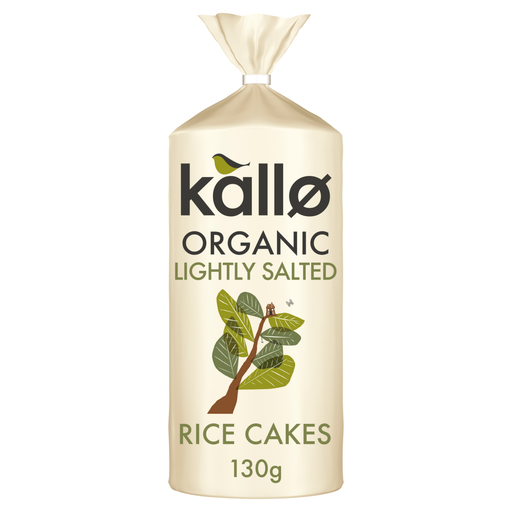
This lightly salted Kallo option is relevant if you want a rice cake to compare with plain varieties for your weekly shop.
 No image available
For a lightly salted rice cake to use with toppings, check the current pack’s fat, salt and allergen information. Joybuy’s product listing states 27 calories per rice cake.
No. The nutrition-claims annex on legislation.gov.uk sets a limit of 3 g fat per 100 g for a low-fat claim on solid food. A reduced-nutrient claim instead requires at least a 30% reduction compared with a similar product, so a low fat figure alone does not establish that a rice cake is reduced fat.
Of the three plain products compared here, Kallo Organic Unsalted lists the least: Ocado gives 0.0 g salt per 100 g. It lists 0.3 g for Kallo Lightly Salted Wholegrain, while Marks & Spencer lists 0.33 g for M&S Lightly Salted.
No. Marks & Spencer lists 22.7 g fat and 13.7 g saturates per 100 g for its Milk Chocolate Mini Rice Cakes, compared with 2.5 g fat and 0.5 g saturates for its Lightly Salted Rice Cakes. Compare the finished products’ nutrition panels.
Check the declaration on the current pack of the exact variety you are buying. Ocado’s listing for Kallo Organic Unsalted says it may contain milk, soya and sesame seeds; do not assume that a plain rice cake has no may-contain warning.
Follow the storage instructions on the particular pack. Kallo advises keeping opened rice cakes in an airtight container, which is worth checking if you expect to use a pack across several days.