For a quick desk lunch, a plain or lightly salted rice cake can serve as a topping base: compare fat per 100 g, then check salt and allergens rather than relying on the word ‘light’. Norfolk and Waveney Integrated Care Board and NHS Norfolk and Norwich University Hospitals NHS Foundation Trust advise including protein, starchy carbohydrate, a fat source and fruit or vegetables in a meal, so plan what will go with the rice cakes rather than treating a few plain cakes as the whole lunch.
Who is choosing rice cakes?
Desk workers assembling lunch
Rice cakes offer a quick starchy base for toppings. If they are part of lunch rather than a small snack, plan the other meal components too; guidance from Norfolk and Waveney Integrated Care Board and NHS Norfolk and Norwich University Hospitals NHS Foundation Trust includes protein, a fat source and fruit or vegetables.
Shoppers looking for low-fat rice cakes
Compare the fat figure per 100 g, not just calories per cake. GOV.UK’s November 2021 guidance on retained nutrition-claims rules and the legislation.gov.uk annex set the ‘low fat’ condition for solid foods at no more than 3 g fat per 100 g.
Shoppers checking salt or allergens
Read the salt figure on the same basis when comparing packs, and check the current ingredients and allergen statement. Tesco Groceries lists a may-contain milk, sesame and soya warning for Kallo Lightly Salted Wholegrain Rice Cakes.
What matters for a desk lunch?
Start with the per-100-g nutrition panel, then consider what the cakes will be eaten with and whether the specific pack meets your dietary needs.
| Priority | What to check | Your needs |
|---|
| Fat claim |
Check total fat per 100 g. GOV.UK’s November 2021 nutrition-claims guidance and the legislation.gov.uk annex give a limit of 3 g per 100 g for a ‘low fat’ claim on solid foods; ‘reduced fat’ is a comparison, not the same absolute measure. |
If I am shopping specifically for low-fat cakes, I want the per-100-g figure rather than a judgement based on calories per cake. |
| Salt |
Compare salt per 100 g with salt per 100 g, or per cake with per cake. Sainsbury’s lists less than 0.01 g salt per 100 g for its No Added Salt Rice Cakes; Tesco lists 0.23 g per 100 g for its Lightly Salted Rice Cakes. |
For a regularly topped lunch base, I may prefer a no-added-salt cake and choose the flavour of the topping separately. |
| Meal components |
Choose a topping or side that supplies protein, and consider fruit or vegetables alongside. Norfolk and Waveney Integrated Care Board and NHS Norfolk and Norwich University Hospitals NHS Foundation Trust also include a fat source in their meal guidance. |
A few plain cakes would only cover the starchy part of my desk lunch; I need to plan what goes with them. |
| Flavour and serving |
Check both per-cake and per-100-g values before comparing different sizes. Snack a Jacks lists 0.26 g salt per Salt & Vinegar Jumbo cake; that figure is not directly comparable with another product’s per-100-g figure. |
I might choose a flavoured cake to eat on its own, but a plain cake gives me more freedom to choose a topping. |
| Dietary suitability |
Read the current ingredients, allergen and may-contain statements for the exact pack. A gluten-free or vegan description does not replace an allergy check. |
If an ingredient or possible cross-contact matters to me, I need to assess that specific product before buying it. |
Common buying mistakes
-
Reading ‘reduced fat’ as ‘low fat’
‘Reduced’ describes a comparison, while the condition for a ‘low fat’ claim on solid foods is an absolute fat figure. The legislation.gov.uk nutrition-claims annex sets that limit at no more than 3 g per 100 g.
Check total fat per 100 g if low fat is the requirement, and examine what any reduction is being compared with.
-
Choosing by calories per cake alone
A per-cake calorie figure does not tell you the salt content, the fat per 100 g or what else the lunch contains.
Read both nutrition columns where available, then decide what topping or side will accompany the cakes.
-
Assuming a flavoured cake has the same salt as a plain one
Snack a Jacks lists 0.26 g salt per Salt & Vinegar Jumbo cake. The salt figure for a different variety needs checking on its own label.
When salt affects your choice, compare products using the same declared serving basis.
-
Overlooking a may-contain statement
Product descriptions such as vegan or gluten free do not remove precautionary allergen information. Tesco Groceries lists a may-contain milk, sesame and soya warning for Kallo Lightly Salted Wholegrain Rice Cakes.
For an allergy, read the current ingredients and allergen information for the exact variety you intend to eat.
Brand and product-line references
These examples show how particular rice cakes differ; the figures belong to the named varieties, not every product from each brand.
Kallo
Lightly salted and unsalted wholegrain varieties offer different starting points for a topping base.
- Tesco Groceries lists 2.8 g fat per 100 g for Kallo Lightly Salted Wholegrain Rice Cakes; Kallo lists 2.7 g per 100 g for its Organic Unsalted variety.
- Kallo’s allergen information for these varieties includes a may-contain milk, sesame and soya warning. Check the statement on the pack you choose.
Sainsbury’s
Its No Added Salt Rice Cakes are a plain option when the topping will provide the flavour.
- Sainsbury’s lists 2.4 g fat and less than 0.01 g salt per 100 g for this variety.
- A plain rice cake supplies the base; a desk lunch still needs its other planned components.
Tesco
Tesco Lightly Salted Rice Cakes provide a simply flavoured base for toppings.
- Tesco Groceries lists 2.9 g fat and 0.23 g salt per 100 g for the 130 g pack.
- Check the current pack label for nutrition and allergens, particularly if your choice depends on a specific formulation.
M&S
M&S describes its Lightly Salted Rice Cakes as wholegrain brown-rice cakes for toppings.
- Marks & Spencer lists 2.5 g fat, 9.6 g protein and 3.4 g fibre per 100 g.
- The listed salt figure is 0.33 g per 100 g; compare it with other varieties if salt affects your choice.
Snack a Jacks
Flavoured Jumbo cakes offer a different choice from a plain topping base.
- Snack a Jacks lists 41 kcal and 0.6 g fat per Salt & Vinegar Jumbo cake.
- The same cake lists 0.26 g salt. Its per-cake fat figure alone does not establish whether it meets a per-100-g low-fat claim condition.
Rice cakes on Joybuy
These options cover a lightly salted wholegrain cake for toppings and a Marmite-flavoured cake for a quick desk snack. Check the pack details for the choice you make.
 No image available
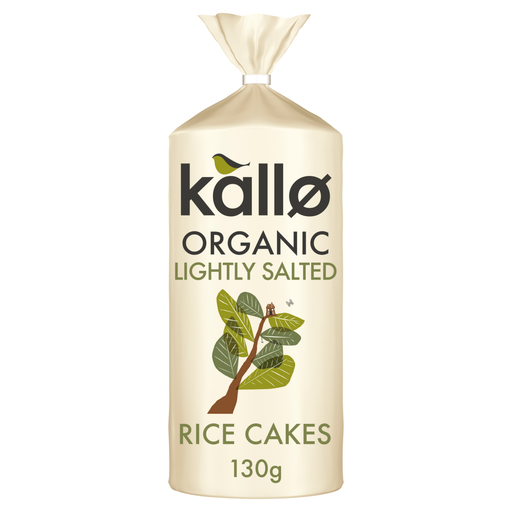
Kallo Organic Lightly Salted Rice Cakes 130g
A lightly salted wholegrain option if you want to choose your own desk-lunch topping. Tesco Groceries lists 2.7 g fat and 0.3 g salt per 100 g for this organic 130 g variety. Check the current pack’s allergen statement if you have an allergy.
View on Joybuy
 No image available
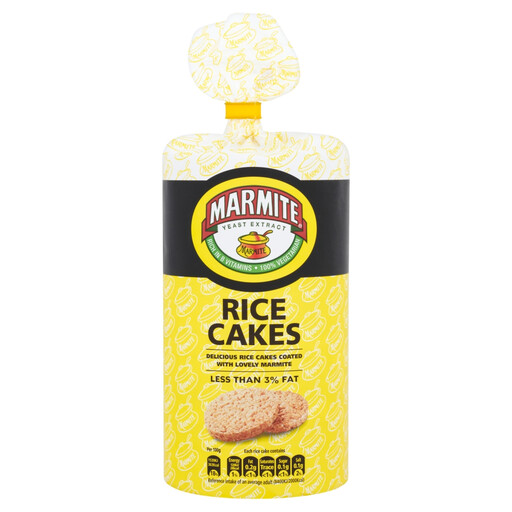
Marmite Rice Cakes 110g
A Marmite-flavoured choice for a quick snack rather than a neutral topping base. Check the current pack’s fat and salt figures per 100 g, along with its ingredients and allergens, before deciding whether it meets your desk-lunch needs.
View on Joybuy
Frequently asked questions
Does ‘reduced fat’ mean ‘low fat’ on rice cakes?
No. ‘Reduced fat’ is comparative; it does not by itself tell you the product’s absolute fat content. GOV.UK’s November 2021 guidance on retained nutrition-claims rules and the legislation.gov.uk annex set the ‘low fat’ condition for solid foods at no more than 3 g fat per 100 g, so check that figure on the pack.
Can plain rice cakes make up a whole desk lunch?
Use them as the starchy base rather than assuming a few plain cakes make up the whole meal. Norfolk and Waveney Integrated Care Board and NHS Norfolk and Norwich University Hospitals NHS Foundation Trust advise including protein, a fat source and fruit or vegetables alongside starchy carbohydrate when putting together a meal.
Which listed plain variety has the lowest declared salt figure?
Among the plain and lightly salted varieties discussed here, Sainsbury’s No Added Salt Rice Cakes have the lowest listed per-100-g figure: less than 0.01 g, according to Sainsbury’s. Compare the current labels for the exact packs you are choosing, especially if salt is a deciding factor.
Is a gluten-free or vegan rice cake automatically suitable for someone with an allergy?
No. Suitability depends on the particular allergen and product statement. Kallo describes its lightly salted wholegrain cakes as gluten free and vegan-friendly, but its allergen information also says they may contain milk, sesame and soya; read the current pack before buying for an allergy.


