Father’s Day shoppers looking for a low-fat option
If rice cakes are part of a gift, compare the fat figure on the pack and choose a flavour the recipient enjoys. Check dietary requirements before giving a snack to someone else.


For a Father’s Day gift, do not treat “reduced fat” and “low fat” as interchangeable: reduced fat compares a product with a similar one, while NHS guidance describes low-fat food as having no more than 3g fat per 100g. Among the checked plain options, Kallo Organic Unsalted lists 2.7g fat and 0.0g salt per 100g; if the recipient prefers a flavoured snack, compare its own label and check their flavour preferences and allergens before buying.
If rice cakes are part of a gift, compare the fat figure on the pack and choose a flavour the recipient enjoys. Check dietary requirements before giving a snack to someone else.
An unsalted rice cake may suit someone who wants to compare salt as well as fat. Ocado’s listing for Kallo Organic Unsalted gives 2.7g fat and 0.0g salt per 100g.
Sweet, chilli and salt-and-vinegar varieties offer different flavours, but their nutrition figures need checking product by product. Marks & Spencer lists different fat figures for its lightly salted and flavoured rice cakes.
Start with the claim on the pack, then compare fat per 100g; check salt, flavour and allergens separately for the person receiving the gift.
| Priority | What to check | Your needs |
|---|---|---|
| Fat claim | Read the exact pack wording and total fat per 100g. A reduced-fat claim compares the product with a similar one; NHS guidance describes low-fat food as having no more than 3g fat per 100g. | I want to know whether the pack promises a reduction against another product or gives me a low-fat option in its own right. |
| Flavour and fat | Compare flavours on the same per-100g basis. Marks & Spencer lists 2.5g fat for Lightly Salted, 15.2g for Sweet and Salty and 16.2g for Sweet Chilli rice cakes. | If the recipient likes a flavoured snack, I would choose a flavour they enjoy rather than assume its fat figure matches a plain rice cake. |
| Salt | Read the salt figure independently of fat. NHS guidance describes 0.3g salt or less per 100g as low; Ocado lists 0.0g per 100g for Kallo Organic Unsalted. | Salt matters to the recipient too, so I want to compare it before choosing between salted and unsalted cakes. |
| Allergens | Read the current pack’s ingredients and allergen statement, including any “may contain” wording. Do not use vegan or gluten-free wording as a substitute for that check. | Before giving these to someone with an allergy, I need to check the particular pack against what they avoid. |
A reduced-fat claim makes a comparison; a low-fat description concerns the product’s fat content. NHS guidance gives a low-fat figure of no more than 3g per 100g for food.
If you specifically want a reduced-fat product, look for that claim on the pack. If you want to compare how much fat the cakes contain, use the per-100g figure.
Marks & Spencer lists 2.5g fat per 100g for its Lightly Salted rice cakes, compared with 15.2g for Sweet and Salty and 16.2g for Sweet Chilli.
Check the nutrition panel of the flavour you intend to buy rather than applying a plain variety’s figures to it.
Fat and salt are separate label figures. Marks & Spencer lists 0.33g salt per 100g for its Lightly Salted cakes, while Ocado lists 0.0g for Kallo Organic Unsalted.
Compare salt per 100g as well if that distinction matters to the recipient.
Retailer listings for checked Kallo rice cakes include “may contain” statements for milk, sesame and soya. Dietary-preference labels do not replace those warnings.
For a recipient with an allergy, read the allergen statement on the current pack before gifting it.
These examples help distinguish individual rice-cake labels; a figure for one flavour should not be applied to an entire range.
Plain, lightly salted and unsalted rice cakes provide options for comparing fat and salt separately.
Its checked lightly salted and flavoured rice cakes show why the individual flavour matters.
Its checked salt-and-vinegar jumbo cake and Singles packs offer flavour-led options with nutrition figures given by cake or pack.
Tesco’s checked Kallo listing is a retailer example, not a nutrition figure for Tesco own-label rice cakes.
These options cover a lightly salted Kallo rice cake and a Marmite-flavoured rice cake. Choose between them by the recipient’s flavour preference, then check the current nutrition and allergen details for the pack you buy.
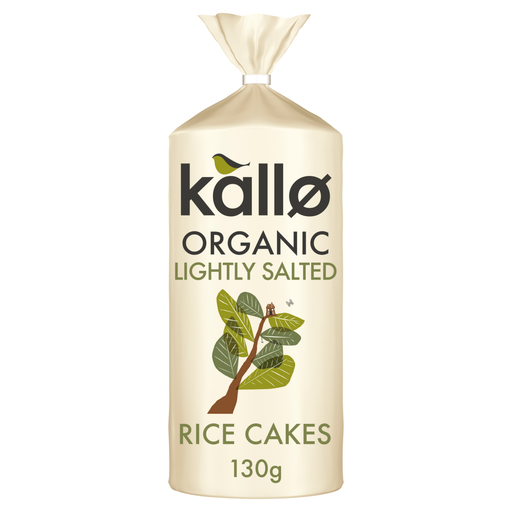 No image available
A lightly salted option for someone who prefers a simple rice cake. Sainsbury’s lists 2.7g fat per 100g for this 130g variety; check the current pack’s salt and allergen information for the recipient.
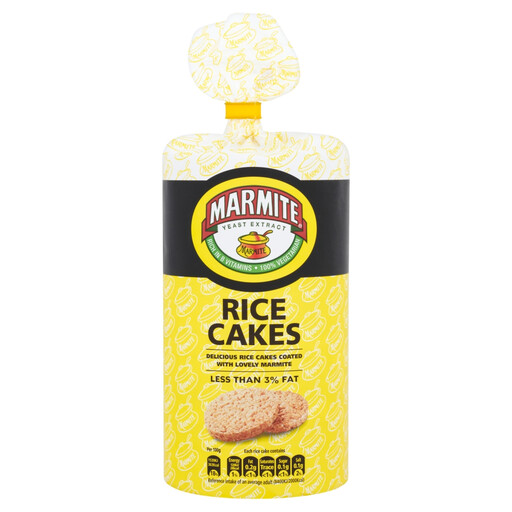 No image available
A Marmite-flavoured option if the recipient likes that taste. Check the current pack’s fat and salt figures, and read its allergen information before giving it to someone who avoids particular ingredients.
No. “Reduced fat” compares a product with a similar one, whereas NHS food-label guidance describes low fat as no more than 3g fat per 100g. Read the pack’s actual claim and per-100g figure rather than treating the terms as synonyms.
Compare both figures for the particular variety. Ocado lists Kallo Organic Unsalted at 2.7g fat and 0.0g salt per 100g; Marks & Spencer lists its Lightly Salted rice cakes at 2.5g fat and 0.33g salt per 100g. The choice depends on which figures and flavour matter to the recipient.
Do not assume they are suitable. Checked Kallo retailer listings include “may contain” warnings for milk, sesame and soya, so read the allergen statement on the exact pack before giving it to someone with one of those allergies.