Office workers comparing fat values
If you want a crunchy snack in your packed lunch, compare the fat figure on the nutrition panel rather than judging a rice cake by its light texture.


For a low-fat office snack, start with the fat value per 100 g on the exact variety: M&S Lightly Salted Rice Cakes list 2.5 g, while Kallo Organic Unsalted and Organic Lightly Salted Rice Cakes each list 2.7 g. Kallo's unsalted variety declares trace salt if that distinction matters to you. Flavoured or coated varieties can have different fat values, and any topping needs to be considered separately from the rice cake.
If you want a crunchy snack in your packed lunch, compare the fat figure on the nutrition panel rather than judging a rice cake by its light texture.
A plain or lightly salted cake gives you a base for a topping. Check the base product's salt and fat values, then assess anything you add separately.
Product-specific labels matter: Kallo's researched rice cakes are labelled gluten free but carry may-contain warnings for milk, sesame and soya.
Choose the variety by its nutrition panel first, then check whether its flavour, allergen information and storage instructions work for your lunch routine.
| Priority | What to check | Your needs |
|---|---|---|
| Fat per 100 g | Compare the exact varieties on the same per-100 g basis. Business Companion's permitted nutrition claims guidance sets no more than 3 g fat per 100 g for a low-fat claim on solid food; check the per-cake figure separately for the portion you pack. | I want the label to support a low-fat choice, even if another rice cake looks just as light. M&S lists 2.5 g fat per 100 g for its Lightly Salted variety but 15.2 g for Sweet and Salty. |
| Salt and flavour | Read the salt value for the exact variety and decide whether you want an unsalted base or a seasoned snack. Kallo lists trace salt for Organic Unsalted and 0.25 g per 100 g for Organic Lightly Salted. | If I am adding a topping, an unsalted or lightly salted base lets me choose the finished flavour. For a snack eaten on its own, I may prefer a seasoned variety. |
| Ingredients and allergens | Check the current gluten-free declaration, ingredients and precautionary allergen statement for the specific pack. Kallo's researched products warn that they may contain milk, sesame and soya. | I need to check whether this particular variety meets my ingredient and allergen requirements; a gluten-free label does not answer every allergen question. |
| Packing and storage | Read the opened-pack instructions and consider how you will carry a serving. M&S advises storing its Lightly Salted Rice Cakes in an airtight container once opened. | I want the cakes to keep their condition until lunch, particularly if I open a larger pack over several working days. |
Coatings and flavourings can make a substantial difference. M&S lists 2.5 g fat per 100 g for Lightly Salted Rice Cakes, compared with 15.2 g for Sweet and Salty and 20.4 g for Milk Chocolate.
Compare the fat value per 100 g on the exact variety before choosing it as a low-fat snack.
A small or airy cake does not establish its fat content per 100 g. Business Companion's guidance sets a defined threshold of no more than 3 g fat per 100 g for a low-fat claim on solid food.
Check the per-100 g panel first, then the per-cake or per-pack figure for the amount you plan to take to work.
The base product's nutrition values do not include a spread or other topping.
If fat content matters to your lunch choice, check the topping's nutrition and the amount you will use separately.
Kallo labels its researched rice cakes gluten free, but warns that they may contain milk, sesame and soya.
Read the ingredients and precautionary allergen statement on the exact pack you buy.
Kallo's plain wholegrain varieties offer unsalted and lightly salted options for comparing fat and salt values.
M&S provides a useful example of why the variety matters more than the rice-cake category alone.
Snack a Jacks is an option to consider if an individually portioned, flavoured snack suits your work lunch.
These options cover a lightly salted rice cake for adding toppings and a Marmite-flavoured cake for eating on its own. Compare the exact packs if fat content, salt or gluten suitability is important to your choice.
 No image available
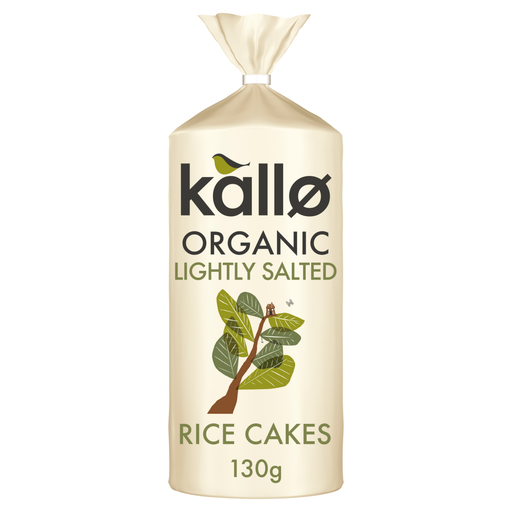
A lightly salted base if you want to pack rice cakes plain or add your own topping. Kallo lists 2.7 g fat per 100 g for its Organic Lightly Salted variety; check the current pack's salt value and may-contain allergen statement.
 No image available
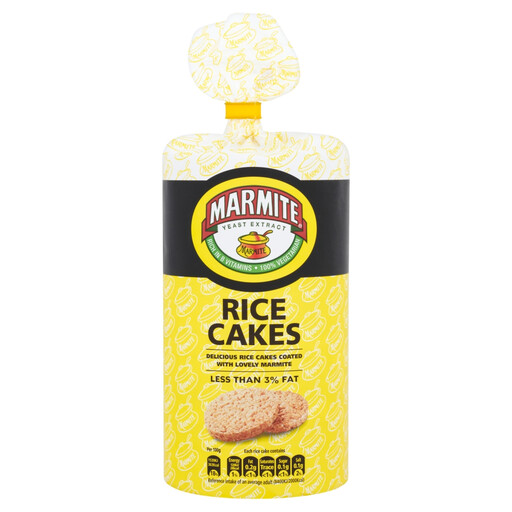
A Marmite-flavoured option for eating without a topping rather than using as a neutral base. It is not suitable for a gluten-free diet; check the current pack's fat and salt values and full ingredient list before buying.
Business Companion's permitted nutrition claims guidance says a solid food making a low-fat claim must contain no more than 3 g fat per 100 g. Check that figure on the exact variety's nutrition panel, as well as the portion you intend to pack.
No. M&S lists 2.5 g fat per 100 g for its Lightly Salted Rice Cakes, but 15.2 g for Sweet and Salty and 20.4 g for Milk Chocolate. Compare varieties rather than relying on the category name.
Kallo Organic Unsalted Wholegrain Rice Cakes declare trace salt and 2.7 g fat per 100 g, according to Kallo. Check the current pack if a particular salt value matters to your choice.
No. Kallo's researched rice cakes are labelled gluten free but carry may-contain warnings for milk, sesame and soya. Read the exact pack's ingredients and precautionary statements before buying.
Yes. A rice cake's declared figure covers the cake, not anything spread or placed on it. If you are comparing lunches by fat content, check the topping's nutrition and the amount you use separately.