For a ploughman’s lunch, choose a plain or lightly salted rice cake with no more than 3 g fat per 100 g if low fat is your priority; NHS food-label guidance uses that cut-off for solid foods. Compare salt as well as fat when adding cheese or pickle, and check the current pack’s allergen statement before relying on gluten-free or vegan-recipe wording.
Who is choosing a rice-cake base?
Lunch builders checking fat
If you want a rice cake instead of a cracker or bread base, compare total fat per 100 g. NHS food-label guidance uses 3 g or less per 100 g as the low-fat cut-off for solid foods; calories per cake answer a different question.
Shoppers pairing cakes with salty toppings
Cheese, pickle or cured meat may make the salt in the base worth checking too. Compare the rice cakes’ salt declarations rather than assuming a flavoured snack and a plain cake are interchangeable.
People checking dietary labels and allergens
Gluten-free or vegan-recipe wording does not replace an allergen check. Kallo’s cited lightly salted products warn that they may contain milk, sesame and soya; Sainsbury’s says its vegan-recipe rice cakes are unsuitable for customers with a milk allergy because of manufacturing methods.
What should you check first?
Start with fat per 100 g, then compare salt on a consistent basis. Ingredients, allergen warnings and storage instructions can settle the choice between otherwise suitable packs.
| Priority | What to check | Your needs |
|---|
| Fat |
Read total fat per 100 g, not just calories or fat per cake. NHS guidance sets the low-fat cut-off for solid foods at 3 g per 100 g. |
I want a rice-cake base that meets the low-fat cut-off, even if pack sizes and cake portions differ. |
| Salt |
Compare salt per 100 g where shown, then check the amount per cake for the portion you plan to eat. Sainsbury’s lists less than 0.01 g salt per cake; Tesco Lightly Salted lists 0.23 g per 100 g. |
With cheese or pickle on top, I’d rather check how much salt the base contributes than choose by flavour name alone. |
| Dietary suitability |
Read the exact pack’s ingredients and allergen statement alongside any gluten-free, organic or vegan-recipe wording. Check may-contain warnings where an allergy is relevant. |
A dietary label matters to me, but I also need to know whether the product’s allergen warning fits my requirements. |
| Storage |
Check the opened-pack instructions if you plan to use one pack across several lunches. Tesco’s listing for Kallo Organic Lightly Salted says to keep it airtight after opening and enjoy it within 14 days. |
I’ll use the cakes over more than one lunch, so the pack’s storage instructions affect which size I choose. |
What can make a comparison misleading?
-
Taking a light texture as proof of low fat
An airy cake or a lightly salted name does not tell you its total fat content. NHS guidance uses no more than 3 g fat per 100 g as the low-fat cut-off for solid foods.
Check the per-100-g nutrition panel first, then look at salt and the number of cakes you expect to use.
-
Comparing a flavoured pack with a plain cake by name alone
Snack a Jacks lists 0.63 g salt per 23 g Salt & Vinegar pack, while Sainsbury’s lists less than 0.01 g per plain rice cake. Those are different portions, so the figures should not be treated as a like-for-like salt ranking.
For a lunch with salty toppings, compare the salt declarations on the actual plain and flavoured products you are considering.
-
Assuming a vegan recipe rules out milk exposure
Sainsbury’s describes its rice cakes as prepared to a vegan recipe but unsuitable for customers with a milk allergy because of manufacturing methods. Kallo’s cited products carry may-contain warnings for milk, sesame and soya.
If an allergy is relevant, make the current pack’s allergen statement your final check.
Rice-cake brands and own-label options
Kallo
Plainly flavoured wholegrain options include an organic lightly salted variant.
- Kallo lists 2.8 g fat per 100 g for Lightly Salted; Tesco lists 2.7 g per 100 g for the organic variant.
- The cited products may contain milk, sesame and soya, according to their allergen information.
Tesco
Its Lightly Salted Rice Cakes offer a brown-rice and sea-salt base.
- Tesco lists 2.9 g fat and 0.23 g salt per 100 g for the 130 g pack.
- Check the current pack when buying, as Tesco notes that formulations and label information may change.
Sainsbury’s
Its plain 135 g rice cakes are an option when you want little salt from each cake.
- Sainsbury’s lists 2.4 g fat per 100 g and less than 0.01 g salt per cake.
- Although prepared to a vegan recipe, the product is not suitable for customers with a milk allergy because of manufacturing methods, according to Sainsbury’s.
ASDA
Its Slightly Salted Rice Cakes use brown rice and sea salt.
- ASDA lists 2.9 g fat and 0.25 g salt per 100 g for the 130 g pack.
- The product may contain soya; check the current pack for its ingredients and allergen statement.
M&S
Its Lightly Salted Rice Cakes are made from puffed wholegrain brown rice.
- M&S lists 2.5 g fat per 100 g for this UK product.
- Its listed salt figure is 0.33 g per 100 g; M&S says availability varies by store.
Snack a Jacks
Its flavoured singles are a different choice from a plain rice-cake base for cheese and pickle.
- The Salt & Vinegar single pack declares nutrition per 23 g pack, making its portion clear.
- That pack lists 0.63 g salt; compare its nutrition panel with a plain option rather than assuming rice-based snacks are alike.
Rice cakes on Joybuy
This organic, lightly salted rice cake is an option for a ploughman’s-lunch base when you are checking both fat and salt.
 No image available
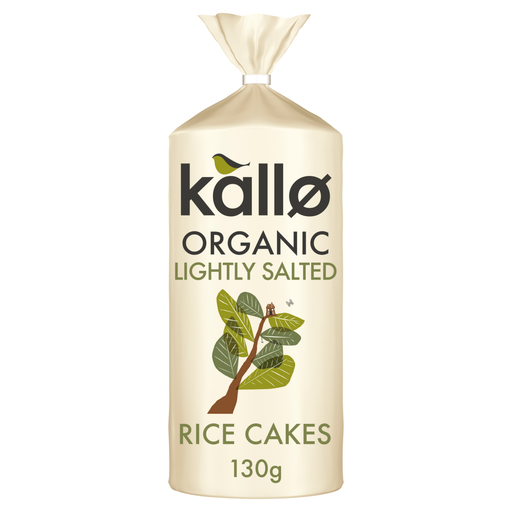
Kallo Organic Lightly Salted Rice Cakes 130g
For a plain base alongside cheese and pickle, this organic lightly salted variant lists 2.7 g fat and 0.3 g salt per 100 g. Its allergen information warns that it may contain milk, sesame and soya. Once opened, keep the pack airtight and enjoy it within 14 days, according to the product listing.
View on Joybuy
Questions about choosing and storing rice cakes
How can I check whether a rice cake is low in fat?
Read total fat per 100 g: NHS food-label guidance uses 3 g or less per 100 g as the low-fat cut-off for solid foods. Calories per cake do not replace that comparison.
Should I compare salt per cake or per 100 g?
Use per 100 g to compare rice cakes on the same basis, then use the per-cake figure, where given, to consider the portion you plan to eat. NHS guidance notes that nutrition labels give per-100-g information and sometimes per-portion information.
Does gluten-free or vegan-recipe wording settle an allergy question?
No. Check the current pack’s ingredients and allergen statement for the exact product. Kallo’s cited lightly salted products may contain milk, sesame and soya, while Sainsbury’s says its vegan-recipe rice cakes are unsuitable for customers with a milk allergy because of manufacturing methods.
How should I store rice cakes after opening?
Follow the instructions on the pack you buy. Tesco’s listing for Kallo Organic Lightly Salted Wholegrain Rice Cakes says to keep the opened pack in an airtight container and enjoy it within 14 days; instructions for other products may differ.


