Students wanting a plain snack between meals
If you want something crisp during a revision break, use the per-100g label to check its fat content rather than assuming all rice cakes are alike.


If low fat is your priority, compare plain rice cakes per 100g: M&S Lightly Salted and Kallo’s Organic Lightly Salted and Lightly Salted products each list no more than 3g fat per 100g, the NHS guide for a low-fat food. For a revision snack, check the exact flavour and any topping too; a plain rice cake is a between-meal option, not a replacement for a meal.
If you want something crisp during a revision break, use the per-100g label to check its fat content rather than assuming all rice cakes are alike.
Rice cakes can be one between-meal option. Check the exact pack’s ingredients and allergen information, and keep regular meals part of the routine.
If flavour matters, compare the nutrition panels of the particular varieties you are considering. Added ingredients can make a substantial difference to fat content.
Start with fat per 100g for a like-for-like comparison, then consider the flavour, your planned portion and any topping.
| Priority | What to check | Your needs |
|---|---|---|
| Fat content | Compare total fat per 100g with the NHS low-fat guide of 3g or less per 100g for food. Check the figure on the exact variety. | I’m looking for a lower-fat option, so I want a per-100g figure I can compare across packs. |
| Flavour and portion | Compare plain and flavoured varieties per 100g. Then use the per-cake value to work out the portion you plan to eat. | A flavoured cake appeals to me, but I don’t want its smaller per-cake number to obscure a different per-100g result. |
| Between-meal use | Decide whether you want a plain cake or an accompaniment. Check any topping separately, including its nutrition and allergens. | For a revision break, I want a snack between regular meals rather than something to take the place of lunch. |
| Ingredients and allergens | Read the current pack’s ingredients and precautionary allergen statements. Check the particular flavour, not just a range-wide dietary description. | If I need to avoid an ingredient or possible cross-contact, the wording on the cake I’m buying matters. |
M&S lists 2.5g fat per 100g for its Lightly Salted Rice Cakes but 15.2g per 100g for its Sweet and Salty variety. A result for one flavour does not describe the whole range.
If low fat is your priority, check the exact product against the NHS guide of 3g fat or less per 100g for food.
Tesco lists 0.2g fat per Lightly Salted Rice Cake, but 3.1g per 100g. The per-cake figure alone does not show whether it meets the NHS low-fat guide.
Compare products per 100g first, then use per-cake figures to consider your portion.
Guidance for teenagers from Norfolk and Norwich University Hospitals NHS Foundation Trust cautions that snacking throughout the day instead of eating meals usually leads to an unbalanced diet.
Keep rice cakes as a between-meal option. If you add a topping, consider the finished snack rather than the rice cake alone.
Kallo’s lightly salted product pages say the cakes may contain milk, sesame and soya. A description of the recipe does not remove that cross-contact warning.
For an allergy or strict avoidance requirement, read the ingredients and precautionary statement on the current pack.
Kallo’s plain lightly salted wholegrain cakes provide two products to compare by their per-100g labels.
M&S shows why the exact variety matters, even within one rice-cake range.
Tesco Lightly Salted Rice Cakes illustrate the difference between per-cake and per-100g figures.
The Jumbo range offers flavoured cakes with nutrition figures published per cake.
This plain, lightly salted option is relevant if you want a rice cake to compare against the NHS per-100g low-fat guide.
 No image available
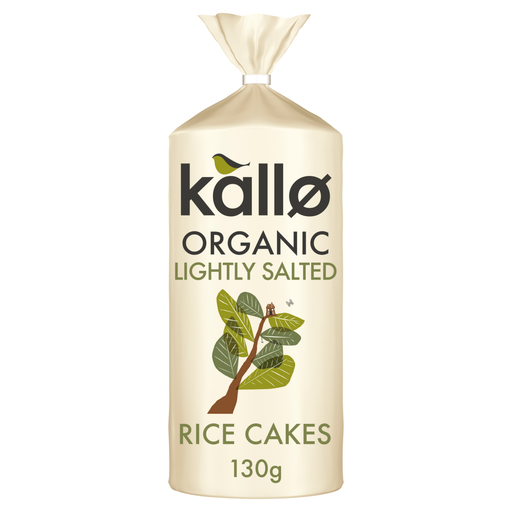
For a plain rice cake between revision sessions, this variety lists 2.7g fat per 100g, within the NHS guide of 3g or less per 100g for a low-fat food. Kallo lists organic wholegrain brown rice and sea salt; its product information also warns that the cakes may contain milk, sesame and soya. Check the current pack if those allergens matter to you.
The NHS guide sets low fat for food at 3g of total fat or less per 100g. Compare that figure on each rice-cake pack rather than relying only on the amount per cake.
No: treat them as a between-meal snack, not a complete meal. Norfolk and Norwich University Hospitals NHS Foundation Trust cautions that snacking all day instead of eating meals usually leads to an unbalanced diet; the NHS gives rice cakes with lower-fat cream cheese and cucumber as one snack example.
Not necessarily. M&S lists 2.5g fat per 100g for Lightly Salted Rice Cakes and 15.2g per 100g for Sweet and Salty Rice Cakes. Check the nutrition panel for the exact flavour you intend to buy.
Read the current pack’s ingredients and precautionary allergen statement for the exact variety. Kallo’s lightly salted product pages, for example, warn that the cakes may contain milk, sesame and soya.