Holiday snack packers
If you are packing rice cakes for a day trip or keeping them in holiday accommodation, compare plain and lightly salted packs by fat per 100g rather than flavour alone. Check how the opened pack should be stored.


For a low-fat rice cake to pack on a summer holiday, start with the fat figure per 100g: NHS food-label guidance defines low fat as 3g or less per 100g. Plain and lightly salted options in the cited Sainsbury’s, M&S and Tesco listings fall between 2.4g and 2.9g per 100g, but compare each flavour separately and check salt, ingredients, allergens and the portion you expect to eat. Follow the pack’s storage instructions once opened.
If you are packing rice cakes for a day trip or keeping them in holiday accommodation, compare plain and lightly salted packs by fat per 100g rather than flavour alone. Check how the opened pack should be stored.
A plain rice cake provides a neutral base for sweet or savoury toppings. Consider the topping and the number of cakes when comparing the snack you will actually eat.
Read the exact pack’s ingredients and allergen statement before buying or sharing. Dietary wording on one rice cake does not establish the suitability of another flavour or product.
Compare fat on the same per-100g basis first, then use the rest of the label and the pack instructions to decide whether a particular rice cake works for your trip.
| Priority | What to check | Your needs |
|---|---|---|
| Fat and portion | NHS guidance sets the low-fat threshold for food at 3g fat or less per 100g. Compare that line across packs, then check the per-cake information against how many you expect to eat. | I want to compare low-fat options fairly, without treating one cake’s calorie figure as the figure for my whole snack. |
| Flavour and nutrition | Read fat, saturates, sugars and salt per 100g on the specific flavour. For context, Sainsbury’s lists 2.4g fat per 100g for its plain rice cakes and 2.7g per 100g for its lightly salted wholegrain version. | A ready-to-eat flavour might suit the journey; if I prefer a neutral base, I can choose a plain cake and account for any topping separately. |
| Ingredients and allergens | Check the current ingredient list, dietary wording and allergen statement for the exact pack. Tesco’s Kallo listing carries a may-contain warning for milk, sesame and soya. | When I’m sharing snacks, I need to check suitability for each person rather than rely on a brand name or a vegan label. |
| Storage after opening | Follow the named pack’s instructions for cool, dry storage and airtight storage after opening. Tesco’s Kallo listing also advises eating that opened product within 14 days. | If a pack will stay open during the holiday, I want a way to close or transfer it as the label directs. |
A per-cake calorie figure does not show whether a food meets the low-fat threshold or represent a snack of several cakes.
Use fat per 100g for a like-for-like comparison. NHS guidance defines low fat as 3g fat or less per 100g; check the per-cake figures for the portion you plan to eat.
Even the cited plain and lightly salted rice cakes have different fat and salt figures. A coated or flavoured version needs its own label check.
Compare fat, saturates, sugars and salt on the current nutrition panels when changing flavour or retailer.
Sainsbury’s states that its plain rice cakes are prepared to a vegan recipe but are not suitable for customers with a milk allergy because of manufacturing methods. Tesco’s Kallo listing has a separate may-contain warning.
Read the current ingredients and allergen statement for the exact product before buying or sharing it.
The cited Sainsbury’s, Tesco and Kallo listings give airtight-storage instructions for opened packs.
Plan how to close or transfer the pack while away, and follow its own post-opening directions.
The Kallo organic lightly salted rice cakes in Tesco’s listing are an option for shoppers looking for an explicitly low-fat, organic-labelled product.
Tesco’s own-label lightly salted rice cakes offer a straightforward option to compare with plain varieties.
The cited Sainsbury’s listings offer both plain and lightly salted wholegrain rice cakes.
M&S lists lightly salted rice cakes alongside other rice-cake varieties.
Snack a Jacks appears in UK supermarket listings with savoury flavoured rice cakes.
These Joybuy options include a lightly salted cake and two distinct flavours for holiday snacking. Compare each pack’s current per-100g nutrition and allergen information before deciding which to take.
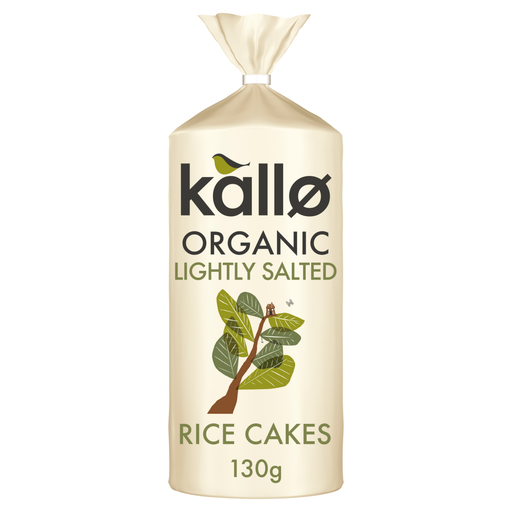 Image unavailable
A lightly salted option to consider if you want a rice cake for eating plain or adding toppings. The Joybuy listing describes organic wholegrain rice and gives 27 calories per cake; check the current pack for fat per 100g, allergens and storage instructions.
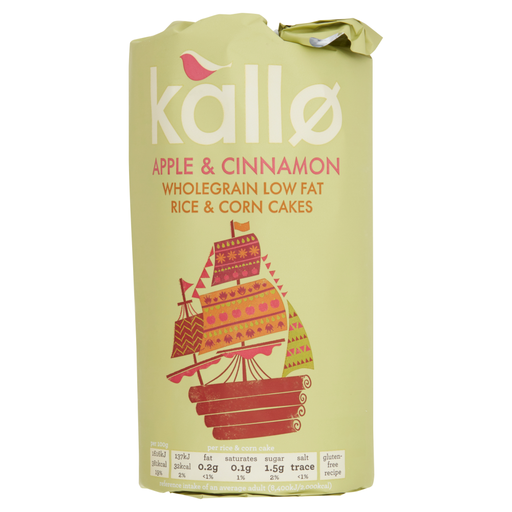 Image unavailable
An apple-and-cinnamon option if you would rather pack a flavoured cake than add a topping. Compare its fat and sugars per 100g with a plain or lightly salted pack, and check its current allergen statement.
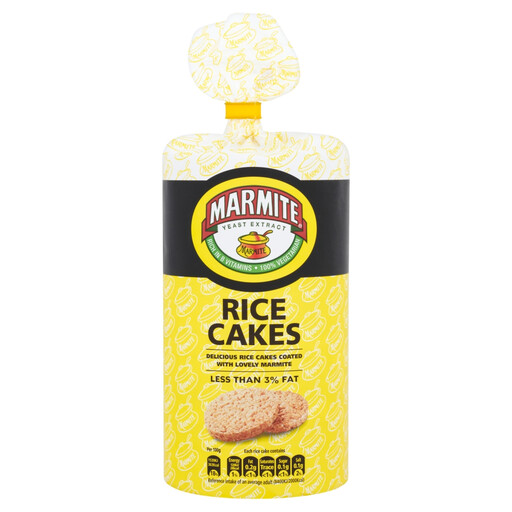 Image unavailable
A Marmite-flavoured option for a savoury snack rather than a neutral topping base. Check the pack’s fat and salt per 100g and read its ingredients and allergen statement before sharing.
NHS food-label guidance defines low fat for food as 3g fat or less per 100g. Compare the per-100g line across products, then check the per-cake or per-serving figures for the portion you expect to eat.
Not necessarily: the number of cakes and any toppings affect the snack you assemble. Check the energy information for your likely portion as well as fat, sugars and salt on the rice cake’s label.
Do not assume so. Sainsbury’s says its plain rice cakes are prepared to a vegan recipe but are not suitable for customers with a milk allergy because of manufacturing methods. Tesco’s Kallo listing also warns that the named product may contain milk, sesame and soya. Read the exact current pack before buying or sharing.
Follow that pack’s instructions. The cited Sainsbury’s and Tesco listings advise cool, dry storage and an airtight container after opening; Tesco’s Kallo listing additionally advises eating its opened product within 14 days. Check another variety’s pack for its own directions.