Shoppers looking for a low-fat base
If a rice cake’s light appearance is what caught your eye, compare the nutrition panel instead. The legislation.gov.uk annex sets the low-fat claim threshold for solid foods at no more than 3g fat per 100g.


For a low-fat tea-break base, start with a plain or lightly salted rice cake and compare fat per 100g. The low-fat claim threshold for solid foods in the legislation.gov.uk annex is no more than 3g per 100g; among the named lightly salted products compared here, Marks & Spencer lists 2.5g fat per 100g for M&S Lightly Salted, while Kallo lists 2.7g fat and less salt per 100g for Kallo Organic Lightly Salted. Check the current pack for allergens and consider any topping separately.
The useful starting point depends on whether fat, salt or a product-specific dietary label matters most to you.
If a rice cake’s light appearance is what caught your eye, compare the nutrition panel instead. The legislation.gov.uk annex sets the low-fat claim threshold for solid foods at no more than 3g fat per 100g.
Lightly salted products can have different salt declarations even when their fat figures fall below 3g per 100g. Kallo lists 0.25g salt per 100g for Organic Lightly Salted; Marks & Spencer lists 0.33g per 100g for M&S Lightly Salted.
Use the label on the exact product, not an assumption about rice cakes as a category. Kallo’s standard Lightly Salted Rice Cakes carry a precautionary statement that they may contain milk, sesame seeds and soya.
Choose the format you want for your tea break, then compare the exact products on the same per-100g basis. A per-cake figure can help with portions, but it does not replace that comparison.
| Priority | What to check | Your needs |
|---|---|---|
| Fat | Read fat per 100g on the exact pack. The legislation.gov.uk annex sets no more than 3g per 100g as the low-fat claim threshold for solid foods. Marks & Spencer lists 2.5g for M&S Lightly Salted; Kallo lists 2.7g for Organic Lightly Salted and 2.8g for standard Lightly Salted. | I want a plain tea-break base whose low-fat description can be checked against a comparable figure, rather than judging it by how light each cake looks. |
| Salt | Compare salt per 100g within the lightly salted options. Kallo lists 0.25g for Organic Lightly Salted and 0.3g for standard Lightly Salted; Marks & Spencer lists 0.33g for M&S Lightly Salted. | Fat is not my only consideration, so I want to see the salt figure for the variety I would buy. |
| Dietary labels | Check gluten-free wording and precautionary allergen statements on the current pack. Kallo says its standard Lightly Salted Rice Cakes may contain milk, sesame seeds and soya. | If I need to avoid an ingredient or require a particular label, the named product and its pack matter more than the general rice-cake category. |
| Flavour and toppings | Check the nutrition panel of a coated or flavoured variety separately from a plain base. Marks & Spencer lists 22.7g fat per 100g for M&S Milk Chocolate Mini Rice Cakes, compared with 2.5g for M&S Lightly Salted. | For toppings of my own, I would start with a plain or lightly salted cake. If I prefer a ready-flavoured snack, I would compare that exact product instead. |
These descriptions do not give you a like-for-like fat comparison. The legislation.gov.uk annex uses fat per 100g for the low-fat claim threshold on solid foods.
Check fat per 100g first, then use the per-cake information if it helps you decide how many cakes to serve.
Snack a Jacks lists 0.63g salt per 23g pack for Sour Cream & Chive Singles, while Kallo’s named lightly salted products list salt per 100g. Those figures have different stated bases and should not be compared as though they were the same serving.
Read the panel for the exact flavour and compare products using the same measurement basis.
Kallo states that its standard Lightly Salted Rice Cakes may contain milk, sesame seeds and soya. The Food Standards Agency explains that precautionary allergen wording communicates possible unintended allergen presence.
If an allergen matters to you, read the current pack’s ingredients and precautionary statements before choosing.
Marks & Spencer lists 22.7g fat per 100g for M&S Milk Chocolate Mini Rice Cakes and 2.5g per 100g for M&S Lightly Salted Rice Cakes. The coating changes the comparison.
Assess a coated variety or your chosen toppings separately from the lightly salted base.
These examples illustrate differences between named rice-cake products and formats; a brand name alone does not establish the nutrition of every variety.
Kallo lists standard and organic lightly salted wholegrain rice cakes with separate nutrition declarations.
The M&S range includes a lightly salted rice cake and coated varieties with different nutrition figures.
Tesco lists an own-label Lightly Salted Rice Cakes 130g product among its plain and salted rice cakes.
Snack a Jacks offers flavoured single-pack rice cakes as an alternative to a plain topping base.
These Joybuy options include an organic lightly salted cake for a simple tea-break base and an apple-and-cinnamon variety for a ready-flavoured snack. Compare the exact pack’s nutrition and allergen information according to which format you want.
 No image available
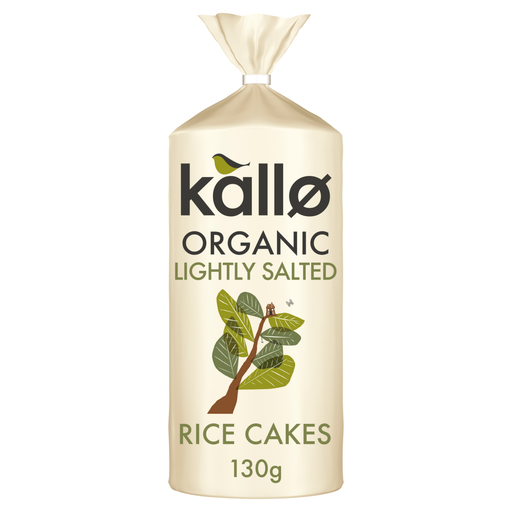
A lightly salted option if you want a base for your own tea-break topping. Kallo lists 2.7g fat and 0.25g salt per 100g for this named product; check the current pack for dietary and allergen information.
 No image available
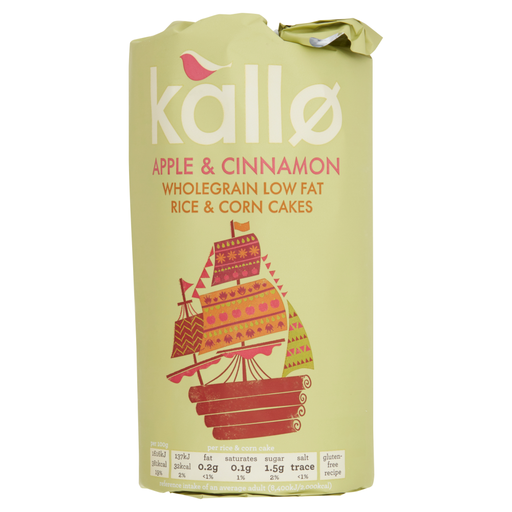
An apple-and-cinnamon variety if you would rather have a flavoured tea-break snack than a plain topping base. Check the current pack’s fat per 100g, ingredients and allergen statements before deciding whether it meets your requirements.
No. The legislation.gov.uk annex sets the low-fat claim threshold for solid foods at no more than 3g fat per 100g. Check the per-100g fat figure for a like-for-like comparison, then use per-cake information when considering your portion.
Among the three named products compared here, Marks & Spencer lists the lowest figure for M&S Lightly Salted Rice Cakes at 2.5g fat per 100g. Kallo lists 2.7g for Organic Lightly Salted and 2.8g for standard Lightly Salted. Check the current pack when buying.
No. Check the label on the exact product. Kallo labels its standard Lightly Salted Rice Cakes gluten free but says they may contain milk, sesame seeds and soya; the Food Standards Agency explains that “may contain” statements indicate possible unintended allergen presence.
Do not assume it has the same nutrition figures. Marks & Spencer lists 22.7g fat per 100g for M&S Milk Chocolate Mini Rice Cakes, compared with 2.5g per 100g for M&S Lightly Salted Rice Cakes. Compare the particular coated product you are considering.
Follow the instructions on your pack. For M&S Lightly Salted Rice Cakes, Marks & Spencer advises storage in a cool, dry place and an airtight container once opened.