Shoppers comparing fat content
If fat content is your main consideration, compare rice cakes per 100g before looking at the amount in one cake. A “low fat” label does not, by itself, tell you how much less fat a product contains than another.


A plain or lightly salted rice cake is a useful starting point when fat content matters more than a ready-made flavour: the Kallo, Sainsbury’s and M&S examples listed by their retailers contain 2.4–2.7g fat per 100g, compared with 5.8g per 100g for the listed Snack a Jacks salt-and-vinegar cake. Compare the pack’s per-100g and per-cake figures before choosing, and count any topping as part of your elevenses snack.
If fat content is your main consideration, compare rice cakes per 100g before looking at the amount in one cake. A “low fat” label does not, by itself, tell you how much less fat a product contains than another.
A plain or lightly salted cake gives you a base for an elevenses snack. Check the cake and topping together if you are comparing the fat or salt in what you will eat.
A flavoured cake may have a convenient stated portion, but its per-cake figure is not enough for comparison with a differently sized plain cake. Check fat and salt per 100g as well.
Start with the type of claim and the per-100g nutrition panel, then check the portion you expect to eat and any ingredients that matter to you.
| Priority | What to check | Your needs |
|---|---|---|
| Fat claim | Read the exact wording: “reduced fat” compares a product with a similar one, whereas “low fat” is a different claim. The nutrition-claims annex published on legislation.gov.uk describes a reduction of at least 30% for a reduced-nutrient claim; check what product is being compared. | I want to know whether the label describes the cake’s fat content or a reduction against another cake, rather than treating the two claims as interchangeable. |
| Fat and portion | Compare fat per 100g, then read the figures for one cake or the stated serving. Sainsbury’s lists 2.4g fat per 100g for its plain cakes; its Kallo listing gives 2.7g per 100g and 27 kcal per cake. | For a mid-morning portion, I need both a like-for-like product comparison and a figure for the number of cakes I plan to eat. |
| Flavour and salt | Check salt and fat per 100g rather than assuming a flavoured cake resembles a plain one. Sainsbury’s lists less than 0.01g salt per plain cake; Joybuy lists 5.8g fat and 1.3g salt per 100g for Snack a Jacks Salt & Vinegar Rice Cakes. | Sometimes I would rather have a ready-flavoured cake, but I still want to see how its nutrition figures compare with a plain option. |
| Toppings | Check the amount and nutrition information for anything added to a plain or lightly salted cake. The cake’s own figures describe the base, not the finished snack. | If I add a spread or another topping, I want to account for what goes on the cake as well as the cake itself. |
| Ingredients | Read the current pack’s ingredients and allergen statement. The Sainsbury’s listing for Kallo Organic Lightly Salted Rice Cakes says they may contain milk, sesame and soya. | I need to check the particular product and pack against my dietary requirements, even if the rice cake has another dietary label. |
A low-fat label alone does not show a reduction against a comparable rice cake. The nutrition-claims annex published on legislation.gov.uk describes a reduced-nutrient claim in comparative terms.
Read the claim as written, then compare the nutrition panels of products you are considering.
Cakes can have different serving sizes. Joybuy lists 43 kcal per cake for Snack a Jacks Salt & Vinegar Rice Cakes, alongside 5.8g fat and 1.3g salt per 100g; a per-cake calorie figure does not replace those comparisons.
Use per-100g figures to compare products and per-cake figures to work out your intended portion.
The nutrition panel for a plain rice cake does not include a spread, cheese or other topping added at home.
Consider the cake and the amount of topping together when choosing your elevenses snack.
Ingredients and allergen information can change, making an earlier listing an uncertain guide to the pack you receive.
Read the current pack’s ingredients, allergen statement and storage instructions before use.
These brand examples illustrate different label, flavour and portion choices; the nutrition figures apply to the named products, not every rice cake from each brand.
Kallo Organic Lightly Salted Rice Cakes are a lightly salted wholegrain option with a stated individual-cake portion.
The salt-and-vinegar products provide ready-flavoured choices with stated serving figures.
Sainsbury’s lists both plain and lightly salted own-label rice cakes with per-cake and per-100g nutrition information.
M&S Lightly Salted Rice Cakes are a wholegrain option for shoppers comparing plain and seasoned bases.
These Joybuy options cover a lightly salted cake that can be topped and a ready-flavoured Marmite rice cake. Compare their current packs if fat, salt or allergens affect your choice.
 No image available
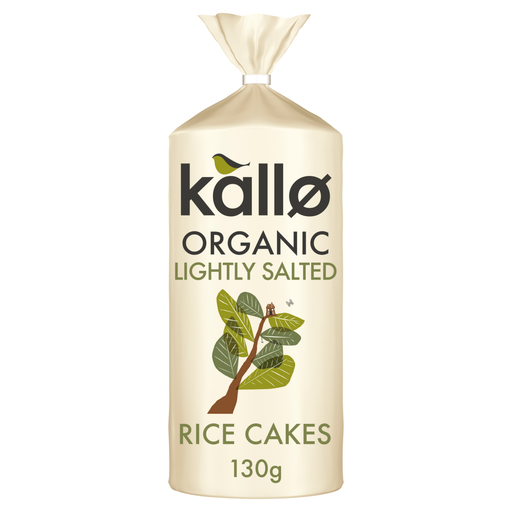
A lightly salted base if you prefer to choose your own elevenses topping. The Sainsbury’s listing for this same product gives 2.7g fat per 100g and 27 kcal per cake.
The listing says the cakes may contain milk, sesame and soya. Check the current pack’s allergen statement before use.
 No image available
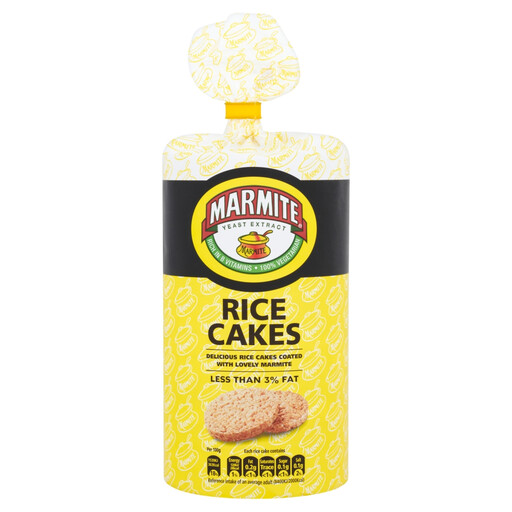
A ready-flavoured option if you do not want to add a topping. Compare the current pack’s fat and salt figures with a plain rice cake, and read its ingredients and allergen statement before choosing.
No. “Reduced fat” describes a comparison with a similar product, while a “low fat” label does not establish that comparison. The nutrition-claims annex published on legislation.gov.uk describes a reduction of at least 30% for a reduced-nutrient claim; read the exact wording on the pack and check what it is compared with.
Use both: per 100g helps you compare differently sized rice cakes, while per-cake figures help you assess the portion you intend to eat. Sainsbury’s lists Kallo Organic Lightly Salted Rice Cakes at 2.7g fat per 100g and 27 kcal per cake.
No. Joybuy lists 5.8g fat and 1.3g salt per 100g for Snack a Jacks Salt & Vinegar Rice Cakes, whereas the Kallo, Sainsbury’s plain and M&S lightly salted examples listed by their retailers contain 2.4–2.7g fat per 100g. Compare the particular products and portions you are considering.
No. Those labels do not replace the allergen statement: the Sainsbury’s listing for Kallo Organic Lightly Salted Rice Cakes says the product may contain milk, sesame and soya. Read the current pack against your own allergy requirements.