Shoppers with a low-fat target
If low fat is the deciding factor, check total fat per 100g before choosing by flavour, portion size or a front-of-pack claim.


Start with total fat per 100g: the NHS describes 3g or less per 100g as low for a solid food. Five named-brand bars in this comparison contain between 16g and 26.7g fat per 100g, so none meets that benchmark. If you choose one for its flavour, ingredients or portion size instead, compare saturates and sugars as well as total fat.
If low fat is the deciding factor, check total fat per 100g before choosing by flavour, portion size or a front-of-pack claim.
You may prefer a particular flavour, fibre or protein content, but still want to compare fat, saturates, sugars and the amount in one bar.
Vegan or gluten-free wording does not answer every ingredient or allergen question. Check the exact bar’s current pack before buying or sharing it.
Compare bars per 100g first, then look at the portion you expect to eat during a TV night.
| Priority | What to check | Your needs |
|---|---|---|
| Total fat | Read total fat per 100g on the current pack. The NHS describes 3g or less per 100g as low for solid food; compare the same measure across different bar sizes. | I’m looking for a bar that meets a low-fat target, not simply one with a smaller portion or lighter-sounding name. |
| Saturates and sugars | Check saturates and sugars separately from total fat, both per 100g and per portion. A no-added-sugar claim does not give the total sugars figure. | Fat is my starting point, but I also want to know what the other figures say before settling on a flavour. |
| Ingredients and allergens | Read the exact product’s ingredients, dietary statements and any “may contain” warning on its current pack. | I need to check whether the bar I’m buying fits my dietary requirements or is suitable to share. |
| Portion size | Note the weight of one bar and its per-portion values. If you plan to eat more than one, account for each portion rather than comparing packs by bar count alone. | When snacks are within reach throughout a programme, I want the label figures to reflect how much I’ll actually eat. |
The named-brand examples listed by Tesco Groceries, Nature Valley UK and Eat Natural UK contain 16g to 26.7g fat per 100g, despite differences in their ingredients and other label claims.
Check total fat per 100g against your target before weighing up fibre, protein or sugar claims.
A 30g bar and a 50g bar represent different amounts of food, so their per-bar figures alone do not give a like-for-like comparison.
Compare per 100g first, then read the figures for the number of bars you expect to eat.
Eat Natural UK lists 18.8g saturates per 100g for its Almond & Apricot Yoghurt Cereal Bar. Total fat and saturates answer different label questions.
If saturates matter to your choice, check that line separately on the current pack; do not judge it by total fat or coating alone.
Alpen Muesli lists Alpen Light Bars Chocolate & Orange among products it no longer makes.
Check the exact product and its current nutrition panel before using an older review or comparison to choose a bar.
These label examples concern specific bars; they do not describe every product made by each brand.
Tesco Groceries lists the Cocoa Orange Big Bar as a 45g fruit-and-nut bar.
Nature Valley UK describes its Crunchy Apple & Cinnamon Flavour Bars as high in fibre and low in salt.
Tesco Groceries lists the Original Oat Protein Flapjack as suitable for vegans.
Tesco Groceries lists the Peanut Butter Oat Boost as a 30g portion.
Eat Natural UK publishes nutrition information for its Almond & Apricot Yoghurt Cereal Bar.
Alpen Muesli identifies some older Alpen bar lines on its UK support page.
These Grenade and Graze bars offer different flavours and pack sizes for a TV-night snack. Compare the current nutrition panel for each exact variety if low fat is your priority; inclusion here does not mean a bar meets the NHS low-fat benchmark.
 No image available
For a TV-night snack with a defined bar size, this is a pack of twelve 50g Double Chocolate bars.
Check the current pack’s total fat, saturates, sugars and allergen statement before choosing it for a low-fat target.
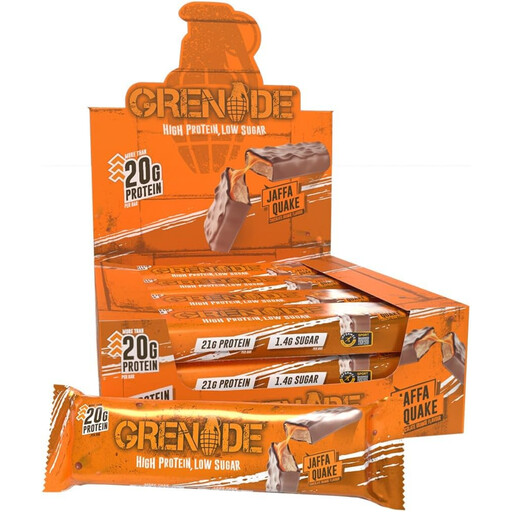 No image available
Each Jaffa Quake bar is listed at 60g, so compare its per-bar figures with the amount you plan to eat.
The product name’s protein and sugar wording does not establish its total-fat content; check fat and saturates per 100g on the current pack.
 No image available
This Cherry Bakewell pack contains four 30g oat bars, a useful distinction when comparing one bar with a larger portion.
Use the current per-100g fat and saturates figures for a like-for-like comparison; check the ingredients and allergen statement for this flavour.
 No image available
This Golden Caramel variety comes as twelve 50g bars, allowing you to identify the portion before reading its per-bar figures.
For a fat-focused choice, compare its current total fat and saturates per 100g rather than relying on the protein-bar description.
 No image available
This Peanut Butter variety is listed as a pack of twelve 50g bars for portion-by-portion comparison.
Check its current fat and saturates per 100g, and read the ingredient and allergen statements before sharing it.
For solid food, the NHS describes 3g fat or less per 100g as low. Read the total-fat figure per 100g on the current bar’s nutrition panel, rather than judging it only by the figure for one portion.
No. “Reduced fat” compares a product with another reference, while the NHS low-fat benchmark for solid food is 3g fat or less per 100g. Check both what a comparative claim refers to and the bar’s current total-fat figure.
No. Nutrition figures published by Tesco Groceries, Nature Valley UK and Eat Natural UK put these five specific bars between 16g and 26.7g total fat per 100g, above the NHS benchmark of 3g or less. That comparison does not establish the fat content of other varieties from those brands.
No. Tesco Groceries describes the Nakd Cocoa Orange Big Bar as having no added sugar, but lists 16g fat and 40g sugars per 100g. Read the nutrition panel for the exact bar instead of using its sugar claim to judge fat.
Read the current pack’s ingredients and any “may contain” statement for the exact flavour. Also check its portion size and nutrition figures if the person you’re sharing with needs that information; a different variety or pack may have different details.