Two people planning a light meal
A can with two stated servings makes it straightforward to compare roughly 200g bowls. Check that the particular soup carries a low-fat claim rather than judging it by its flavour or appearance.


For two people, start with a 400g soup whose current label makes a low-fat claim and gives nutrition for two servings or a half-can portion. Compare the fat and salt each person would eat, then check ingredients, protein and fibre if the soup is intended as a meal rather than a starter. A low-fat claim alone does not settle those choices.
Whether a 400g can works for two depends on the portion each person expects and what else they will eat with it.
A can with two stated servings makes it straightforward to compare roughly 200g bowls. Check that the particular soup carries a low-fat claim rather than judging it by its flavour or appearance.
If you prefer lentils and vegetables to smooth tomato soup, compare protein, fibre and salt per portion as well as the current vegetarian and allergen information.
A low-fat choice can still have a salt amount worth comparing. Use the half-can figure when each person will eat half of a 400g can.
Choose a soup that meets the dietary requirements of both diners, then compare the nutrition for the portion each will actually eat.
| Priority | What to check | Your needs |
|---|---|---|
| Low-fat choice | Look for a low-fat claim on the current can and read its fat value per 100g and per serving. UK Department of Health & Social Care guidance gives a limit of 3g fat per 100g for a low-fat claim on solid foods; do not assume a flavour name establishes whether a soup qualifies. | I want to choose by the particular soup’s label, not assume that tomato or vegetable soup is low in fat. |
| Portions | Check the pack size and stated serving count. If a 400g can is divided equally, each person receives 200g; check whether nutrition is given per half-can. | One can needs to provide the portions we plan to serve, whether the soup is a starter or part of a meal. |
| Salt and other nutrition | Compare salt for each person’s portion alongside fat. If protein or fibre matters to your choice of soup style, compare those values on the same serving basis. | I may choose a lentil or chicken-and-vegetable soup over smooth tomato, but I still want to see its salt per bowl. |
| Ingredients | Read the current ingredients and allergen declaration for both diners. Check any vegetarian statement on the specific product rather than inferring it from the soup’s name. | Either diner may need to avoid an ingredient, so a suitable fat figure is not enough on its own. |
Tomato flavour does not establish the fat content. Marks & Spencer lists its Cream of Tomato Soup at 3.1g fat per 100g.
Check the fat panel and any low-fat claim on the particular can instead of choosing by flavour or appearance.
A per-100g figure helps compare soups, while a half-can figure shows what each person gets when a 400g can is split equally.
Use the same portion basis when comparing fat, salt, protein and fibre between cans.
Low-fat soups can have different salt figures and declared allergens. ASDA Groceries, for example, lists 1.3g salt per half-can and milk and barley allergens for Heinz Chicken Broth Soup.
Compare salt per portion and read the current allergen declaration for both diners.
Ingredients and nutrition can change; Marks & Spencer advises shoppers to read the product label for its soup.
Check the can before purchase and again before serving, particularly when an ingredient matters to either diner.
These examples show why the choice needs to be made product by product, not by brand name alone.
Tesco Groceries lists 400g Low Fat Tomato and Low Fat Lentil & Vegetable soups with nutrition for a half-can portion.
Sainsbury's lists its 400g Be Good To Yourself Tomato & Spicy Lentil Soup as serving two.
The cited Heinz 400g soups include broth, vegetable and chunky chicken-and-vegetable products; their ingredients and portion figures differ.
Check M&S soups individually rather than treating cream of tomato as a low-fat choice by name.
Tesco Groceries lists Campbell's condensed Cream of Mushroom and Cream of Chicken soups in 295g cans.
These are two 400g Heinz soups to assess if you plan to share a can. Check each current label for a low-fat claim, serving information and the ingredients that matter to both diners.
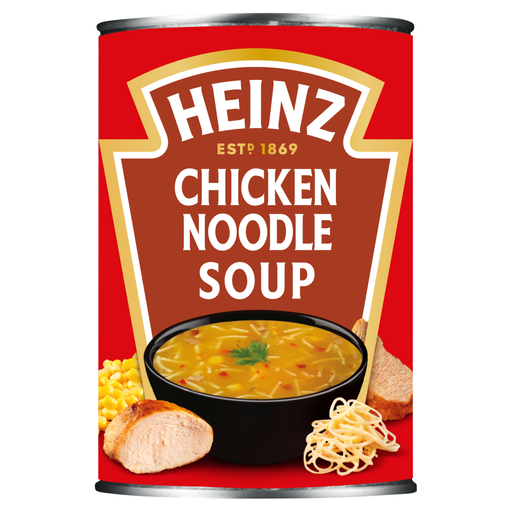 No image available
The 400g can can be divided into two 200g bowls. Check its current serving information, low-fat claim, salt and allergen declaration before choosing it for both diners.
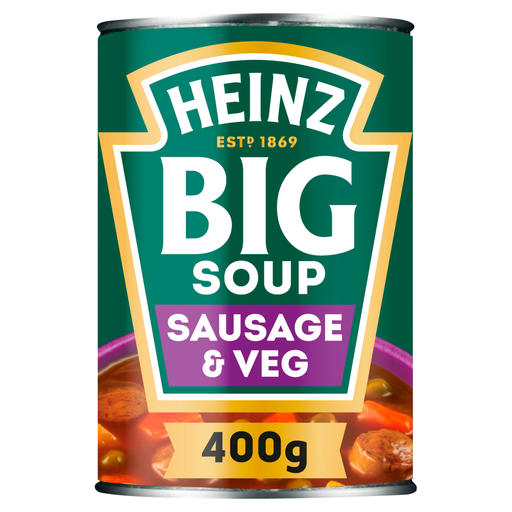 No image available
This 400g sausage-and-vegetable soup could be split into two 200g bowls. Check the current can for its low-fat claim, portion nutrition and ingredients before deciding whether it suits both diners.
Yes, if two 200g portions suit the meal you have planned. Tesco Groceries gives half-can nutrition for its listed 400g Low Fat Tomato and Low Fat Lentil & Vegetable soups, while Sainsbury's states that its 400g Tomato & Spicy Lentil Soup serves two. Check the particular can’s serving information and decide whether you want anything alongside it.
It is a regulated nutrition claim, but it does not describe the soup’s salt, protein or ingredients. UK Department of Health & Social Care guidance specifies no more than 3g fat per 100g for a low-fat claim on solid foods; do not apply that solid-food condition to every soup without checking the relevant claim and current product label.
No. Tesco Groceries lists 0.93g salt per half-can for its Low Fat Lentil & Vegetable Soup, and ASDA Groceries lists 1.3g per half-can for Heinz Chicken Broth Soup. Compare salt for the portion each person will eat rather than relying on the low-fat description.