Care-home menu planners
Catering managers and cooks choosing a lower-fat soya drink where a resident’s nutrition plan supports it. Nutrient declarations, storage and the way the drink will be used in meals all matter.


Choose a lower-fat soya drink only when it fits a resident’s assessed nutrition plan and they can safely have soya. Check the current pack for energy, fat, protein and fortification, as well as its storage instructions. Do not make a light drink the default for residents who are losing weight or need nutrition support: their alternative should follow an individual care plan.
Catering managers and cooks choosing a lower-fat soya drink where a resident’s nutrition plan supports it. Nutrient declarations, storage and the way the drink will be used in meals all matter.
Nurses, carers and caterers need to check the individual plan before substituting a light drink for a nutrition-support option, particularly when a resident is losing weight or is underweight. East Lancashire Hospitals NHS Trust also identifies a MUST score of 2 or more as a trigger in its malnutrition guidance.
A dairy-free requirement does not establish that soya is safe for a particular resident. Care teams need the resident’s allergy information and the ingredients of the drink they actually serve.
Start with the resident’s nutrition and allergy requirements, then compare labels and pack formats for the drinks that remain suitable.
| Priority | What to check | Your needs |
|---|---|---|
| Individual nutrition | Confirm the resident’s nutrition plan. Read energy, fat and protein on the stated per-100-ml or per-100-g basis; do not assume different bases are directly comparable. | I need the drink to fit this resident’s plan, rather than applying a lower-fat choice to everyone. Norfolk and Waveney Integrated Care System’s care-home guidance calls for residents’ nutritional needs to be assessed and reviewed. |
| Fortification | Check whether the current pack declares added calcium, iodine, vitamin D and vitamin B12, and note any stated amounts for menu calculations. | For a dairy-free menu, I need to know what the chosen drink contributes alongside the rest of the resident’s food and drink. |
| Soya allergy | Check the resident’s documented allergies, each pack’s ingredients and the allergen information used at service. Manage cross-contact when preparing an alternative. | If a resident has a soya allergy, I need a suitable non-soya drink; a dairy-free label alone does not answer that question. |
| Storage and use | Check whether the carton needs chilled storage before opening, then follow its opened-pack refrigeration and use instructions. Match pack size to service volume. | We need a format the home can store and use within the period stated on its pack. Tesco Groceries, for example, instructs users to refrigerate its Unsweetened Soya Drink and consume it within five days of opening. |
A resident who is losing weight or needs nutrition support may require a different drink. East Lancashire Hospitals NHS Trust discusses full-fat milk as part of its food-first malnutrition guidance; that does not establish a light soya drink as an equivalent substitute.
Check the resident’s nutrition care plan before changing their drink, and use the home’s dietetic pathway when the appropriate alternative is unclear.
Labels disclose different nutrients and amounts. Tesco Groceries declares calcium and iodine quantities for its Unsweetened Soya Drink, while the cited Marks & Spencer product information identifies fortification without equivalent quantities in the supplied product details.
Read the current pack and record its declared values on the correct per-100-ml or per-100-g basis for menu calculations.
Soya is itself an allergen, so a soya drink is not an alternative for a resident with a known soya allergy.
Check ingredients on delivered packs, keep service information accurate and use a suitable non-soya alternative with appropriate cross-contact controls.
Opened-pack instructions affect how much a kitchen can use from each carton. Tesco Groceries says its Unsweetened Soya Drink must be refrigerated and consumed within five days of opening.
Choose pack volumes that suit the home’s service pattern, mark when cartons are opened and follow the instructions on each product.
Cartons left open beyond their stated use period may need to be discarded.
Tesco Groceries describes Alpro Soya Light as a reduced-fat soya drink with added calcium, iodine and vitamins B2, B12 and D2.
Tesco Groceries publishes a per-100-ml declaration for Tesco Soya Drink Unsweetened.
Marks & Spencer lists an unsweetened soya drink fortified with calcium, iodine, vitamin D and vitamin B12.
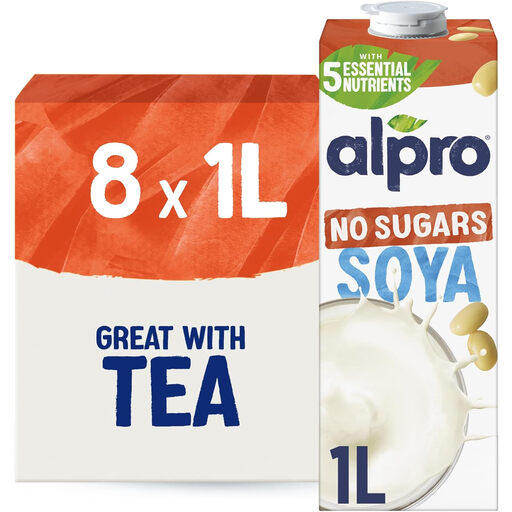
This long-life soya drink is an option to assess when a resident’s plan allows a lower-fat soya choice; its label and the resident’s allergy information still determine whether it fits.
 No image available
The eight-carton long-life pack may suit a care-home ordering pattern if its current storage instructions and opened-carton use period fit the kitchen’s service volume. Check the pack’s energy, fat, protein, fortification and soya allergen declaration against each resident’s plan before serving it.
No. A lower-fat soya drink should fit the individual resident’s assessed nutrition plan, preferences and allergy requirements. Norfolk and Waveney Integrated Care System’s care-home guidance calls for nutritional needs to be assessed and reviewed regularly.
Do not switch them to a light soya drink automatically. East Lancashire Hospitals NHS Trust’s malnutrition guidance discusses a food-first approach, including full-fat milk, for residents who are losing weight, are underweight or have a MUST score of 2 or more. If dairy is unsuitable, follow the resident’s nutrition care plan or seek dietetic advice on an alternative.
Check declared energy, fat and protein, noting whether values are per 100 ml or per 100 g. For a fortified choice, check calcium, iodine, vitamin D and vitamin B12 and any stated amounts; do not assume two drinks have the same nutrient content.
Yes. Soya is an allergen, and a dairy-free soya drink is unsuitable for a resident with a known soya allergy. GOV.UK and Food Standards Agency guidance dated July 2026 says retail and catering food businesses must provide allergen information for prepacked and non-prepacked food and drink.
Follow that carton’s instructions rather than applying one period to every drink. Tesco Groceries instructs users to refrigerate its Unsweetened Soya Drink and consume it within five days of opening; check the pack used by the care home for its own directions.