Shoppers who need a tin
A ready-to-serve can may suit a recipe that specifies tinned custard. Compare fat and sugars per 100g on the current label: the word “light” alone does not tell you both figures.


If dinner or a recipe specifically needs a tin, compare the fat and sugars per 100g on ready-to-serve cans rather than relying on “light” wording. If the container does not matter, a ready-to-serve carton avoids preparation, while custard powder gives you control over the milk used but needs heating. Whichever format you choose, check how much you will use and the pack’s allergen and storage instructions.
A ready-to-serve can may suit a recipe that specifies tinned custard. Compare fat and sugars per 100g on the current label: the word “light” alone does not tell you both figures.
If a carton is acceptable, compare its pack size with the amount needed for dinner and any planned leftovers. A larger pack is useful only if you can store and finish the remainder as directed.
Bird’s Original Custard Powder is an alternative if you can prepare custard with milk, sugar and heat. Its prepared nutrition figures are based on semi-skimmed milk, so they should not be applied unchanged to a different recipe.
Decide whether the tin itself matters, then compare nutrition per 100g and choose a pack you can use within its storage instructions.
| Concern | What to check | Who this matters to |
|---|---|---|
| Fat and sugars | Read fat, saturates and sugars per 100g on the current pack. Ambrosia Low Fat Custard 400g lists 2.0g fat and 7.4g sugars per 100g; ASDA Light Custard 400g lists 1.6g fat and 8.3g sugars per 100g. | If the main aim is to choose a lower-fat dessert, I need the nutrition panel to support that choice without assuming it is also lower in sugars. About 40% of consumers put this nutrition comparison first. |
| Usable pack size | Match the pack weight to the portions you need and decide whether a can is required; the checked cans are 400g, while the ready-to-serve alternatives discussed here include 500g packs. | For dinner shared with others, I want enough custard without leaving more than I can use after opening. Roughly 40% of consumers make usable quantity their primary concern. |
| Preparation and storage | Check whether the product is ready to serve or needs preparation, then read its allergen declaration and after-opening instructions. | When time or kitchen equipment is limited, I want to know whether custard needs cooking and what to do with leftovers. About 20% of consumers place preparation and storage first. |
A reduced-fat comparison does not tell you how two different custards compare on fat or sugars. The Department of Health and Social Care states that a UK “low fat” claim on solid food requires no more than 3g fat per 100g.
Compare the declared fat, saturates and sugars per 100g on the products you are considering.
Ready-to-serve cartons can provide custard for the same meal, but they do not meet a requirement for a canned product.
Check whether “tinned” describes a necessary container or simply the convenient, ready-to-serve custard you had in mind.
The checked Ambrosia, ASDA and Sainsbury’s products call for refrigeration after opening and use within three days. Ambrosia also instructs users to transfer remaining custard out of the can.
Choose a manageable pack size and follow the exact storage directions on the pack you buy.
Custard left unused beyond the stated storage period may need to be discarded.
The checked ready-to-serve custards declare milk, while Bird’s Original Custard Powder says it may contain milk. Fat content does not establish allergen suitability.
If buying for someone with a milk allergy, read the ingredient and allergen declaration on the exact current product.
Its Low Fat Custard 400g is a ready-to-serve canned option for a tin-first choice.
Its Light Custard 400g is a can; its separate 30% Less Fat Custard 500g is a ready-to-serve alternative when a tin is not essential.
Ready To Eat Lighter Custard 500g is an option when a ready-to-serve carton will do.
Tesco lists Reduced Fat Custard in 500g and 1kg sizes among its lower-fat custard options.
Original Custard Powder is a make-your-own alternative, not ready-to-serve tinned custard.
Silky Smooth Custard is a canned reference for shoppers comparing standard custard with lower-fat choices.
These ready-to-serve custards are relevant to a student dinner, but check the container type if you specifically need a tin. Compare the current pack’s nutrition and storage directions before choosing a quantity.
 No image available
Consider this ready-to-serve custard when a 400g can fits the meal or recipe. The product information lists 2.0g fat and 7.4g sugars per 100g. It contains milk; follow the can’s directions for transferring and refrigerating any remainder.
 No image available
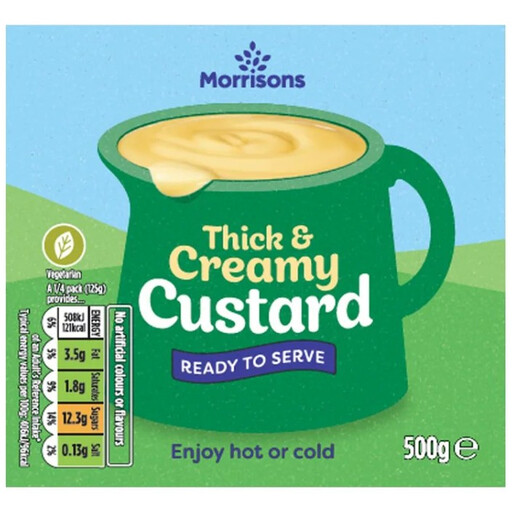
The 500g ready-to-serve pack may suit a dinner needing several portions. If a tin is essential, confirm the container before buying; compare fat and sugars per 100g on the current label and follow its allergen and after-opening instructions.
No: compare sugars separately on the nutrition panel. The checked Ambrosia Low Fat 400g can lists 7.4g sugars per 100g, while ASDA Light Custard 400g lists 8.3g per 100g.
Yes, if the meal does not require a can. Check that the carton is ready to serve, that its size suits the portions needed and that you can follow its instructions for any leftovers.
Follow the instructions on the exact pack. The checked Ambrosia, ASDA and Sainsbury’s products call for refrigeration and use within three days; Ambrosia also instructs users to transfer custard remaining in the can before refrigerating it.
Do not assume so: the checked Ambrosia, ASDA and Sainsbury’s ready-to-serve products declare milk, and Bird’s Original Custard Powder says it may contain milk. Read the current allergen declaration for the exact product you intend to use.