What should you check before buying?
Start with cooking versus drinking, then check the exact product, your intended portion and how you will use the opened pack.
| Priority |
What to check |
Your needs |
| Product format |
Check whether the label describes a cooking milk, milk-style drink or creamed-coconut block. UK listings distinguish 400ml tins, 1L drinks and 200g blocks. |
I need coconut milk for a cooked dish, rather than a carton intended as a drink. If my recipe calls for creamed coconut, I need the block format instead. |
| Serving size |
Check the exact format and measure the amount consumed. Monash FODMAP rates unsweetened UHT coconut beverage low FODMAP at ¾ cup and moderate at 1 cup (250 ml); that result does not establish a serving for a cooking tin or block. |
For a drink, I want to measure my serving rather than judge it by carton size. For a recipe made with a tin or block, I need guidance for that product and my portion of the dish. |
| Drink fortification |
If replacing dairy regularly, read the calcium value per 100ml. Monash FODMAP advises choosing a plant-based milk with at least 120mg calcium per 100ml; the Ocado listing for Koko Unsweetened Long Life Calcium Drink gives 120mg per 100ml. |
I use a coconut drink regularly, so the nutrition label matters as well as the flavour and carton size. |
| Pack use and storage |
Check the current pack’s directions after opening and plan how much each recipe will use. For example, the Sainsbury’s listing for KTC Coconut Milk 400ml says to consume it within two days. |
Before buying a large format, I want a plan for the portions and leftovers I will actually use. |
| Diet plan |
Check ingredients and portions against the guidance for your own low-FODMAP plan. Cambridge University Hospitals describes an initial four-to-six-week restriction followed by gradual reintroduction. |
If I am in the elimination phase, I need to distinguish a measured, applicable serving from a general claim about coconut milk. |
Brand and retailer references
These examples show why the format and label matter; a retailer listing does not establish a low-FODMAP serving for every product it carries.
Koko
Koko Unsweetened Long Life Calcium Drink is a coconut-based drink rather than a culinary tin.
- Its Ocado listing gives 120mg calcium per 100ml and lists 9% coconut milk.
- Use the guidance for the exact drink and serving; these label details do not establish a product-specific FODMAP rating.
Tesco
Tesco Groceries lists coconut products in several formats, including light 400ml coconut milk, coconut cream and a 1L coconut-milk product.
- The format labels help distinguish a cooking purchase from a larger pack.
- Check the individual product and its intended use rather than treating the category listing as portion guidance.
Sainsbury's
Sainsbury’s listings include own-label and KTC 400ml culinary coconut-milk tins.
- The own-label listing states four servings and 68% coconut extract; the KTC listing states 54.55% coconut extract.
- Those figures distinguish the tins but do not give them an interchangeable low-FODMAP serving.
M&S
M&S describes its 400ml Coconut Milk for curries, soups and sundaes, and lists a separate Creamy Coconut Drink.
- The drink is described by M&S as enriched with calcium, iodine and vitamins B12 and D.
- Check the exact format and serving; the cooking and drinking products should not be treated as the same food.
Waitrose
Waitrose & Partners lists 400ml coconut-milk tins separately from a Blue Dragon Creamed Coconut Block 200g.
- The separate listings make the tin-versus-block distinction clear when shopping for a recipe.
- A block’s weight does not establish an applicable low-FODMAP portion.
Creamed coconut on Joybuy
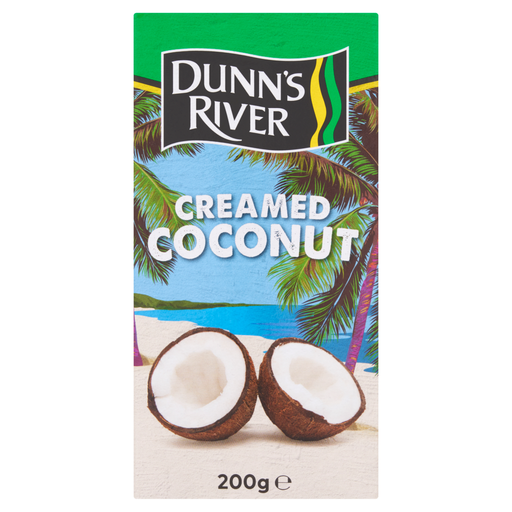
This option is a creamed-coconut block for recipes that call for a concentrated coconut ingredient. It is not a milk-style drink or a culinary coconut-milk tin.
 No image available
Dunn's River Creamed Coconut 200g
This 200g block is an option when a recipe calls for creamed coconut rather than a drink. Measure the amount used in the recipe and your portion of the finished dish; Monash FODMAP’s serving guidance for unsweetened UHT coconut beverage does not establish a serving for this block.
View on Joybuy
Questions about coconut milk and low FODMAP
Is coconut milk automatically low FODMAP?
No. Monash FODMAP rates unsweetened UHT coconut beverage low FODMAP at ¾ cup and moderate at 1 cup (250 ml). That guidance does not establish the same serving for a cooking tin, coconut cream or creamed-coconut block.
Can I use a cooking tin instead of a coconut drink?
Use a culinary tin when the recipe calls for cooking coconut milk, not as an automatic substitute for a milk-style drink. Retailer listings distinguish cooking tins for dishes such as curries and soups from coconut drinks; check the exact product and portion if you are following a low-FODMAP plan.
What should I check in a coconut drink that replaces dairy?
Check the current label’s calcium figure per 100ml. Monash FODMAP advises looking for at least 120mg calcium per 100ml in a plant-based milk; the Ocado listing for Koko Unsweetened Long Life Calcium Drink gives 120mg per 100ml.
How should I plan for an opened tin or carton?
Follow the storage and use-by instructions on the exact pack, and consider how much your planned portions will use. Instructions differ between products: the Sainsbury’s listing for KTC Coconut Milk 400ml says to consume it within two days.
Should a low-FODMAP diet be a long-term elimination diet?
Cambridge University Hospitals describes an initial four-to-six-week restriction followed by gradual reintroduction, rather than indefinite elimination. NHS guidance says a dietitian may recommend a low-FODMAP diet for IBS; discuss your plan and uncertain product portions with your dietitian.


